
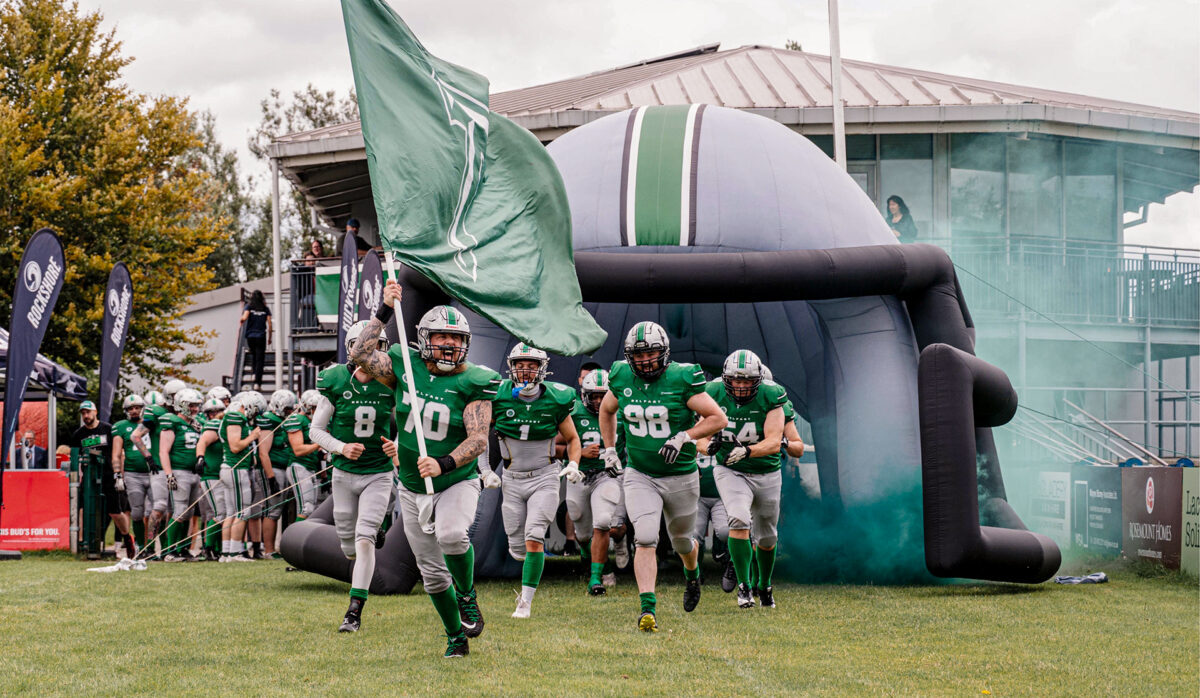
It began on a sunny day at a local park in Belfast, Ireland. International Mission Board missionaries Russell and Tori Minnick were watching their kids have fun on a playground when, at the far end of a field, a group of men were running routes and huddling over playbooks.
Subscribe to The Alabama Baptist today!
SIGN UP for our weekly Highlights emails.
Russell could tell they were practicing American football, so he decided to ask about it. He introduced himself to Barry Keil, team president of the Belfast Trojans, one of two teams in the city.
Russell and Barry met later over coffee, where Russell confessed his lifelong love of American football, growing up a Kansas City Chiefs fan. Barry saw a need for a wide receiver and offered Russell a spot on the roster.
The Belfast Trojans play in the American Football Ireland League. Though it’s not the level of the National Football League in the U.S., the Irish American football scene is a tight-knit league of eight teams scattered across Ireland. Dublin, Cork, Galway and Belfast are the major competing cities. Most players are “rugby athletes in their off-season,” according to Russell, bringing raw speed and tackling prowess to the gridiron.
Russell’s first season was a slap-in-the-face reality check. At 35, his body could not keep pace with 20-year-old athletes, though he did play the full season and even scored a touchdown. But the coach saw a spark in Russell’s football IQ. He offered Russell a coaching job for running backs and wide receivers.
That pivot turned out to be a blessing. As he taught routes and blocking schemes, Russell noticed something that the practice drills could not reveal. The players’ lives off the field were a tangle of anxiety, family strain and unspoken grief.
“I felt the Lord pulling on me,” Russell said. “I realized we were shaping bodies but not souls.”
From coach to ‘pastoral care coach’
He approached Barry and Mark McGrath, general manager, with a request, “Could I serve as a chaplain?” They agreed to make Russell “pastoral care coach” — a term borrowed from the United Kingdom school system, where a pastoral care teacher looks after the whole person, not just academic performance.
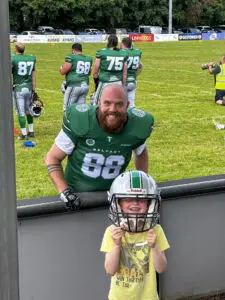
Russell became a confidant to burly linemen who shared about impending fatherhood, to a rookie terrified of a career-ending injury and to a veteran whose wife was expecting their first child and whose confidence was shaken.
“I just try to be present, to listen and let the Spirit work in whatever way He chooses,” he explained.
The bigger picture of suicide and trauma
Northern Ireland bears one of the highest suicide rates in the United Kingdom. Decades of war and threats of war have left a residual trauma that still haunts families. People recall mornings of checking under the car for a bomb before driving to work. Many communities are starving for mental health support.
Russell and Tori volunteer with West Wellbeing, a counseling center that offers free non-medical services. West Wellbeing runs a “befriending program” for people who are not quite ready for formal therapy or who need a bridge out of it. Tori has a nursing background in mental healthcare. They both serve as “befrienders,” meeting clients for coffee, listening and gently weaving Scripture into the conversation when opportunity allows.
The Minnicks are the only Christians who serve at West Wellbeing, but Russell said, “The language from the non-Christian volunteers sounds like it could be right out of a Southern Baptist potluck fellowship.”
They have heard comments like “I just want to bring them hope.” And “They need a purpose in life.” And “Be a light that pierces the darkness.”
One of their favorite activities at the counseling center is art therapy, or as Russell describes it, “Bible-story art therapy.” While he led a painting session, Russell paused to recount how Jesus calmed a storm — prompting a discussion on how to weather personal tempests.
During another art therapy session, participants painted a tranquil scene of a forest with a stream of water. “As I led everyone through the steps of the painting,” Russell said, “I discussed how this picture reminded me of Psalm 23. David was once walking through a dark time, and it was the Lord who comforted him. It was the Lord who ‘led him by still waters.’ I told them, ‘That is the same Lord who loves you and wants a relationship with you.’”
Sharing coffee and care on a bike
Another ministry the Minnicks are pursuing involves a mobile coffee shop. With the help of two Journeymen who have a flair for entrepreneurship, this global outreach team is taking the concept of a coffee stand and turning it into “Shepherd’s Cuppa,” a tricycle-mounted coffee shop.
The bike they envision will fold out into a tiny counter, complete with a grinder, espresso machine and a bright logo that reads “Shepherd’s Cuppa — come for a cup, stay for a conversation.”
Funded through Send Relief and soon to be in operation, the bike would roll into parks, community centers and even the outskirts of Belfast’s troubled neighborhoods. “It serves more than caffeine,” Tori said. “It’s a doorway to trauma-healing groups and an invitation to hear about the Bible study we lead.”
Caffeine and a listening ear
Russell’s eyes lit up when he described the coffee bike ministry. “It’s a practical way to meet people who might never step into a church or a counseling center,” he said. “A cup of coffee becomes a bridge to a conversation about hope.”
Last season, the Belfast Trojans went undefeated, winning the league’s Shamrock Bowl in Dublin. Russell continues as a coach with the team and offers counseling to players.
The Minnicks continue to be involved with West Wellbeing and plan to launch regular trauma-healing groups, where people can unpack the inherited hurts of decades of conflict. They also hope their Bible study fellowship group will draw more people, and Shepherd’s Cuppa will roll out soon to neighborhoods that need both a caffeine fix and a listening ear.
EDITOR’S NOTE — This story was written by Chris Doyle and originally published by the International Mission Board.


Share with others: