
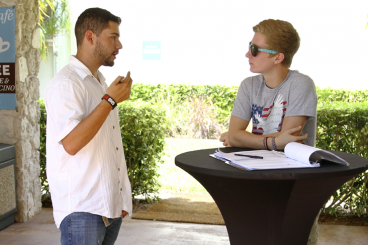
Gabriel Revilla recalls a “Nike moment” when his college pastor in Miami, Fla., approached him with a question.
“What do you think about recruiting an actual team of students and allowing them to come to Miami to reach lostness here?” Gus Hernandez, collegiate pastor at Christ Fellowship Baptist Church, Miami, asked Revilla.
The question was neither small nor random. Hernandez knew Revilla’s heart and potential for leadership in ministry.
‘Just do it’
Revilla accepted the challenge and decided to, “Just do it.”
Then came Chicago.
Hernandez connected Revilla with a North American Mission Board (NAMB) Generation Send (GenSend) mobilizer. That mobilizer challenged Revilla to experience the GenSend model by leaving his comfort zone in Miami to learn how to be a missionary in another major city. Going somewhere new for six weeks in the summer of 2014 was attractive to Revilla.
Through Christ Fellowship Baptist, Revilla gained early exposure to missions in Miami. They regularly hosted a missions camp that included all seven of the church’s campuses meeting for an entire week at the downtown campus to serve the city of Miami.
“If you can’t make disciples where you currently live, I think it will be extremely difficult to make disciples in a setting in which you are unfamiliar with (the) language and culture. So the mission starts where you are right now.
“Missions is important because when our heart is in God then our heart is in the nations because God is in the nations,” Revilla said. International missions trips to Haiti and the Dominican Republic enlarged his understanding of what God was doing beyond Miami, but also brought a realization.
“Here I am traveling the world, and I don’t even know what’s going on in my own country outside Miami.”
In early June 2014, Revilla attended a Next Generation Leader’s Conference in Nashville. That conference helped prepare him for his Chicago assignment in 2014. His assignment to Miami would start in 2015.
When he landed in Chicago, the time had come for Revilla to do it.
“You can only read so much until you actually do something,” he said. “I came into O’Hare Airport thinking I could do this and so when I got there it was interesting to see how God humbled me to show me that being on this trip meant loving on people and intentionally caring for people because they are people not just an objective. So it was great to see God readjust my mindset.”
Revilla’s team lived in Edgewater, the northernmost part of Chicago, before the transition to the suburbs. Edgewater includes Loyola University, home to students and scores of established and affluent people.
Bordering Lake Michigan, the community also represents the full effect of America’s diversity as it includes Devon Street, which claims to be the most diverse street in the United States.
Like GenSend missionaries in other cities, Revilla’s assignment was to walk the streets and engage people. NAMB designs this immersion as part of the Send North America strategy to help a generation of Southern Baptist college students develop a heart for America’s major metropolitan areas where most of the nation lives. Chicago and Miami are 2 of 32 Send North America cities.
Revilla said, “You learn to live in the city and you let the city change you.
“You figure out the rhythm of the city, the flow and the tides.”
While he’s had some success in sharing his faith with people in the city, Revilla has found many who simply don’t want to talk.
“I get discouraged when I see the brokenness and people don’t want to talk. They don’t know who Jesus is, and they still don’t want to talk,” Revilla said. “The urgency is extremely overwhelming.”
‘People are lost here’
Revilla said that about 96 percent of Miamians don’t have a personal relationship with Christ and he estimates the same to be true in Chicago.
“People are lost here,” he said of the Windy City. “People don’t know who Jesus is.”
Having now experienced missions in two urban areas, Revilla has developed convictions about missions in America’s big cities.
“If you change cities you can change the world,” he said. “I’m a firm believer in that. The cities impact everything else.”
In 2016, Revilla will mobilize a GenSend team to meet Miami and learn how to minister there.
“The reason to do it is not because it’s just another missions trip,” Revilla said, who aspires to be a collegiate minister. “It’s the kind of missions experience that allows you to see where your own heart is, to realize how important people are.
“We don’t serve to get people saved; we serve because we are saved. I want to be a part of that.” (NAMB)

Share with others: