
In recent years the name David Barrow has been rediscovered as an example of an early Kentucky Baptist who stood against the evils of slavery. In his own day, Barrow was known as one of the most gifted Baptist preachers and writers in pioneer Kentucky. He was also recognized as a passionate evangelist and a faithful Baptist.
Born in Brunswick County, Virginia, Barrow was saved at age 16 and then baptized into the fellowship of the Fountain Run Baptist Church by pastor Zachariah Thompson. Before long he felt a call to preach and began to encourage those around him to turn to Jesus. Following his ordination three years later, Barrow became both a pastor and evangelist, serving the Lord in Virginia and North Carolina.
Persecution
During these years, Baptist preachers were often persecuted and suffered much hardness.
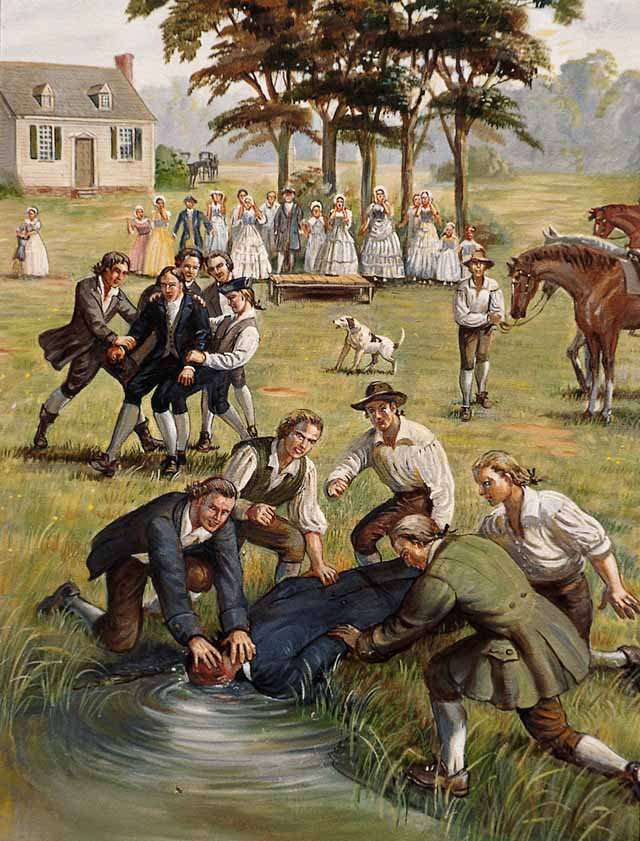
In 1778, while Barrow and another preacher named Edward Mintz were ministering near the Nansemond River, they were approached by a rowdy mob of Episcopalian men. Kentucky Baptist historian J.H Spencer describes what happened next:
“As soon as a hymn was given out, the persecutor sang an obscene song. They then seized both the preachers, and dragged them down to a muddy pond, saying to them: ‘As you are fond of dipping, you shall have enough of it.’ They then plunged Mr. Barrow into the mud and water, holding him under till he was almost drowned. They then raised him up and asked him derisively if he believed. In this manner they plunged him the third time, asking him each time if he believed. (Before being released) he finally said: ‘I believe you will drown me.’
“They plunged Mr. Mintz but once (before also letting him go). The whole assembly was shocked. The women shrieked. But none dared to interfere; for about 20 stout fellows were engaged in this horrid measure. They insulted and abused the gentleman who invited them to preach, as well as everyone who spoke in their favor. Before (both of) these persecuted men could change their clothes, they were dragged from the house and driven off by these outrageous churchmen.”
Continuing to preach
Stories like this were common in the 1760s and 1770s. Nevertheless, the Baptists would not compromise their convictions, nor did they stop growing. In spite of oppression, men like David Barrow continued to preach the gospel and plant new Baptist churches.
In 1798, like many Virginians, Barrow decided to move to Kentucky. He settled in Montgomery County and was soon pastoring Mount Sterling Baptist Church. In addition, he was called to serve the Goshen and Lulbegrud Baptist congregations.
It was during this time that Spencer declared, “With the exception of John Gano, he was probably the ablest preacher, and, without any exception, the ablest writer among the Baptist ministers in Kentucky, at the beginning of the present century. Of his purity of life, devotion to the cause of his beloved Master and constancy of zeal and piety, it would be difficult to say too much.”
Convictions on emancipation
Today Barrow is best known for his convictions on emancipation. In 1784, while still living in Virginia, he became convinced that slavery was morally wrong. He promptly freed his two slaves and became a vocal critic of slavery.
Moving to Kentucky only strengthened his convictions. In 1808 he published his views in the book “Involuntary, Unmerited, Perpetual, Absolute, Hereditary Slavery, Examined; on the Principles of Nature, Reason, Justice, Policy, and Scripture.” Sixty-four pages in length, these books were not sold but rather given away throughout Kentucky. Together with 10 other like-minded Baptist preachers from Kentucky and Ohio, he organized the Baptized Licking-Locust Association, Friends of Humanity. Functioning as both a Baptist association and an abolition society, Thomas Lincoln, Abraham’s father, was a member of one of the churches in this fellowship. Barrow even wrote retired President Thomas Jefferson letters encouraging him to aid the fight against slavery.
As one might guess, the results of these efforts were mixed and are a fascinating story for another day. Even so, the life of David Barrow demonstrates that not every Baptist in the South before the Civil War was pro-slavery. There were men like David Barrow and J.M. Pendleton who were fervent in their gospel appeals and staunch in their theological convictions yet were convinced that every person in America had the right to be free.
David Barrow died on Nov. 14, 1819 at age 66. He was buried in the Barrow and Hoskins Cemetery in Montgomery County. His son declared that shortly before he breathed his last breath, he quoted Psalm 23. Because of Jesus, David Barrow could testify, “Yea, though I walk through the valley of the shadow of death, I will fear no evil: for thou art with me; thy rod and thy staff they comfort me” (Psalm 23:4).
EDITOR’S NOTE — This story was written by Ben Stratton and originally published by Kentucky Today. Stratton is pastor of Farmington Baptist Church in Graves County and a historian with the J.H. Spencer Historical Society.


Share with others: