
Code-named Gideon, the Ukrainian military guide took a 60-mile detour to avoid “Death Road,” a dangerous span in eastern Ukraine so named because many have been killed on it by Russian forces.
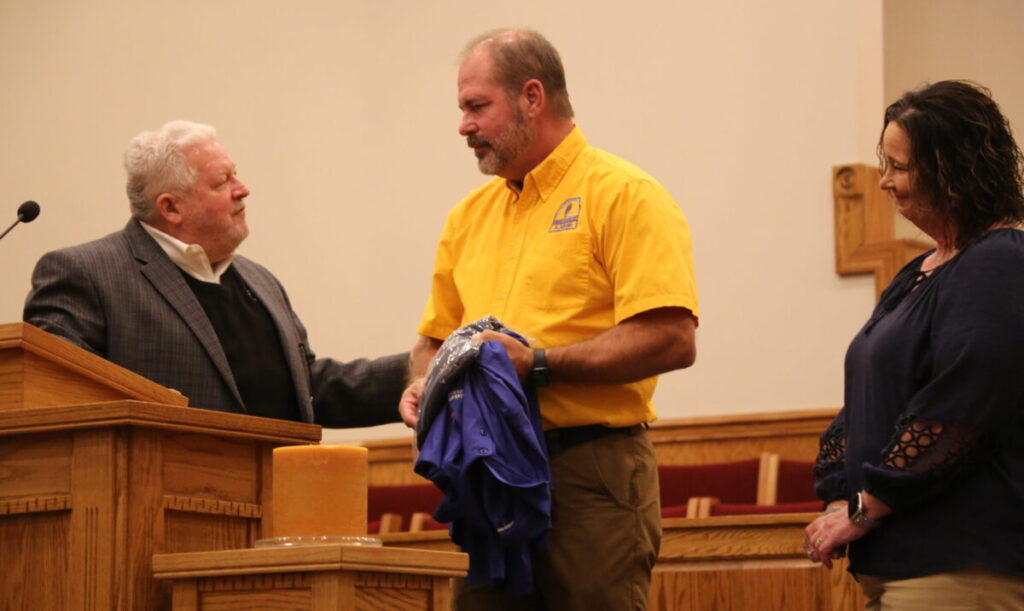
In the car alongside Gideon was Karl Ahlgren, honorary consul of Ukraine in Oklahoma, a volunteer military chaplain to Ukraine and a humanitarian who had commissioned his friend Gideon to drive him from Kyiv to Kramatorsk. There, he would visit Pastor Viktor Pavenko at The Good News Church, an evangelical congregation.
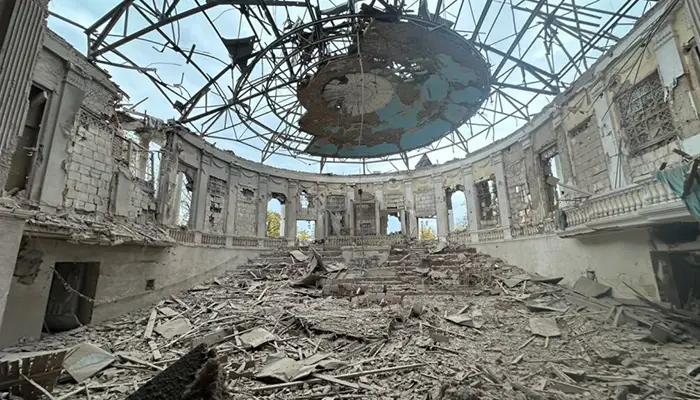
They arrived Aug. 29 for a few days’ stay at the church, the walls of which, just seven weeks later, no longer stand.
‘Intent to kill’
Russia destroyed the church around 9 a.m. Sunday, Oct. 18, in a missile strike Mikhail Pavenko, Viktor’s nephew, believes was intended to kill worshippers.
“I think that was absolutely the intent to kill the worshippers. A Russian 500 kilogram guided bomb struck basically the center of the sanctuary and destroyed the church,” said Mikhail, a Ukrainian whose family immigrated to the U.S. in the 1990s when he was a child. “Now, due to the situation on the ground, my uncle Pastor Viktor made a call not to gather as a large congregation, [for] safety. And that was absolutely the right call to make.”
Searching for another meeting space
No one was injured in the attack, but the church is looking for another meeting space.
“Obviously, the church is destroyed. The building is destroyed. And they are helping with evacuations, with refugees. They’re helping the soldiers,” Mikhail said. “They’re ministering in any way that they still can.”
The church campus had survived previous Russian attacks, including a strike in June that destroyed a portion of the roof and ceiling. Good News Church has served as a humanitarian hub during the full-scale attack. Viktor slept in the church sanctuary for months after he evacuated his wife and daughter, he told Ahlgren.
“He said, ‘I had people knocking on the church door at 12 a.m., at 1 a.m., basically 24 hours a day. And I also wanted to protect the church physically. You know, I was there spiritually to help people, but I also wanted to physically protect the church,” Ahlgren quoted Viktor.
For Mikhail, who has served since 2015 as a volunteer chaplain to Ukraine, the war is a battle between good and evil, a perspective long shared by evangelical leaders in Ukraine and abroad.
“I would say that Ukraine is probably one of the freest nations for the gospel. It’s incredible. In every war, [when] Russian occupation happens, the Protestant churches are shut down,” Mikhail said. “There are no Protestant churches operating in [Russian] occupied areas. The Russians only accept one faith, that is called the Moscow Orthodox Church, Moscow Orthodoxy. Everything else, they’re deemed as Western agents and they’re banned to operate in those areas.”
‘Holding their own’
Mikhail readily thanks Americans for prayer and financial support, crediting God for sustaining the smaller nation in a war nearing five years.
“The Ukrainians are holding their own. In some areas, they’re pushing the Russians back. And for me, this is also a war where I’ve seen God’s goodness and God’s grace and God’s miracles take place,” Mikhail said. “It doesn’t make sense that a nation that is 27 times smaller than Russia is not [simply] holding on, but they are pushing the Russians back. I think today the Russians actually occupy less land than when they started. They’re not winning this war.”
Viktor is among three of Mikhail’s uncles pastoring churches near the frontline of Russia’s war on Ukraine.
The Good News Church had been one of the few sources of clean water in Kramatorsk for several days after Russia struck the city’s water system. The Good News Church sits atop an aquafer, and installed a filter system to supply clean water to the community.
Lacking resources
When Ahlgren arrived at the church weeks before the missile strike, about a dozen or more people were awaiting their turns to fill their containers.
“The city doesn’t have any water,” pastor Viktor had told Ahlgren, “because the Russians took a missile and struck our water system, and it’s been down for three days now.”
Ahlgren and Gideon had spent a couple of nights at the church, with Gideon translating as Ahlgren, a former youth pastor, preached that Sunday in a church location the June missile strike had missed.
“They sing the same songs that we sing in our church, whether it’s a traditional worship service or it’s a modern worship service, they’re singing the same songs,” Ahlgren said. “You’ll know them by their music, and they give the Lord’s Prayer. While they’re saying it, when they start saying it, I know exactly what they’re doing, and so I just start speaking it to myself in English, because I don’t speak Ukrainian.”
After worship, the church distributed to worshippers free loaves of bread freshly baked and donated by a Kramatorsk bakery.
“They’ve just given them the bread of life from the Word of God. And now they’re giving them the physical bread,” Ahlgren said. “They’re giving spiritual water outside — physical and spiritual water — and physical and spiritual bread. What more can you, you know? And I think of this verse, John 6:35, ‘And Jesus declared, I’m the bread of life. Whoever comes to me will never go hungry, and whoever believes in me will never be thirsty.’”
Kramatorsk’s public water system has since been repaired, Ahlgren said, but the reality of war can make clean water intermittent.
Both Ahlgren and Mikhail have ministered often in eastern Ukraine, sometimes traveling together. Mikhail is scheduled to travel there in November, and Ahlgren in January.
As the war nears its fifth year, Mikhail is thankful for the military support the U.S. has supplied. But he invokes the 1994 Budapest Memorandum in which the U.S., Russia and other nations agreed to provide specific military support to Ukraine – and to respect Ukraine’s borders – in exchange for the nation agreeing to nuclear non-proliferation.
More than about land
Mikhail implores the White House to consider all ramifications of the war — including religious freedom and other human rights — in its dealings with Russian President Vladimir Putin.
“Forcing Ukraine to give up its land is not only immoral but it is also a sin. This isn’t just about land. We are talking about abandoning millions of Ukrainian citizens who are currently living under Russian occupation,” Mikhail told Baptist Press. “These people are praying and waiting for their liberation.
“We cannot abandon a nation that freely gave up its nuclear weapons in exchange for its territorial integrity assurances under the 1994 Budapest Memorandum,” he said, pointing out past U.S. and Ukrainian cooperation. “The soldiers of Ukraine also fought alongside our U.S. forces in Iraq and Afghanistan for many years. Ukraine has been a faithful ally to us when we needed them in our battles.” (Baptist Press)


Share with others: