
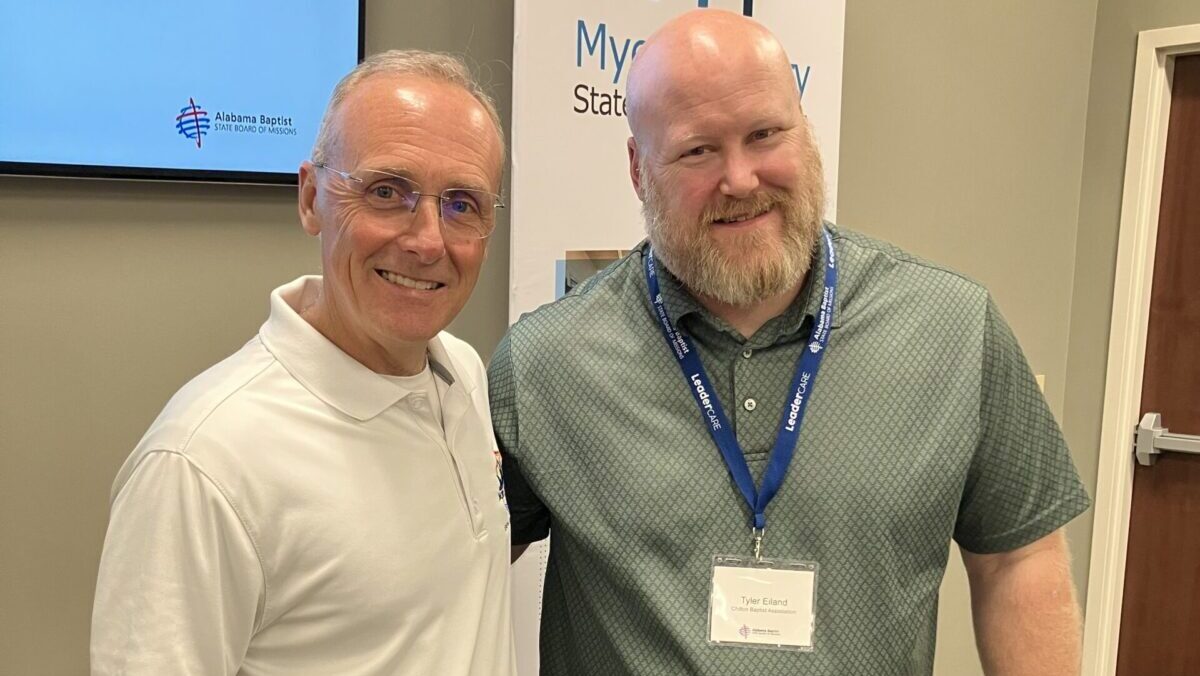
A leading Alabama Baptist admitted recently he’s “often felt overwhelmed, but God has been faithful.”
Speaking at the final Intentional Leader event of 2026, Kevin Blackwell told the Sept. 15 audience, “I imagine many of you in this room arrived to find some surprises the search committee didn’t tell you about.”
Get news delivered right to your doorstep – Subscribe Today!
Blackwell — executive director of the Mobile Baptist Network and special assistant to the president for institutional relations and assistant professor in the school of Christian studies at the University of Mobile — said strategic vision is a component of effective leadership.
“Many church members can’t answer the question, ‘What is God’s preferred vision for this church?’” he said.
Where vision begins
“Vision begins with the pastor. What is God baking in your heart?” Blackwell asked. “You are the shepherd who leads the church down new paths to greener pastures. We can’t be comfortable with the ways things are but must constantly seek what kind of church God wants us to be.”
Blackwell defined a church needing a “new pathway” as one that has experienced plateau or decline for at least three consecutive years.
“Many churches are maintaining ministry rather than pursuing mission,” he declared. “In these churches, few are talking about the future of the church, ministries work independently of one another, and the congregation has lost expectancy. The church’s rearview mirror has become larger than the windshield.”
Blackwell illustrated visionary process with examples from Nehemiah.
“Nehemiah’s mission was a remarkable 52 days,” Blackwell noted. “He sought God’s will and asked God for help. Vision is not ‘wimp’s work’ since it involves risk, but Nehemiah demonstrated courage — he refused to be deterred by his enemies; he communicated what God wanted because a vision that’s not shared is only a dream.”
Blackwell suggested pastors find some “Kingdom warriors” in the congregation who can help with the vision process.
“If you were going to attack hell tomorrow, who would you choose to be on the front lines?”
What kind of church do you want to be?
Ask those leaders “‘what kind of church do we want to be?’” Blackwell said, “and then listen to them. Ask for honesty and pray together for discernment.”
Strategic planning includes looking at “spiritual markers,” including things that need to be preserved and things that need to be strengthened, Blackwell said.
“We ask questions, like, ‘Why does this church exist?’ and ‘What does Scripture command us to do?’ and ‘What matters most?’
“Look at the Annual Church Profiles for the past 10 years and ask the state board for demographic reports of who lives in your neighborhoods,” Blackwell suggested. “And strive to do the traditional ‘SWOT’ analysis: strengths, weaknesses, opportunities and threats.”
He said a purpose or mission statement should be “simple and succinct” and “ambitious, but attainable.”
“I think of the ‘T-shirt’ test,” Blackwell related. “Will your purpose statement fit on the back of a T-shirt?”
Then the statement is presented to the church for approval.
“We’re congregational, and there’s power in the pew,” he said. “Assign responsibility and accountability. Afterwards, leaders must constantly articulate the mission. There’s no such thing as over-communication.”
Critical evaluation
Blackwell also stressed the need for evaluation.
“I recommend a fresh look every three to five years,” Blackwell said.
“Some things will probably bomb, so we reevaluate, review and adjust,” he acknowledged. “We’ve all made mistakes, but I think God in His grace can sanctify our mistakes.
“Share and celebrate what God is doing in your church — what you celebrate in the pulpit will be celebrated in the pew.”



Share with others: