
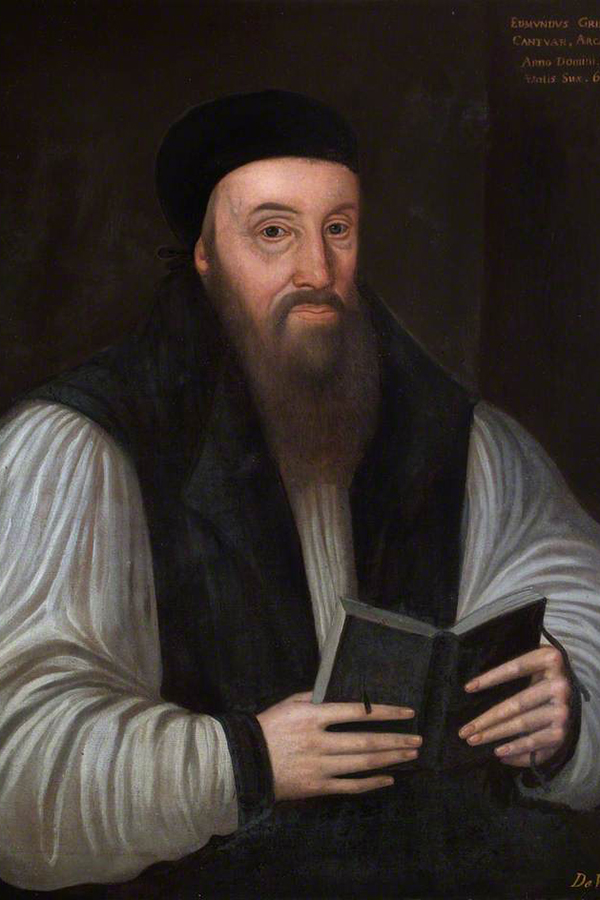
2019 marks 500th anniversary of founder of St. Bees School
By Joanne Sloan
Edmund Grindal (1519–1583) was an English Protestant who held the posts of Bishop of London, Archbishop of York and Archbishop of Canterbury during the reign of Elizabeth I.
This year marks the 500th anniversary of Grindal’s birth.
He was born in 1519 in St. Bees, Cumberland County. His father was William Grindal, a farmer.
He studied at Pembroke Hall, Cambridge, where he received his bachelor’s and master’s degrees. In 1544 he was ordained a deacon.
When Nicholas Ridley, master of Pembroke Hall, became Bishop of London in 1550 he appointed Grindal one of his chaplains.
Ridley described Grindal as a man “of virtue, honesty, wisdom and learning.” Soon Grindal was promoted to a chaplain of King Edward VI.
On June 11, 1553, he was nominated to be Bishop of London. However, a month later Edward VI was dead and Catholicism returned.
During the 1553–1558 reign of Queen Mary I he fled to the continent with other English Protestants.
He returned to England on Jan. 15, 1559, the day Elizabeth I was crowned. He joined a group of men who established the reformed church.
In 1560 he became Bishop of London. Although Grindal had misgivings about vestments (liturgical garments) and other traces of “popery” he was reluctant to change policies. He did make judgments against Catholic priests — but not against English Puritans.
In 1570 he became Archbishop of York. Although many Catholics resided in York, few Puritans did. During his tenure even his critics said that he “enforced uniformity against the Roman Catholics with good will and considerable tact.”
Grindal was named Archbishop of Canterbury on July 26, 1575. No proof exists that he ever visited his district at Canterbury.
It was not long before he and Elizabeth had disagreements. The queen wanted him to suppress “prophesyings.” These were meetings where the Puritan clergy met and discussed the Scriptures and prayed. She also wanted him to disapprove of the Puritans’ preaching. Grindal refused. In June 1577, for his disobedience, he was suspended from his jurisdictional duties but not his spiritual duties. He stood firm.
Greatest legacies
He was suspended from his office and restricted to his house. In 1581, Elizabeth rejected a petition for his reinstatement. The next year he apologized to the queen. She reinstated him but his health was declining. He resigned as Archbishop and returned to his home in Croydon.
Grindal died on July 6, 1583. He is buried in Croydon, London.
One of his greatest legacies is the St. Bees School that he founded in his native village. It is still in existence today after more than 430 years.
EDITOR’S NOTE — Joanne Sloan, a member of First Baptist Church, Tuscaloosa, has been a published writer of articles and books for 30 years. She has a bachelor’s degree double majoring in history and English from East Texas State University (now Texas A&M–Commerce) and a master’s degree specializing in English from the University of Arkansas (1978).
Share with others: