
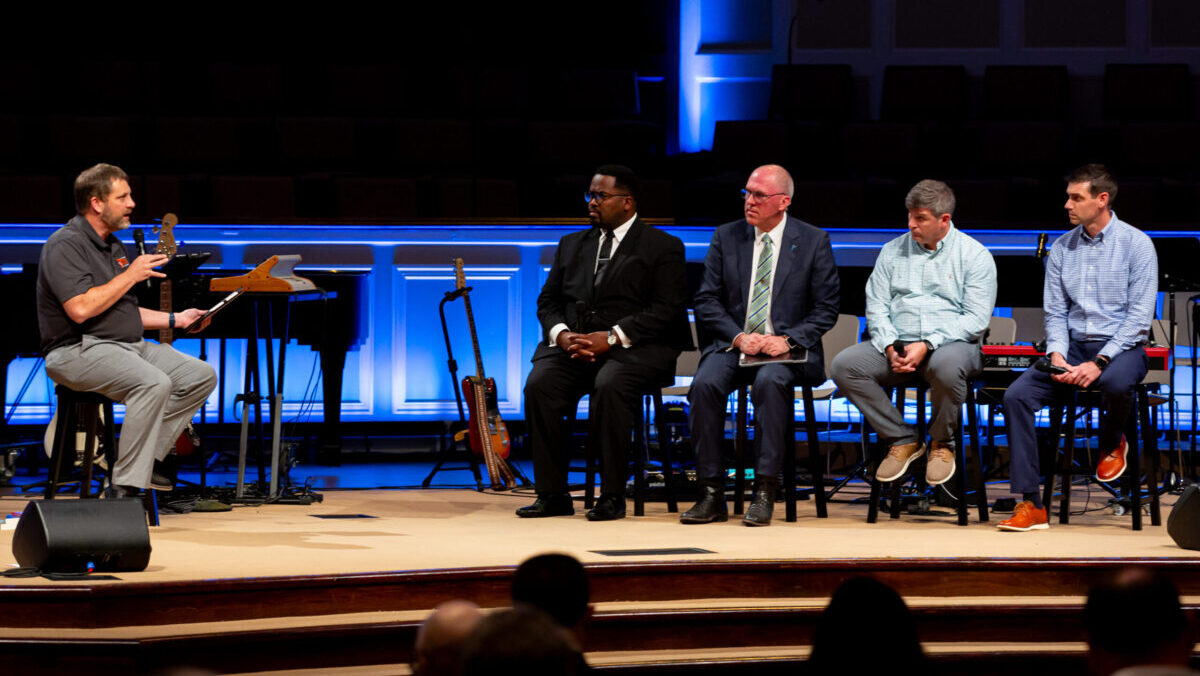
Matt Haines, president of the Alabama Baptist Pastors Conference, said pastors “all know we’re called to preach the gospel.”
But that mission can at times have distractions, said Haines, who also serves as pastor of Central Park Baptist Church in Decatur.
He pulled together the four pastors who spoke during the morning and afternoon sessions of the Pastors Conference on Nov. 11 for a panel to talk about those distractions.
Here are a few responses to questions Haines posed.
What are the primary obstacles to gospel-centered ministry that pastors face?
Chad Hunsberger, pastor of Colonial Heights Baptist Church in Ridgeland, Mississippi, said one challenge is that what people need is Christ crucified but they want something else.
“The pressing thing is whatever they’re wanting right now,” he said. “Whatever season they’re in, that’s what they want answers for.”
Daylan Woodall, pastor of First Missionary Baptist Church in Decatur, said it can be tough for pastors to navigate the “economy of commodification” where churches are ranked by likes and shares.
“It requires that we have a greater faithfulness,” he said.
Chris Jones, pastor of Meadow Brook Baptist Church in Birmingham, said it is helpful to “have a rhythm and a pattern of sitting under Scripture” and letting that drive the pastor’s messages.
“There is this desire for the latest and the greatest, but also something better than we’ve had before. I think that we feel that as pastors, as preachers, we want to be better than we were before. We feel the pressure,” he said.
It’s not bad to strive for excellence as a pastor, but it is good to know “the message is set; the hope is there,” Jones said.
How do pastors balance measuring numbers with preaching Christ crucified?
Woodall and Hunsberger both pointed out that to focus on numbers is both ahistorical and abiblical — the early church was not measured in this way.
Hunsberger said that means that in today’s church, a pastor needs to take the four steps off the pulpit and into the congregation and know his church members, whether it’s eight or 800, to gauge the health of the church.
Jones said when numbers are present, thank the Lord for that and recognize that He has provided.
“Let’s celebrate the things that matter — discipleship, celebrate lives changed, believers who are sent on mission,” he said.
Bart Barber, pastor of First Baptist Church Farmersville, Texas, said the important thing is to have pragmatism toward the right metrics — do the numbers reflect what your mission or your goal is?
“You can pack a church full of heretics who are headed to hell and not impact their life at all, and that’s not something to be celebrated,” he said.
How do pastors balance preaching Christ crucified with politics?
Woodall said if pastors are biblically faithful, they will be “perpetually politically uncomfortable.”
“If this world is not our home, then we should not expect to find comfort in the politics of this world,” he said. “To be biblically faithful necessitates a kind of political homelessness. … We can’t expect to be well represented.”
Hunsberger said it’s important to impart that perspective to church members. Instead of telling them who to vote for, give them a better understanding of who Christ is.
“If our people are in this perpetual state (of homelessness), then it is with the knowledge that Jesus is King, and if Jesus really is sovereign, then who the president is, it’s for us to … provide an instruction to our people that says ‘Jesus is King, so rest there,’” he said.
Don’t feel the pressure to instruct them on policies, Hunsberger said.
He said he reminds his church that there will be people who voted differently than them around the throne.
“So let’s practice that now, that unity. Let’s let the culture see something different,” Hunsberger said.
Jones said pastors should have forward-looking preaching that reminds church members that Jesus is coming back and that “doesn’t allow us to get settled here and comfortable here.”
What advice would you give about engagement on social media and keeping nothing but Christ crucified at the center?
Barber said he’s made every mistake you can make on social media.
“The biggest thing that happened that helped me was when a moment came that I realized that the Bart Barber that my church family knew and my family at home was not what they found when they found me online,” he said.
Barber said at this point in his life, he’s trying to apply the fruit of the Spirit to his social media presence and to his in-real-life presence.
“And I want those things to line up pretty closely so you feel like you’re meeting the same person whether you meet me in person or encounter me online,” he said.
Hunsberger said he tries to think through three things before he hits “post.” Is it true, is it loving and is it helpful?
“Sometimes that third one is the one that will get you. It might be true, and it might be loving but why are you posting it? Does it bear fruit?”
Pastors can be prone to drift into pragmatism. How can they guard their hearts and know nothing but Christ crucified?
“We’re working for a ‘well done, good and faithful,’” Woodall said. “There won’t be an audit of the likes and shares.”
He said the conversation that pastors should have with themselves early, often and regularly is, “Am I patterning my life and my faithfulness in ministry after the life and faithfulness of Christ my Savior?”
Hunsberger said to saturate your mind with the richness of the truth of God’s Word.
“If you think you don’t have time for that, you’ve grossly misunderstood your time,” he said. “Look to Him day in and day out and be on your knees.”
Jones said to disciple men one on one, two or three in the Word, reading Scripture and sharpening each other.
Barber said pastors are humans with human failures and human emotions, and while they have to deal with that part of who they are, they can also choose where they focus.
“We have to be careful what we focus on. We have to be careful what we love,” he said. “It also matters what you’re terrified of.”
Barber said when he sees people behave in a way that they besmirch the office of pastor, it terrifies him for them.
“For me, it helps a little bit that I’m way more terrified of the expectations placed on this office in 1 Timothy 3 than anything else that might happen,” he said.



Share with others: