
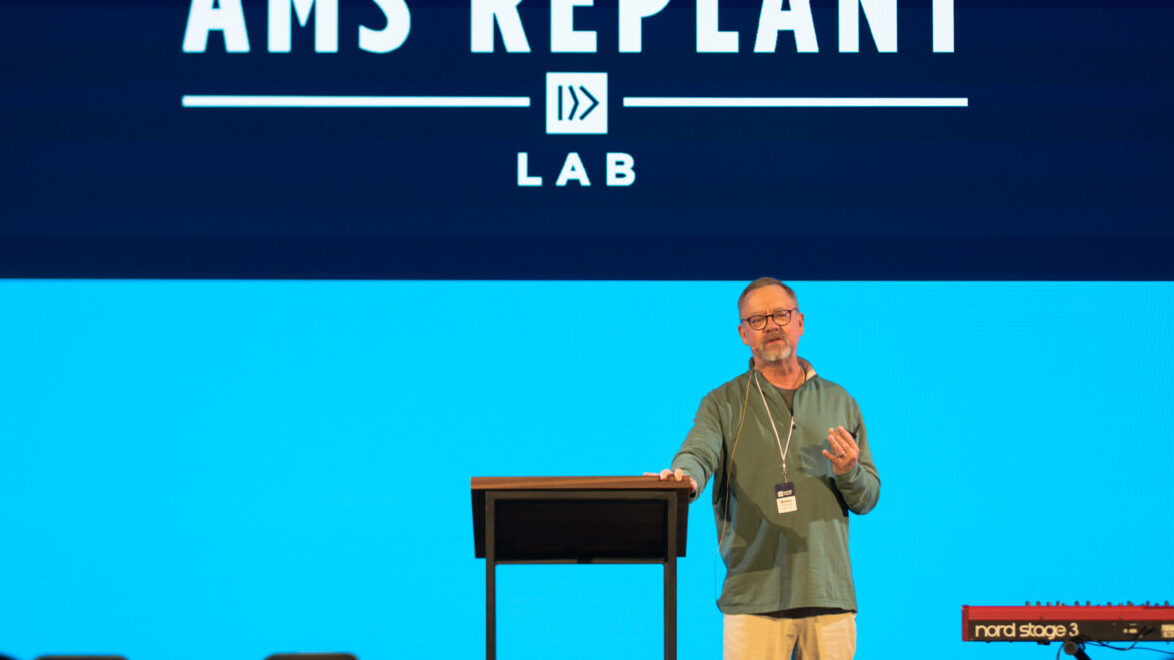
Kevin Ezell, president of the North American Mission Board, predicted that by 2030, one-third of the existing Southern Baptist churches will have been started since 2010.
“We’re on pace to see this and this is exciting news,” Ezell noted. “The Annie Armstrong Easter Offering for North American Missions is upcoming, and we promise to be good stewards of every dollar given by our churches. All of these funds go to our missionaries in the field and strengthen our witness and work.”
Ezell greeted more than 300 attendees at the Replant Lab who convened Feb. 24–26 at NAMB headquarters in Alpharetta, Georgia.
Replant Lab is designed for Baptist associational leaders interested in helping sister churches renew, revitalize and replant.
Associational mission strategist liaison Walker Armstrong explained in a plenary session that congregational change can sometimes be seen as a threat, even when a congregation is struggling.
“Believers wrestle against evil, and sometimes we want to cling to tradition and see change as evil,” he said. “We should remind our fellow church members that we must always seek God’s best and that Jesus has a plan for every church.”
Taking the first step
“The first step in renewal is repentance,” Armstrong said. “We repent of our past sins and seek to restore right relationships in the local body of Christ. And we must renew our commitment to the Great Commission as we seek to win people to Christ.”
Armstrong explained several broad pathways that churches seeking renewal could follow.
“Replanting is mostly external,” Armstrong said. “Fresh recruits are welcome to bring new ideas and a new focus. The church may change its name and redesign its worship and ministry for the sake of the gospel.”
Another pathway is “merger” or “marriage,” he said.
“It may be that one of the churches is weaker or that two congregations are struggling. The congregations unite to form a stronger group and commit together to witness and serve. The two celebrate what God has done in their churches over the years and commit to a new way forward in partnership.”
Walker noted that sadly, another pathway is further decline and closure when church members decide to “stick it out” despite declining attendance, baptisms and contributions.
“This might happen because a faction in the congregation won’t cede control, what I call ‘the big C,’” he said. “As Mark Clifton often says, ‘What about a dying church brings honor to God?’”
Preparation
Bob Bickford, executive director of the Nashville Baptist Association, agreed that spiritual preparation is the key to moving forward, and partnership with caring friends is necessary. Associational or denominational teams commit to walking with churches, talking with them, surveying the congregation and community and formulating a recommendation for action.
“We’ve found that churches say ‘yes’ to a new pathway the majority of the time when the process has been bathed in prayer,” he said.
Replant specialist Brandon Moore called the “yes” commitment “the next right step.”
“The work of replanting is hard work,” he said, “but it’s God’s work. Since Jesus has a plan for every church, we seek His will. Processes sustain the pathway, so teams show the way forward step by step and commit to continue walking with the congregations.”
NAMB offers video resources, assessment tools and podcast links at namb.net/church-replanting.
Annie Armstrong Easter Offering resources are at anniearmstrong.com.


Share with others: