

Lilia was having a hard time seeing a scenario where her family stayed together.
The morning before, she’d been woken up at her house by the sound of explosions.
“It was supposed to be just a regular day,” she said.
She’d had plans to bake a cake and have her mom and grandmother over. Now she found herself sitting in her car in a miles-long line at the border of her country, Ukraine, crying and praying for a miracle.
“A policeman we talked to along the way told us that when we got to the border, I would be able to go with the kids but my husband would have to stay and defend our country,” Lilia said. “The president had made a law that only women and kids could leave.”
Her husband started to prepare her that she and the kids might have to leave him behind. To her, that sounded like a nightmare.
“I asked him, ‘How would I survive? Where would I go?’ I didn’t know how I would make it just me and the kids,” she said.
A big move
As they discussed what to do, their three children sat in the back seat, the youngest just a toddler in diapers. Her family could afford a normal life in Ukraine, but they hadn’t saved up money for a move like this.
“When we left home, all I was thinking about was our documents, and I grabbed a few other things,” Lilia said.
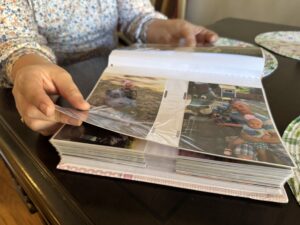
One of those things was an album full of photos of their youngest daughter, whose very presence in the car was a miracle.
And because of her, they would also see another miracle very soon.
A few years back, Lilia had been struck with a “very big desire” for a third child, and she wasn’t sure why, or why the desire wouldn’t go away.
She had married at 19, and quickly after she had delivered her first child and then her second.
“With our son, it was a difficult pregnancy, and my body couldn’t recover. I couldn’t have kids anymore,” she said. “But for me, it was fine — we had two kids, a boy and a girl. We had our house and a car, and my husband had his own business. We had a good life.”
Talking about adoption
But then one day that desire for another baby showed up.
And Lilia started talking with her husband about adoption. It was out of left field, because in Ukraine, people usually only adopt if they can’t have kids or if they are very rich, she said.
“For a couple of years, I just prayed, and my husband and I talked about it,” she said. “And one day he said, ‘OK, let’s do it. It’s good; we’re Christians, and we can tell this child about God.’”
So they did. For two years, they waited to be matched with the right child, and while they waited they prepared. They even built another room onto their home.
Finally they got word that a baby was waiting for them.
“We did all the paperwork, and it took more than two months to complete it all,” she said.
They brought their new daughter home in March 2020, and the next day, everything shut down because of the COVID-19 pandemic.
“It really was a miracle that we were able to get her before everything closed,” Lilia said.
Their family of five was finally together, and now as they approached Ukraine’s border, all Lilia wanted was for them to stay together.
That day, “we just stayed in line the whole day, and we cried and prayed,” she said. “It was very difficult.”
But then something hopeful happened.
As they crept toward the front of the line, a woman approached them and said she and her husband and three children had just tried to cross the border but had turned back because her husband wasn’t allowed to leave.
“But then she showed us on her phone that right now our president had adopted an addition to the law that said a man who has three kids or more, they can cross the border,” Lilia said.
The woman asked if she could stay in front of Lilia’s family in the line and try again with this new piece of information.
“We said, ‘Yes, of course, try,’” Lilia said.
The woman’s family showed their documents to the border patrol and then showed them their phone. At first the officers said no — the addition to the law was so new that they didn’t even know about it yet. But they asked some higher authorities, and in the end, they said yes.
“After that it was our turn, and we showed our documents,” Lilia said.
The other family got held up because they didn’t have their car’s documents with them, but Lilia’s family moved on through.
“When we got into Slovenia, an officer who saw my husband said, ‘How is it possible? You are the first man who has done this,’” Lilia said. “For us, it was a really, really big miracle. When we adopted our daughter, we thought we were doing something good for her, but really because of her, we were all able to stay together. God took care of us.”
And she said He continued to take care of them as they traveled across Europe to Spain, where they were able to stay with a kind-hearted woman for free for several weeks.
They were grateful. But the emotional toll of the war was tough.
“Spain is a beautiful country, but really for a month and a half I just cried,” Lilia said. “All my thoughts were about Ukraine, my home, my mom, my sisters and their kids. It was very, very difficult.”
Finding a job was difficult too — they didn’t know any Spanish at all.
So eventually relatives in the United States sent them some money to fly to Mexico, where a California church group helped them get to the border to talk to a U.S. official.
“We talked with American representatives and explained that we’re from Ukraine and we have relatives in Texas and we need help, and they provided humanitarian parole for one year.”
Rebuilding life
Lilia and her family moved in with their relatives in Texas, and her husband got a job where he worked hard but didn’t make much money. That first year, Lilia still had her mind set on returning to Ukraine.
But the war dragged on.
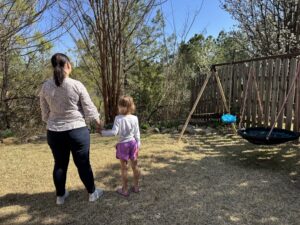
“We understood after a while that it’s not stopping so quickly, and we need to build our life here,” she said.
They worked hard on learning English. Lilia had lessons three days a week online with an English teacher she knew from Ukraine.
They also got involved in a church, and the members there helped them pay the deposit for a small house and get some furniture.
In God’s hand
“It was impossible for us to buy those things — we had just enough money for food,” Lilia said. “I really see a lot of miracles and care; God held all this in His hand.”
Then after visiting Ukrainian friends in Alabama for Christmas, they felt God prompting them to move to the state. Now they’re members of an Alabama Baptist church.
“We feel like the church is our home; we have friends here,” Lilia said. “I believe God put us in this church in this place, and it’s not a coincidence — it’s God’s will and it’s how He takes care of us.”
Government changes
Now, as the U.S. government makes changes related to immigration and the war in Ukraine, Lilia and her family wait to see what will happen with their legal status in the future.
“We can’t go back to our city or our house, so if we have to move somewhere, we will be starting from scratch again,” she said. “I’m not ready to do that — right now, we have a house, a job, a church and friends.”
She also prays her children won’t have to move into a new school situation with a different language again. She has so many questions in her mind, but in the midst of that, she has an anchor in God — and she said she doesn’t know how anyone survives something like this without it.
“Sometimes I think about it and I ask God why. But I know God brought us here and took care of us, so I know in the future it will be the same,” she said. “No matter what, He will take care of us.”
EDITOR’S NOTE — Name has been changed for security reasons.

Share with others: