
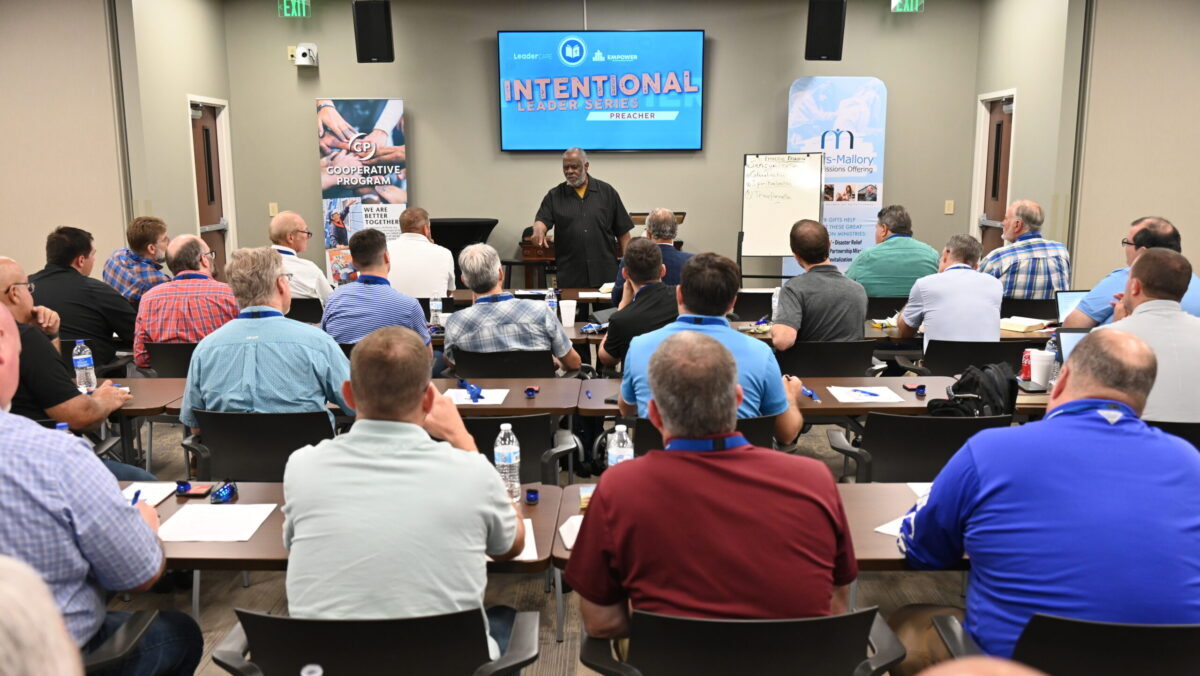
While all pastors have times of struggle, they should be “empty pitchers before the fountain of God’s word,” said Robert Smith Jr.
Smith, presenter for the July 15 Intentional Leader Series sponsored by the Alabama Baptist State Board of Missions, was professor of Christian preaching at Beeson Divinity School more than 25 years, where he held the Charles T. Carter Baptist Chair of Divinity. Previously he was the Carl E. Bates associate professor of Christian preaching at Southern Baptist Theological Seminary in Louisville, Kentucky.
Subscribe to The Alabama Baptist today!
SIGN UP for our weekly Highlights emails that hit your inbox on Monday, Wednesday and Friday.
The theme of the ILS was the minister as “preacher who exposits Scripture,” and Smith told the audience that preaching involves “something old and something new.”
“We preach what the Reformers did,” he explained. “Calvin and Luther and Melanchthon preached the same doctrine we hold. This is orthodoxy. But we must be open to communicating doctrine in a fresh way.
“Psychology explains that we’re ‘right-brained’ when we use images, metaphors and pictures. We define, but we also give a picture. These things will move our hearers.”

Examples
Smith provided two examples of fresh interpretation of doctrine, or what he called “grabbing hold of words.”
“Clarence Jordan of Koinonia Farms translated 2 Corinthians 5:19 to read, ‘God was in Christ, hugging the world to Himself,’” Smith noted.
“And Gardner Taylor said the incarnation made Jesus ‘death-eligible.’ These images help people move the truth from their heads to their hearts, and this 18-inch journey can be the longest journey in the world.”
Smith added that illustrations also are vital in communicating.
“No illustrations are better than Scripture, and your study of Scripture means Scripture should be ‘dripping off’ you,” he said. “Use Scripture with excellence to tell the story of redemption.”
Smith noted biblical characters provide wonderful illustrations.
“Every biblical character is stained with sin and failure,” he said.
“They are not models for morality, but mirrors for identity. These characters come out of the picture frame of the Bible, and we use them to illustrate our shared humanity and struggle.”
Another source for illustrations is the hymnal, Smith said.
“I think the Bible and the hymnbook should be side-by-side in the preacher’s study.”
He told of speaking at a recent conference and asking the young musician to play, “Jesus, Keep Me Near the Cross” during a closing prayer.
“This young man was gifted, but he did not know the hymn,” Smith said. “We preachers are the caretakers of dying truths from the classic hymns.”
Use the senses
Smith exhorted ILS participants to use the six senses to teach biblical truth.
“The olfactory glands, our sense of smell, cause the unconscious to be conscious,” he asserted.
“John specifically said Peter warmed his hands by a charcoal fire when he denied knowing Jesus, and then Jesus served him a meal from a charcoal fire after His resurrection. Surely Peter smelled that odor, remembered his sin and experienced the grace of Jesus.
“And John told us also about the stench of death at Lazarus’ tomb. We should help our hearers reflect on the smell of death and know that Lazarus’ death was real, and Jesus’ power was great.”
In response to an audience question Smith suggested that shorter sermons due to shorter attention spans is a myth.
“There’s no deficit of attention span at a three-hour football game,” he noted. “The difference is engagement, and this is the work of the preacher.”
Preparation is key, Smith noted, and the modern preacher must make time for earnest study.
“Read your text all week and every day,” he exhorted. “Think about it all the time. Psychology says the last thing we see at night can be part of our dreams, so don’t watch that horror movie on Saturday night. Read your text and let your brain do some work for you as you sleep. Preparation gives you freedom to improvise, or to ‘riff’ on Sunday morning like a jazz musician does, because you are confident in the truth you’ve studied.”
“Preparation is hard work but preaching is fun,” Smith declared. “We’re actually on the ‘playground’ of the Holy Spirit and there’s joy in making God’s word real for our congregations. It’s the greatest work in the world!”
Bryan Blass, director of the ALSBOM Office of LeaderCare, said the ILS, in its third year, is designed to inspire and encourage ministers through those seasoned in ministry.
The final 2025 ILS is scheduled for Sept.16, focusing on the work of the pastor.
The schedule for events is posted at leadercareal.org. Blass can be reached at bblass@alsbom.org or 334.613.2210.



Share with others: