
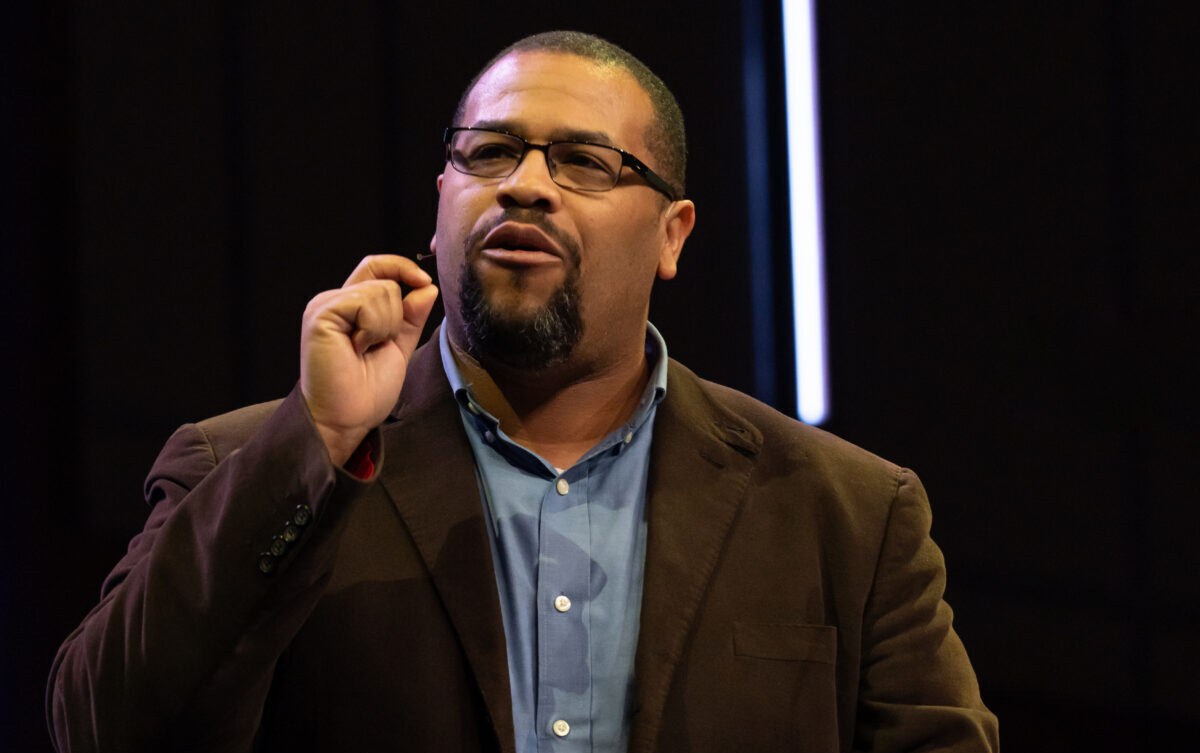
Fred “Chip” Luter III said he didn’t want to be too offensive, but he wanted to ask a question to those gathered at the Alabama Baptist Pastors Conference on Nov. 10.
“Why are we here? What’s our purpose? Is it to have the biggest pulpit? Is it to be the most relevant? Is it to have the widest influence on the largest platform? Why, pastors, are we really here?”
Luter, senior associate pastor and senior pastor elect of Franklin Avenue Baptist Church in New Orleans, said God put each pastor at their church for this season for a predetermined reason.
“Our purpose has already been written, and it’s not about us,” he said. “We’ve been called to the ministry of reconciliation.”
Preaching from 2 Corinthians 5:16-21, Luter shared three things that fuel the church as an agent of reconciliation.
1. The mission of God
Reconciliation was initiated by God, he said. “The mission didn’t start with us. It began in the heart of God from eternity past. The Father purposed to exalt His Son through the redemption of sinners.”
What normally happens between people when a relationship is broken is that the party who is hurt expects the offender to take the first step toward reconciliation, Luter said.
“But I love the gospel of Jesus that says we hurt Jesus, we betrayed Him, it was our sin on the cross and He took the first move to reconcile us to Himself.”
With reconciliation, “Christ makes the first step, and so should we,” Luter said.
Sometimes people can choose people groups, politics, preferences and personalities over pursuing people who are different from them, he said, “but our pulpit should be about bringing people together for the gospel of Jesus Christ.”
2. The ministry and message from God
“He gave us the ministry — the ministry that has a message,” Luter said. “The same Christ who accomplished reconciliation has entrusted to our stewardship that we are ministers and messengers of that reconciliation.”
There are three great enemies to reconciliation, he said. One is sin that shows up in greed, pride, selfishness, social division and other things that prevent unity. Another is Satan, the great divider.
“But we carry a powerful message that is powerful enough to heal anything that’s broken in this land,” Luter said.
The answer to brokenness is the gospel, and the world longs for the peace it brings, he said. That’s why pastors must proclaim it.
“Our world loves to form alliances — oh, don’t we love to pass resolutions. And we love to legislate reform. But without the cross, these are temporary truces,” Luter said. “True reconciliation flows from Christ’s finished work.”
He asked pastors if their churches could see them walking out reconciliation in their own lives in the way they relate to others.
“Are we ready to not just talk reconciliation but to live reconciliation?”
3. The mandate
If someone were an ambassador for the United States in another country, when someone met that ambassador, it would give them a taste of what the U.S. is like, Luter said. It’s the same with the gospel.
“When God wants to make His appeal, He uses you and me,” he said. “We are not motivational speakers; we are ambassadors of the King.”
He challenged pastors to let the wonder of Christ’s reconciliation for them to revive their souls and fuel them to share it with others.
He also encouraged them to evaluate their relationships and pray for opportunities to be an agent of reconciliation.
“We have the privilege of the ministry of reconciliation,” Luter said. “If Jesus can be on mission for us, why can’t we stay on mission for Him?”
Share with others: