
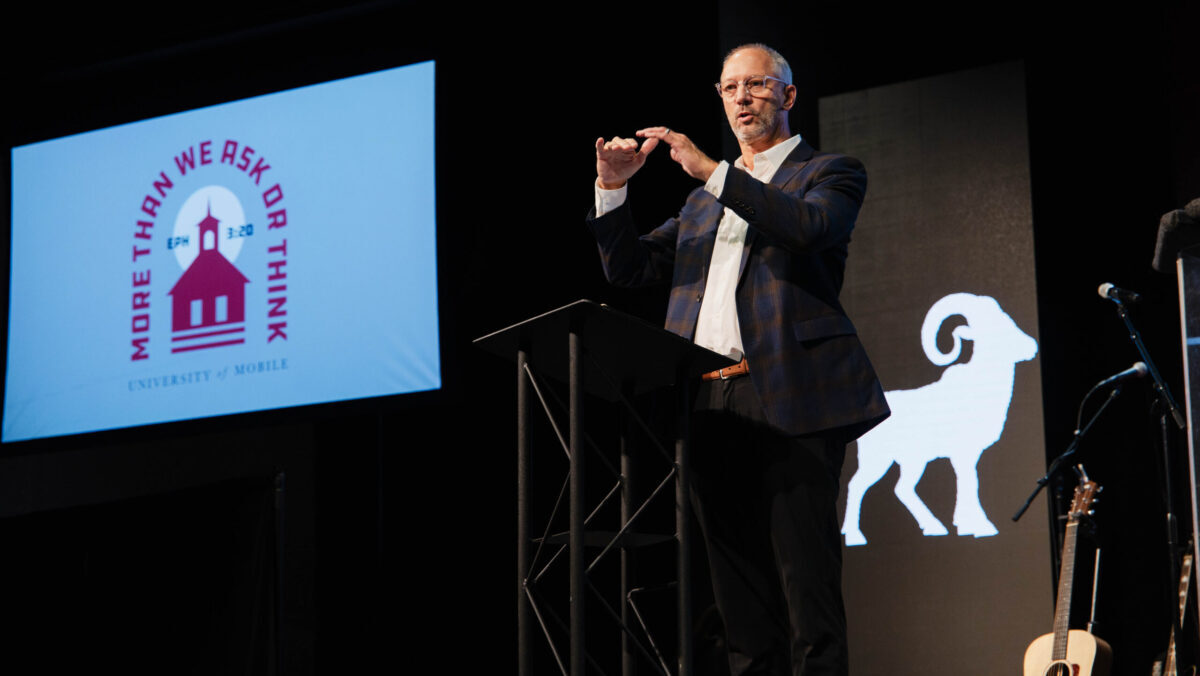
Mark Vroegop spoke on the power of lament during a recent University of Mobile chapel service.
Vroegop is president of The Gospel Coalition and has served in pastoral ministry leadership for 30 years. He has written several books, including “Dark Clouds, Deep Mercy: Discovering the Grace of Lament” and “Waiting Isn’t a Waste: The Surprising Comfort of Trusting God in the Uncertainties of Life.”
Subscribe to The Alabama Baptist today!
SIGN UP for our weekly Highlights emails.
As Vroegop presented a message from Psalm 77 during the Oct. 29 chapel service, he opened up about a painful journey of lament that he and his wife, Sarah, experienced following multiple miscarriages and a false-positive pregnancy. He went onto share with students about prayers of lament.
Prayer that ‘leads to trust’
“I want you to understand how to talk to God when life is really hard,” Vroegop said. “Although I was a student in the church for many years, and I’d gone to seminary, somehow I had missed this important biblical language. For me, it became life-giving and helped me to process my pain and for my wife as well. You know what I’ve discovered after I think of my own journey and the churches that I’ve pastored and people that I’ve talked with? I’ve learned that crying is very natural and very familiar and very easy, but lamenting — the kind that is biblical and redeeming — is not quite as natural. I would suggest to you that we know how to cry, but we may not know how to lament.”
Vroegop explained to students that lamenting is uniquely Christian as he defined lament as a “prayer in pain that leads to trust.” He also noted that one out of every three Psalms is a lament.
“These are prayers that God’s people prayed when they didn’t know what to do,” Vroegop said. “You may not know it now, but three months from now, you could be walking through a difficult season, and this is going to give you a language for how to be able to process what you are dealing with.”
At some point, he noted, everyone is going to run into “a pain, a sorrow or difficulty that you’re not going to think your way out of or work your way out of.”
“You’re going to come face to face with the fact that the world is broken, and sin has caused death in the world,” he said. “You will have to reckon with and make sense of the world. What you’re going to see in this Psalm is a connection to the gospel. The Lord Jesus when He hung on the cross prayed a lament prayer when He said, ‘My God, my God, why have you forsaken me?’ Lament is connected to the gospel in the sense that we mourn the brokenness of the world, and the ultimate hope that we have is in the person and work of Jesus Christ.”
Avoid the ‘silent treatment’
He asked the students, “What does this mean if you’re a Christian?”
“Don’t give God the silent treatment. Don’t let your pain become your identity,” he added.
“Work it out with Him and talk to Him,” he said. “There’s nothing that’s rolling out in your heart that God isn’t fully aware of. Nothing that you pray that He isn’t already aware of. Talk to Him, and take the bold step to pray through your pain. If you have a friend who is walking through grief, be careful not to hush their pain or silence their pain, walk with them and help them learn the pathway of lament. In all of our lives, you’re going to come to a moment when something hard is going to happen in your life. In that moment the question is, ‘Are you going to turn to Christ, who can deal with the ultimate need within your soul, which is a relationship with Him?'”
He added, “That helps you process everything because the trajectory of your life is now contained within the sovereign plan of a good God, and there’s grace for those who realize that a prayer in pain can actually lead to trust. That’s what it means to lament.”


Share with others: