
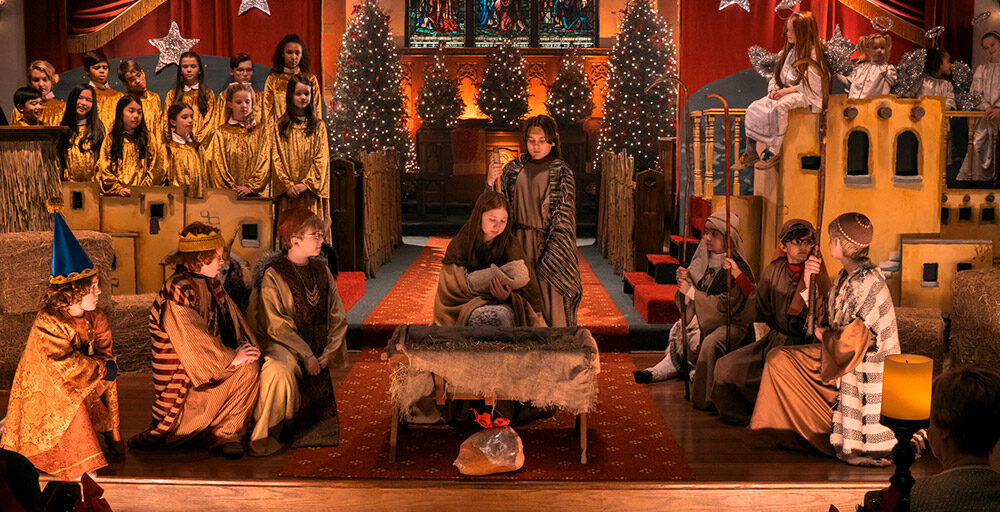
If I were to ask you to name the best Christmas movies of all time, I am confident several titles would make the list: “It’s a Wonderful Life,” “Miracle on 34th Street,” “A Christmas Carol,” “A Christmas Story,” “How the Grinch Stole Christmas,” “Home Alone,” and “Elf” (no, Die Hard is NOT a Christmas movie).
No matter how many times you’ve watched these holiday films, chances are you will do it again this year, and every year, when Christmas rolls around. Box office hits like these become as much a part of our seasonal tradition as the music we listen to, the decorations we hang, or the food we enjoy.
RELATED: Check out more articles on faith and culture from pastor Adam Dooley.
Subscribe to The Alabama Baptist today!
Rarely, however, does a new movie come along that you instantly expect to enjoy from now on. Last Christmas, however, with the theatrical release of “The Best Christmas Pageant Ever,” I knew immediately we would share it as a family every December. Based on the children’s book written by Barbara Robinson in 1972, the play tells the story of the Herdman children, the meanest kids in town, who took over the local Christmas pageant even though they had never heard the Nativity story.
What Christmas is all about
Seeing the events surrounding Jesus’ birth through their inquisitive eyes offers a powerful reminder of what our favorite holiday is all about.
Frankly, their fresh perspective is a needed experience for all Christians. Surprisingly, “the worst kids in the history of the world” have much to teach us as we celebrate the birth of our Savior. Their mere presence in the storyline reinforces the biblical truth that Christmas is a season for outcasts.
Don’t believe me?
Even a cursory reading of Jesus’ genealogy reveals our categorical bias often identified as “those people.” I may fall short, we reason, but not like “those people.” I need salvation, but not as badly as “those people.” Church is for everybody, but “those people” would not be comfortable here. Yet, despite our internal prejudices, the family tree of our Lord is full of every kind of reject imaginable.
Consider the five women listed in our Savior’s lineage. For a society dominated by men, where the testimony of females was inadmissible in court, including these names was taboo. Amidst 39 recorded fathers, these five women stick out like thorns in a rose. Just as strange, though, are the female names omitted. Matriarchs like Sarah, Rebekah and Leah are absent in exchange for Tamar (Matt. 1:3), Rahab (Matt. 1:5), Ruth (Matt. 1:5), Bathsheba (Matt. 1:6) and Mary (Matt. 1:16).
Four of these five women were Gentiles of the worst kind. Tamar and Rahab belonged to the forbidden Canaanites, a people known for their wickedness (Deut. 9:4-5). Ruth was a Moabite, a people descended from incestuous Lot (Gen. 19:30-38). Bathsheba was a Hittite by marriage to Uriah (2 Sam. 11:3). Jews viewed each of these groups as unclean by birth.
Even more remarkable is that three of these women were moral outcasts as well. Each experienced sexual liaisons that would have made Hollywood blush. Matthew hints at one such sordid affair by saying, “Judah was the father of Perez and Zerah by Tamar (Matt. 1:3).” The statement hearkens back to the book of Genesis, where Tamar dressed as a prostitute in order to deceive Judah into fathering her child (Gen. 38).
Next, the record reveals that “Salmon was the father of Boaz by Rahab (Matt. 1:5).” We tend to be more familiar with Rahab because the New Testament heralds her as a hero of the faith (Heb. 11:31; James 2:25). In light of her later praise, it is easy to forget that what Tamar pretended to be, Rahab actually was — a prostitute.
Finally, the Bible’s curious way of referring to Bathsheba should not be lost on us. Matthew says bluntly, “David was the father of Solomon by Bathsheba who had been the wife of Uriah (Matt. 1:6).” With no effort to hide the uncomfortable truth, Scripture reminds us that Bathsheba was an adulterer.
But what is the point of all this dirty laundry? Simply, the invite list for the biblical Christmas party had a lot of unexpected guests. These were not people who felt comfortable in church. They were not family members you would be eager to tell others about. They were outcasts.
By the way, the more recognizable, respectable names on Matthew’s list were not all that impressive either. They, too, were outcasts. Two times he mentions King David (Matt. 1:1, 6). Yet, in addition to being an adulterer with Bathsheba, Israel’s most famous king was also a murderer who plotted to have the husband of his mistress killed (2 Sam. 11:1-27).
When Abraham’s name appears (Matt. 1:1-2) it conjures up images of Israel’s greatest patriarch. Nonetheless, a closer examination of Old Testament history exposes his devastating flaws. Twice Abraham denied his wife, Sarah, allowing Pharaoh to violate her (Gen. 12:10-20, 20:1-18). Worse still, he repeatedly doubted God’s promises throughout his life (Gen. 12-21).
Each name surveyed bears similar outcomes.
Judah, the father of the messianic tribe, sold his brother Joseph into slavery (Matt. 1:3). Solomon, the wisest king who ever lived, surrounded himself with hundreds of wives (Matt. 1:7). Despite his reforms, Hezekiah felt morally superior (Matt. 1:9). Wicked kings like Abijah, Joram, Ahaz, Manasseh, Amon and Jeconiah presided over the decline and demise of the nation.
Christmas reminder
Some lived as social outcasts because their sins were open and bare, while others functioned as secret outcasts because their transgressions were hidden beneath the surface. And the same is true for us.
We are all outcasts by nature.
Christmas is a reminder that none are so bad that they cannot be saved, but none are so good that they need not be saved either. Jesus was born through sinners, for sinners (1 Tim. 1:15). Jesus’ family tree proves that God will accept those whom the world rejects if you abandon your sin and come to the Father through the Son. The Lord is willing to meet us in our failures, because that is where we need Him most.

Share with others: