
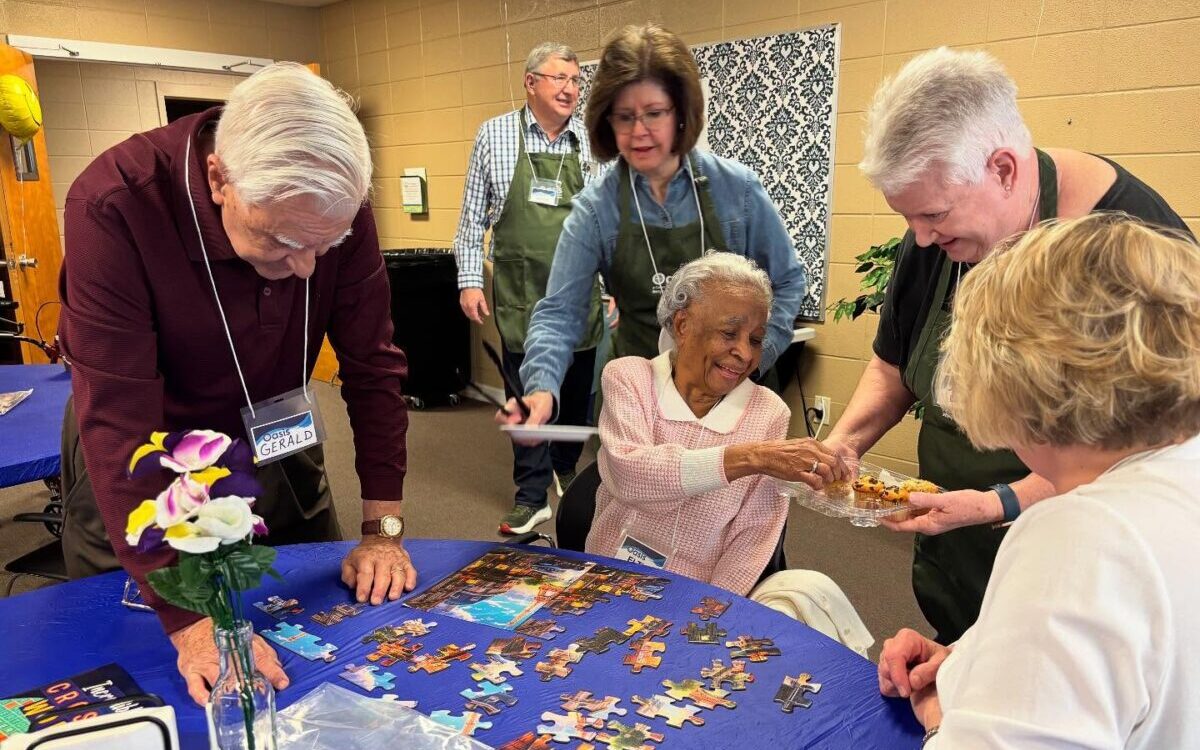
Respite for All (RFA), an Alabama-based non-profit that began in 2012 to assist people living with dementia and their caregivers and families, has grown dramatically over the past 13 years.
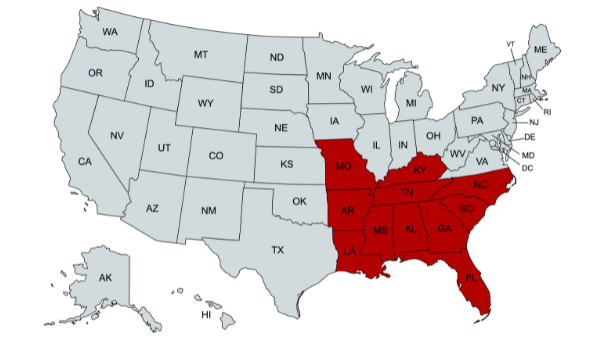
As of December 2025 there were 65 respite communities in 18 states engaging 1,250 people with dementia, according to Daphne Johnston, co-founder of RFA. That means some 1,250 volunteers who contributed 500,000 volunteer hours during the year.
RELATED: Click here to read about two churches ministering to families living with dementia.
Johnston and Lawson Bryson launched a respite ministry 14 years ago at First United Methodist Church Montgomery, and it has expanded to include 11 denominations, Johnston said. RFA will launch its first Roman Catholic ministry church in Birmingham in September.
“We think every denomination needs it.”
Statistics support that. More than 6 million Americans are living with dementia or Alzheimer’s in the United States and that number is expected to double by 2050, according to the RFA website.
Johnston stressed that 6 million reflects only those who have been diagnosed.
“Think of the millions of people who have dementia but have not yet gone to the doctor to be diagnosed,” she said.
While Alzheimer’s is the best known and most prevalent type of dementia, there are some 120 different types and forms.
The number of respite sites continues to grow as 21 ministries are slated to begin this year, Johnston noted.
“We are on the cusp of doubling in size from the 65 we now have.”
Why RFA was established
Johnston, who established the RFA Foundation along with Warren Barrow, a Montgomery businessman whose wife was diagnosed with dementia, explained how it got its name.
“We began the ministry so we could give caregivers a break,” Johnston said. “But once we got our friends with dementia together, we discovered they also needed a break from their stressed caregiver and were excited to meet and be with new friends.
“That’s how we came up with the name Respite for All. It’s a respite for the caregivers, the people living with dementia and the volunteers,” Johnston said.
She defined respite as “taking a break from something hard. There’s nothing harder than living with dementia 24-7.”
How RFA works
Respite for All guides churches and organizations in building successful communities that provide social support for families living with dementia, Johnston explained.
She stressed that RFA is based on a social model of care.
“That’s what sets us apart from other ministries,” she said.
Churches do not have to have medical personnel on hand because no medical care is provided or medicines given out during the four-hour stay.
RFA is staffed by church volunteers (primarily senior adults) who minister to individuals living in the early to middle stages of a diagnosis, who are able to care for their own restroom needs, are comfortable in a group setting and are able to eat on their own, Johnstone said.
“It truly is a discipleship experience for both the volunteers and our friends with dementia.”
“Volunteers are the lifeblood of the ministry,” Johnston acknowledged, observing that once people volunteer, they never leave. Churches often add days to their program to meet the demand for people living with dementia and additional volunteers who want to serve.
Partnership with churches
RFA’s model of care is based on partnerships with faith communities (churches) that provide free space and a network of volunteers who offer community and companionship, in addition to activities that benefit those living with dementia, Johnston said.
Churches that adopt the RFA model do not have to “reinvent the wheel,” she noted.
“We provide training on budget, dementia education, activities and programming. We provide everything a church needs to know. It’s like, ‘Just add water and stir.’ The churches do not have to research anything.”
The beauty of RFA is that it can be done by any church, large or small, whether in the city or in a rural setting, Johnston said.
The RFA Foundation has made the process of beginning a ministry affordable, she noted. Churches that commit to launching a site are eligible for a $10,000 “seed grant” that helps fund a part-time director chosen by the church, and each site is a stand-alone ministry.
The churches are autonomous and set their own guidelines as to days the ministry is available, Johnston said, while each church determines a modest tuition (generally $20 to $50 a day) to assist with operating expenses.
She stressed, however, that no one is turned away.
“Scholarships are available from the local church,” she affirmed.
Johnston urged churches to consider partnering with RFA.
“Your church will be an asset locally when you can provide this ministry to the entire community.”
For more information visit respiteforall.org.



Share with others: