
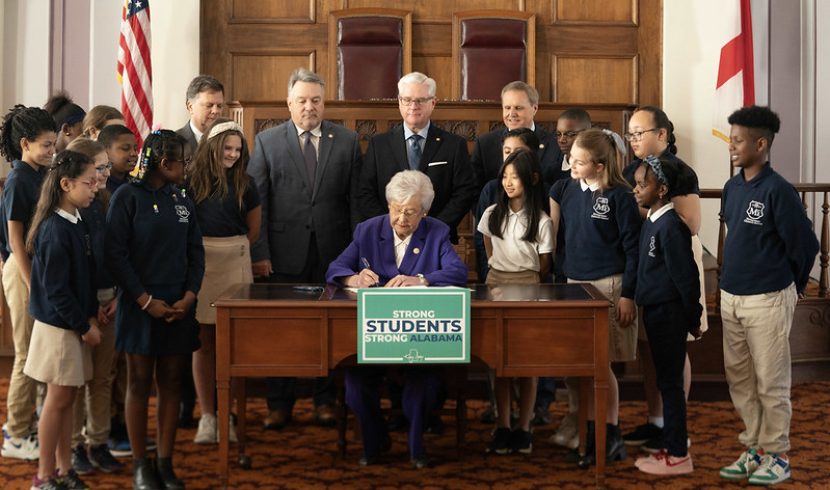
Nearly 49,000 students applied for Alabama’s education savings account program for the 2026–27 school year, Gov. Kay Ivey announced Wednesday (April 8), well above last year’s 37,000 students.
The application period closed at midnight March 31 with 29,341 applications representing 48,927 students, according to the governor’s office. That includes 18,832 new applications covering 29,986 students and 10,509 renewal applications covering 18,941 students.
RELATED: Check out more Alabama news.
“The CHOOSE Act has changed the lives of thousands of Alabama families by enabling them to choose schools that best align with their priorities and their child’s specific needs,” Ivey said in a statement.
“The increase in applications for the upcoming school year shows that the people of Alabama want school choice, and I am proud that we are able to give it to them!”
What is the CHOOSE Act?
The CHOOSE Act, short for Creating Hope and Opportunity for Our Students’ Education Act, was enacted in 2024, creating Alabama’s first statewide education savings account program. It allows eligible families to use public funds for approved education expenses outside the traditional public school system.
Under the law, eligible families may receive up to $7,000 per child to attend a participating school or $2,000 per child for homeschooled students, capped at $4,000 per family.
Funds can be used for a range of education-related expenses, including tuition, textbooks, curriculum materials, school fees and certain educational services such as occupational or speech therapy.
In the FY27 education budget package finalized this week, lawmakers allocated $85 million from the Education Trust Fund and $100 million from the CHOOSE Act fund to pay for education savings accounts for the 2026–27 school year.
To be eligible for an education savings account, a family’s income in 2025 could not exceed 300% of the federal poverty level, about $80,000 for a family of three. The income limit is expected to be removed for the 2027–28 school year.
In 2025, the first year ESAs were available, 22,167 families submitted applications representing 36,873 students. Around 23,000 students received awards and about 19,000 students are using them during the current school year. The state expects to spend about $100 million on ESAs for the 2025–26 school year.
The governor’s office said the racial makeup of the 2026–27 applicants closely mirrors Alabama’s overall population. Among new applicants, 66.3% identified as white and 33.7% identified with a minority racial group, compared to 2024 census figures showing Alabama’s population as 68.2% white and 31.8% minority.
The population of students enrolled in Alabama’s public schools differs substantially from the state’s overall population, though. Enrollment in public schools this year shows that 49.8% of students identify as white and 50.2% identify as members of a minority racial group.
CHOOSE Act applicants for 2026–27 came from a mix of school backgrounds. The state reported 21,351 applications from private school students, 13,425 from homeschool students and 8,961 from public and charter school students.
Applications were split almost evenly by gender, with 24,305 female students and 24,611 male students applying.
Special needs
The governor’s office also said 5,115 students with special needs applied, along with 1,121 applications from active-duty military families living in priority school districts.
Families are expected to be notified in mid-April about funding approval. Approved students can begin using CHOOSE Act funds for eligible expenses in July.
EDITOR’S NOTE — This story was written by Trisha Powell Crain and originally published by Alabama Daily News.

Share with others: