
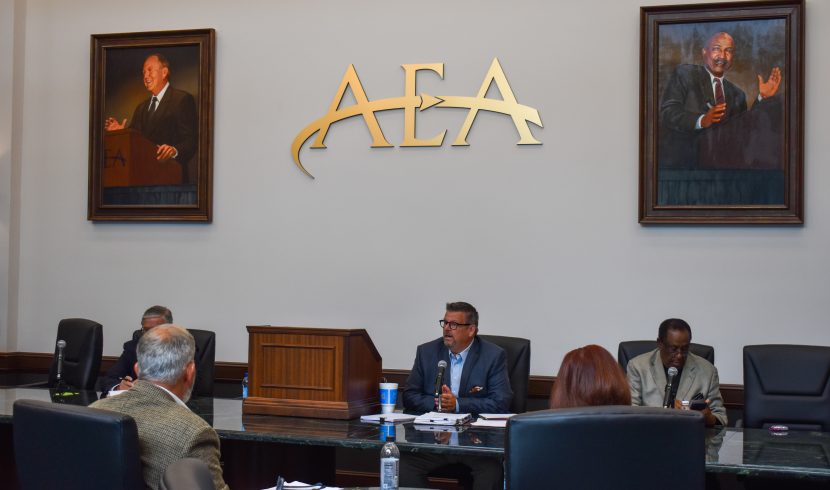
The new state agency created to administer workers’ compensation for education employees is on pace to be up and running by its Oct. 1 deadline, board members said at a meeting Tuesday (July 14).
The Public Education Employee Injury Compensation Board was created by a 2025 law but is still working to get off the ground. The board has set its members, hired a third-party administrator and found office space, but there’s still a lot to do before the board can begin processing teachers’ and other school workers’ claims.
Stay updated on stories like this — Get news delivered to your inbox
Unlike other state employees or workers in the private sector, Alabama’s teachers, support staff, bus drivers and cafeteria workers do not currently have access to workers’ compensation coverage. They are required to pay out of pocket for medical bills related to their injury and seek reimbursement from the state Board of Adjustment after the fact. That process can be slow and at times leaves teachers responsible with significant costs upfront.
The 2025 legislation creating the PEEICB — titled the Maryann Leonard Educators’ On-The-Job Injury Act — mandated that it start accepting on-the-job injury claims no later than Oct. 1.
90% complete
Executive Director Craig White was confident during Tuesday’s meeting that everything would be ready for that deadline. He estimated that the set-up of the agency is 90% complete.
“(There are) a lot of wheels in motion right now, but I believe they will all come to fruition and we’ll be ready to go,” White said. “It was just timeframes, as y’all know, dealing with state government and inefficiencies of that. … Everything takes so long to get anything done. That’s why we had to move so quickly because there’s no time to waste.”
But building a state agency from the ground up isn’t easy, board chair Joey Ammons said.
He said that most people working in state government have never been involved in creating a new state agency, which can slow things down.
“Even though we had a pot of money that we could potentially spend, it was just sitting in the Treasury Department, and you’ve got to actually form funds and different pots of money to place the money,” Ammons said. “You can’t just say, ‘Oh, I’ve got $15 million in the bank to spend,’ you’ve got to actually have it set up… It’s been a work in progress for a lot of people. As a lot of people say, the wheels of state government run a little bit slower than they do with the private sector.”
Gauging size of program
Though the legislation was applauded by lawmakers from both parties and representatives in the education world, it’s hard to gauge the size of the program.
Ammons estimated that 104,000 employees will be eligible for workmen’s comp under PEEICB but said that he doesn’t know how many claims that will amount to.
“We don’t know exactly how many claims we’re going to have,” Ammon said. “I’ve said that time and time again when I meet with the state, we don’t know if this is going to be 300 claims, 3,000 claims, 6000 claims… Are school teachers less likely to be injured than state employees?”
A fiscal note from December of 2025 estimated that the startup and first year cost of the program would be at least $15.6 million.
Full story.
EDITOR’S NOTE — This story was written by Claire Harrison and originally published by Alabama Daily News.

Share with others: