
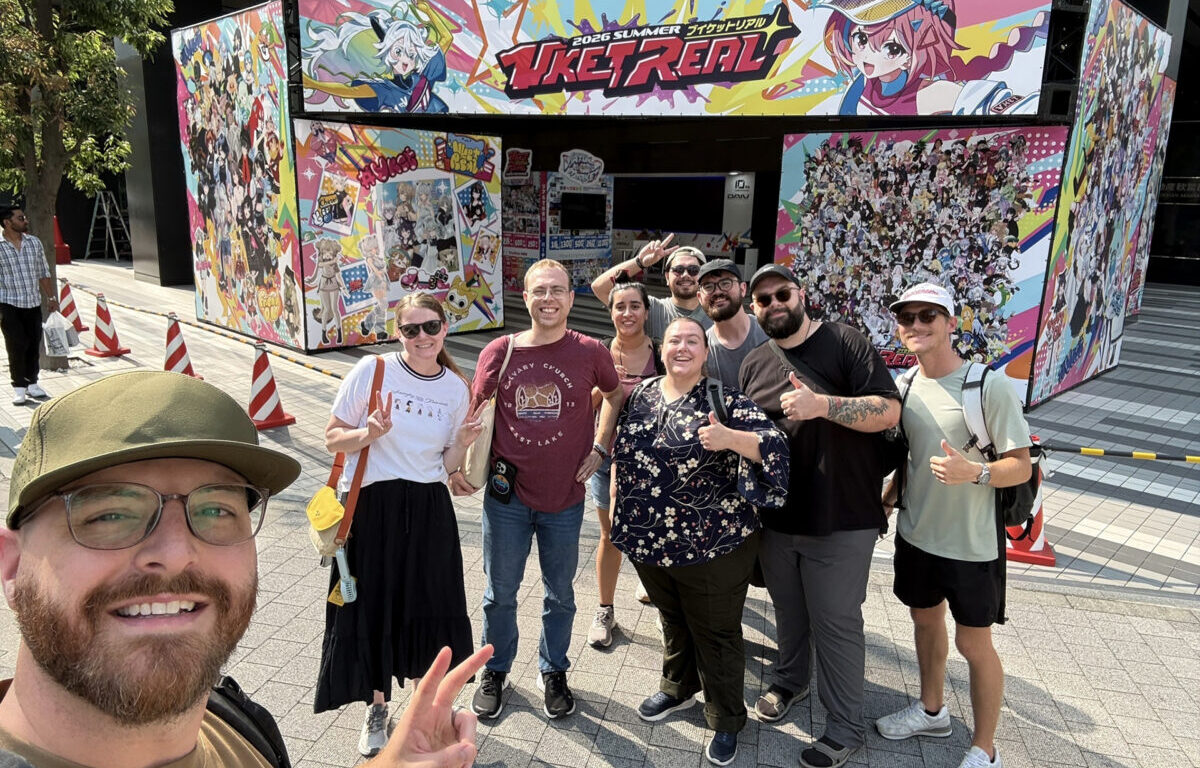
A bright purple robot mechanically wobbled past Jill Kane as colorful anime characters and avatars faded into towering buildings and flashing signs. It looked like one of the virtual reality worlds she had explored from her church in Clearwater, Florida.
Except this time, it was real.
Check out more stories on international missions.
Kane stood outside a Tokyo convention hall, packed with thousands attending Virtual Market Real (VKET), one of Japan’s largest VR gatherings. For two years, she and other short-term mission volunteers from Calvary Church have partnered with International Mission Board missionaries to share the gospel in virtual spaces. This summer marked a new step in IMB’s virtual reality ministry as those online connections moved to face-to-face conversations in Japan.
“It was particularly cool because for the first time, we were making connections online and then seeing them in person,” Kane said. “But it also was vice versa. I met Japanese people in person at VKET Real, and then we followed up with them in VR and Discord, [an online gaming community].”
Testing ground
VKET Real was an ideal testing ground for this step. Held both in virtual reality and at a physical venue in Tokyo, the convention attracts thousands of VR enthusiasts, creators, streamers and fans. IMB missionary Daniel Rice explained the idea behind the physical venue is to take a fully digital experience and develop a real-life community to augment it.
This step is often the hardest to do when it comes to digital engagement. When Rice and Calvary Church began testing virtual reality as a platform for engaging people with the gospel, being physically present was always the next step. Together they launched Gospel Hope Japan, a ministry that uses VR gatherings, Discord communities and eventually, in-person events to share the gospel.
Before VKET Real, the Floridians and IMB missionaries were already meeting Japanese users through VKET’s online events. They invited anyone interested into the Gospel Hope Cafe, a custom-built virtual environment designed for ministry conversations. At the two-day convention, they worked to take those online interactions to in-person conversations.
Rice admitted it’s a lot harder than they thought, but VKET officials encouraged the missionary to keep trying. They even offered assistance since Gospel Hope Japan is the first community to actively invite people into it with open arms.
The team distributed stickers with QR codes and NFC cards, physical cards with microchips that transfer data wirelessly. These tools linked users directly to spiritual surveys, gospel presentations and the Gospel Hope Japan Discord server. Every person they engaged connected through friend requests or joined the Discord community, allowing conversations to continue after the event ended.
One relationship during the week really stood out to Kane. The team went out in pairs to start gospel conversations. Kane and her partner met a young Japanese woman known online as “Vanilla” and some of her friends.
“We met in person and had a really great interaction,” Kane said. “Then, we connected with her in our Discord server. Through that, she was excited to hang out with us in VR in the IMB’s Gospel Hope Cafe the very next night.”
New model of ministry?
The Gospel Hope Cafe is a virtual world created by the IMB missionary team.
For Kane, the experience highlighted a new model of ministry where virtual and physical spaces reinforce one another.
This overlap is increasingly important in Japan, according to IMB Journeyman Alex McDonald. He’s spent the past year using VR as part of his ministry to students. Whether on the train or at their home, students are always online.
“If we want to reach the Japanese people or other people of the world, it has to start online,” McDonald said. “Recently, I had a friend who told me that his only outlet for talking to people was actually talking to AI itself. People are looking for community and looking for hope.”
This is why Rice views virtual reality not as a temporary tool but as an ongoing ministry platform in Japan. The Gospel Hope Community Discord serves as a bridge connecting digital relationships with long-term spiritual conversations, whether those happen in VR or around a table in the real world. “The VR communities live both in VR and Discord,” Rice said. “It’s the bridge to getting this community to events for more than just VKET. It’s a community platform that affords us shared space with Japanese that is designed for conversation, including faith discussions.”
After posting online and inviting people in person, the team hosted gatherings during VKET and afterward in the Gospel Hope Cafe. Here, not only did visitors hang out with the Floridians and IMB missionaries, but they could also access Bible resources in Japanese and English. Approximately 100 Japanese watched a gospel presentation, and 30 people engaged in gospel conversations.
Looking ahead
Rice said the partnership between IMB missionaries, Japanese churches and Southern Baptist churches is what makes this work.
“Virtual reality won’t replace mission trips or sending missionaries long term.” Rice said.
“What it will do is help us have more gospel presence in the lives of Japanese or other people groups. Digital communities like VR and Discord increase the frequency we can engage with the lost. It makes us that much sharper and experienced when we are ministering on the field in person.”
EDITOR’S NOTE — This story was written by Matthew Banther and Sue Sprenkle and originally published by the International Mission Board.

Share with others: