
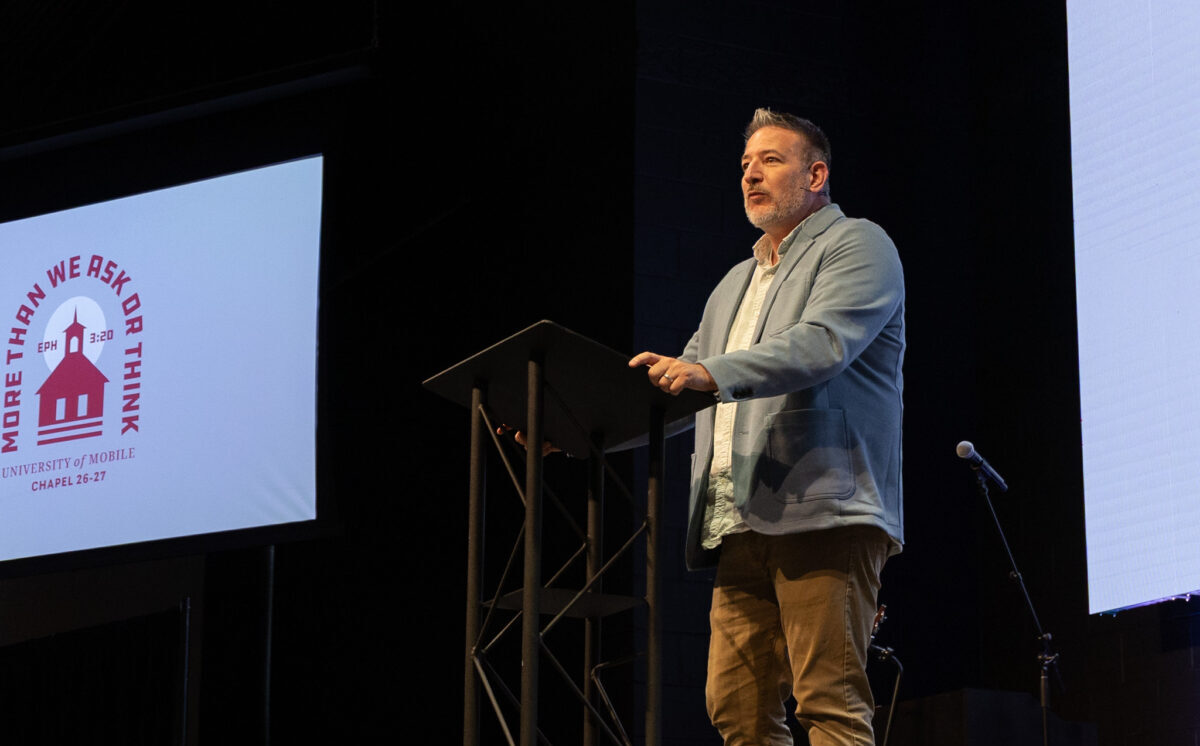
While speaking out of Ecclesiastes 11-12, Jared Wilson reminded students how the Old Testament points to the hope of salvation found in the New Testament through Christ, the One who brings meaning and purpose to all of our lives. Jared Wilson, associate professor of pastoral ministry at Midwestern Baptist Theological Seminary, recently spoke during a chapel service at University of Mobile.
“We’re going to be looking at an important passage, a key passage for your season of life,” Wilson said during the Oct. 28 service. “I used to not really care for the book of Ecclesiastes. I don’t know how much experience you have with it, but it was mainly because I just didn’t know what to do with it. It seemed very confusing to me. There is a recurring phrase throughout the book of Ecclesiastes.
“Different translations will put it differently, but it goes something like this, ‘Everything is meaningless, or everything is vanity, or everything is futile.’ It doesn’t seem like the kind of book you’d want to spend a lot of time reading.”
Book of ‘discouragement’?
Wilson also admitted that the phrase “everything is meaningless” seems full of discouragement.
“It seems like a downer,” he acknowledged. “But I’ve really come actually to love this book, mainly because it shows us life as it really is. If anyone ever says to you that the Bible doesn’t really deal with life as it really is, that God’s Word is out of touch with what we actually go through in this life, take them to the book of Ecclesiastes.”
Wilson then shared the testimony of a college student going through a very dark season, who was depressed, anxious, despondent and even suicidal. Wilson said it was the straightforward approach of the book Ecclesiastes that resonated with this young man and connected him to Christ.
“This young man was walking to the edge of a cliff to throw himself off,” Wilson said. “And in that moment, the way the sun glint off the ocean over the other side of the cliff just gave him a little glimpse of beauty that made him think, ‘Not in this moment.’”
Wilson described it as a pivotal moment and crucial turning point for this young man.
“He eventually was invited by one of his peers to a Bible study, where they were studying the book of Ecclesiastes,” Wilson noted. “Now, if someone comes to you and says, ‘I’m thinking about how, you know, life is rotten and stinks and I may even want to take my own life,’ I don’t know if Ecclesiastes is the book that you would go to, but this young man found himself in the study of Ecclesiastes, and he said, ‘It finally opened up my eyes to the reality of God’s Word.’
“He also said that he didn’t know there was a book of the Bible that spoke to exactly how he felt and what he was experiencing. This man knew about religion, and he knew about the church. What he did not know was that God’s Word speaks to the reality of his inner life and the truth about the human condition.”
As Wilson continued to dive deeper into his message, he emphasized a powerful point to students that “in the midst of all the brokenness of life, what our faith is actually for.”
“One thing you need to know about the man who wrote these words, and most believe that is King Solomon, is that he had tried everything,” Wilson said. “He had experienced everything. In Ecclesiastes, Solomon’s basically surveying all of the things that he’s achieved and all that he’s enjoyed as king of Israel and all of his pleasures. He built huge mansions that he adorned with gardens. Then, with all of his money and all of his power, he assembled the best entertainers and artists to perform for him. He ate the best foods in the world, and he drank the finest wines. He sought more and more money and more and more pleasure, more and more women even. If anyone had an Instagrammable life, it was Solomon.
‘Chasing the wind’
“He had accumulated and indulged in everything that anyone can think of to make life worth living. If we went around the room and said, ‘What is it that makes life worth living?’ Every answer you give is something that Solomon could have at the snap of a finger. Anything you can come up with to define what happiness is in this life, he had done it. Do you know what his conclusion about all of it is, over and over? He says, ‘It’s all meaningless and was like chasing the wind.’”
Wilson also shared with students that Solomon learned some of the hardest lessons through painful experiences that led him to this conclusion.
“When he gets to this part of the book to say, ‘Remember your creator in the days of your youth before the evil days come,’ he is not someone who doesn’t know what he’s talking about. He is someone who has learned the hardest lessons that there are to learn. So, when he speaks and the Holy Spirit is speaking through him here, we ought to pay attention.”
Wilson noted one problem we have when we are younger is the inability to think very long term.
“When you’re in college, you think about starting a career or maybe building a family, but that’s about as far out as we can get,” Wilson said. “We have a sense of career and our goals, but it’s all things that will make us happy, things that we believe will satisfy us. We aren’t really thinking or preparing for what Solomon is calling the evil days, but they’re coming sooner than we think. He says to remember God while you are still young precisely for that reason.”
While highlighting the main points of Ecclesiastes, Wilson encouraged students to “trust God in the midst of difficult seasons.”
“There will come a point in your life where you’ll have to trust Him for some very difficult things a lot more quickly than you think you will,” Wilson said. “In fact, you need to trust in Him this very moment. You shouldn’t wait to put faith in Christ. You should do it today. And what should you have faith for? Well, first of all, you should have faith that God made you and that we’re not in control.
“Solomon is leading us down the path to face that even in our hard work, in our strength, in our diligence, even in our success, we are not sovereign over the results. We are finite creatures with finite strength and finite knowledge. This is a call to everyone who reads these words to remember that they are not God. You didn’t make yourself. God made you. Remember your bounds and your limits.
Wilson encouraged students not to be afraid to admit they don’t know something.
He added, “Dark days will come if they haven’t already, but the love of God is over those who trust in Christ. Your doubts are no match for His commitment to you. Your sin is no match for His grace. He will not leave you or forsake you. When it came time to rise from the grave and conquer death forever, He remembered you. Only the fame of Christ Jesus endures forever. We must remember this now while we’re young when the promise of our own fame seems so tantalizing.”




Share with others: