
The Air Force issued revised guidelines on religious expression Feb. 9, reiterating its official neutrality on matters of belief but making subtle changes in language that drew both criticism and praise from disparate groups.
Religious activists gave diverse interpretations of whether and how the guidelines address some of the most controversial issues, such as whether Christian chaplains can evangelize and say public prayers “in Jesus’ name,” as many are accustomed to doing.
“We will respect the rights of chaplains to adhere to the tenets of their religious faiths and they will not be required to participate in religious activities, including public prayer, inconsistent with their faiths,” the new document reads.
Reduced from four pages to one, the latest “interim” guidelines were released after the Air Force received feedback on a previous version issued in August. Air Force officials said they heard from religious groups, members of Congress and others and interviewed 500 Air Force personnel.
Jennifer Stephens, an Air Force spokeswoman, said it is likely that Air Force officials will make the latest guidelines the permanent ones, but she said the service branch “will need experience with how the guidelines work in practice before deciding on the finalization date.”
Air Force Chaplain (Maj.) Jim Glass said the new guidelines will help chaplains return to a “climate of mutual respect.”
Glass, who calls Alexander City home, served as an Alabama Baptist pastor before re-entering the Air Force as a chaplain. He currently serves as chief of the excellence division at the Center for Character Development at the U.S. Air Force Academy in Colorado Springs, Colo.
For the most part, Glass said, those in his line of work breathed a sigh of relief when the revised guidelines were released.
“We are injecting some common sense back into what we’re all about,” he said. “We are saying we realize that, yes, many people do embrace some form of spirituality, and we can allow them to express themselves and be careful we are respectful of others, too.”
According to Chaplain (Capt.) Scott Bush, an Individual Ready Reservist with the Army National Guard and pastor of Southcrest Baptist Church, Bessemer, Army chaplains similarly are instructed to be sensitive to other religious beliefs, but “I have never been asked to abandon or alter my own,” he said.
“Whether I am preaching in a chapel service or engaging in a casual conversation, I am free to share the gospel and to say that there is salvation in Christ alone. I am a Christian chaplain — it would be inappropriate for me to say anything else,” Bush said.
The watchword seems to be pluralism, he said, which is not watering down his beliefs but rather being sensitive to the differences of others and maintaining our differences “in an atmosphere of civility.”
“To be a good chaplain, I must safeguard freedom of religion for all soldiers, and to do that with integrity, I must hold firmly to my own convictions,” Bush said.
Among other non-Air Force entities, immediate reaction to the guidelines was unusual in that some groups were in agreement with organizations they normally oppose. Critics of the latest version of the guidelines range from the head of an evangelical organization that endorses chaplains to Americans United for Separation of Church and State.
On the other hand, Focus on the Family, a conservative Christian group, praised the changes, as did a more liberal Reform Jewish organization.
“It is subtle language and it does not answer the question, ‘Can a chaplain pray in the name of his Lord in a public ceremony?’” said Billy Baugham, executive director of the International Conference of Evangelical Chaplain Endorsers in Greenville, S.C.
Rabbi David Saperstein, director of the Washington-based Religious Action Center of Reform Judaism, said he thinks the latest language permits chaplains to pray naming the divinity of their choice, “but they’re not going to be invited to do that with broad, inclusive groups.”
Saperstein said that achieves an “appropriate balance” for those in the military service, protecting the free exercise rights of both chaplains and the men and women in the Air Force.
But Barry Lynn, executive director of Washington-based Americans United for Separation of Church and State, said the newest guidelines no longer address the rights of people of minority faiths or of nonbelievers.
Although the one-page document refers to respect for chaplains’ religious rights, Lynn said, “It is shocking that there is no similar provision for regular Air Force personnel who do not wish to participate in prayer or other religious activities.”
Tom Minnery, senior vice president of government and public policy for Focus on the Family, applauded the latest rules, saying they would “bring an end to the frontal assault on the Air Force by secularists who would make the military a wasteland of relativism.”
His organization is based in Colorado Springs, Colo., the home of the Air Force Academy.
“We particularly thank the Air Force for specifically recognizing that ‘voluntary participation in worship, prayer, study and discussion is integral to the free exercise of religion,’” Minnery added.
In a separate but related matter, the National Association of Evangelicals (NAE) announced that it filed a motion Feb. 8 to intervene in a case in which Air Force veteran Mikey Weinstein wants to halt what he views as unconstitutional evangelistic practices within the service branch’s ranks.
“We believe this is a watershed issue,” said NAE President Ted Haggard in a statement noting his opposition to Weinstein’s position.
“How can we ask our men and women in uniform to give their lives extending freedom and civil liberties to oppressed people across the globe while they are denied the very freedoms they are fighting to secure for others?” (Religion & Ethics Newsweekly, TAB contributed)
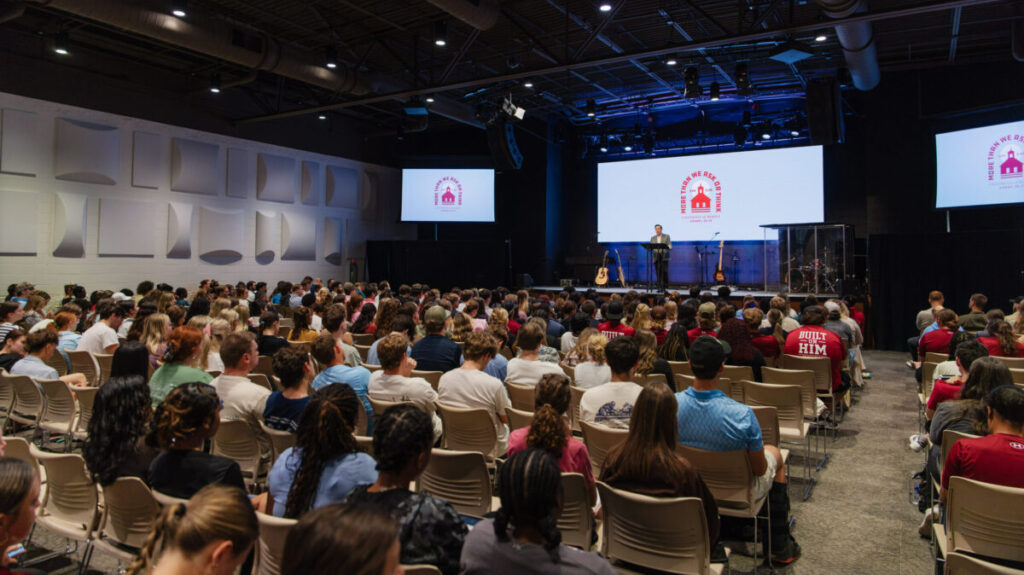
Wax challenges students to conform to Christ not culture
During the University of Mobile Chapel on October 14, Trevin Wax, vice president of research and resource development at the North American Mission Board, challenged students to passionately follow Christ and not the patterns of this world.

Latest news: Protests and destruction in France; Andy Stanley to step down from leadership; Evangelical Press Association name change sparks debate
Check out these recent headlines reported by The Baptist Paper.
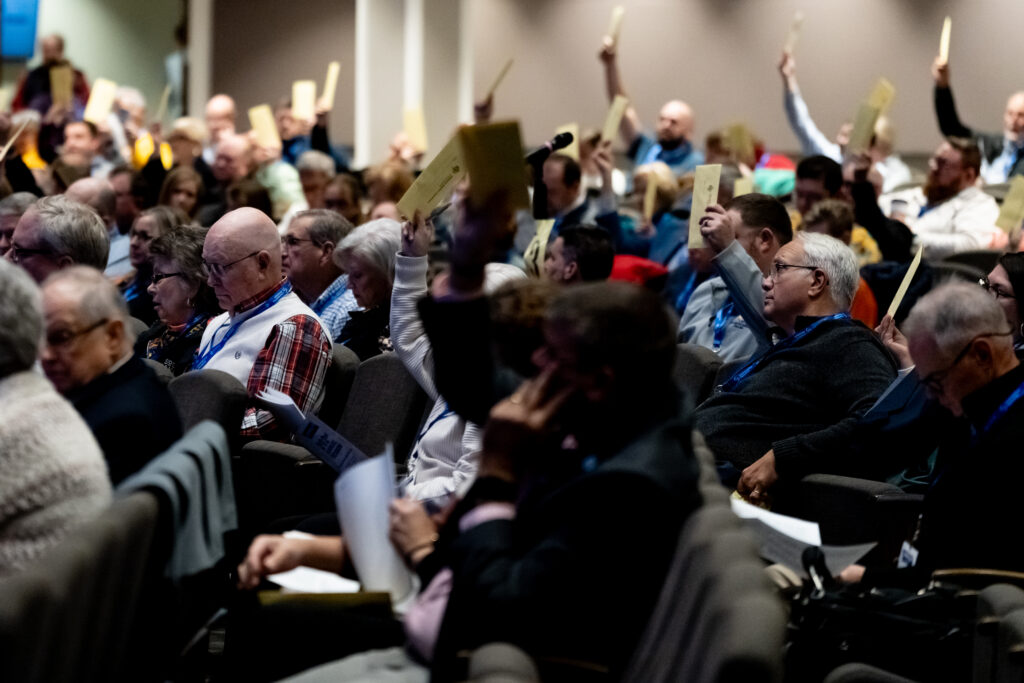
Alabama Baptist messengers to consider $38.5 million CP budget during upcoming annual meeting
Rick Lance, executive director of the State Board of Missions, described the 2027 budget proposal as “both ministry-driven and fiscally conservative.”

School-related amendments on Alabama’s November ballot: What would they do?
Alabama voters will decide Nov. 3 whether public schools should be required to allow student-led prayer, conduct the Pledge of Allegiance daily and play the national anthem weekly.
Share with others: