
The U.S. Department of Health and Human Services proclaims each September National Alcohol and Drug Addiction Recovery Month. Baptists in Alabama reach out to help the recovery efforts year-round at Christian-based entities. Among them is New Hope Ministries in Dadeville.
This ministry is “the last house on the block” for many persons addicted to drugs and alcohol, said New Hope founder Joel Griffin, who said the facility’s recovery success rate exceeds 50 percent.
Griffin immerses the men in intense individualized Bible study, supervised group study of addiction recovery materials and study and discussion groups about Christianity. This recovery phase is for 12 weeks. During this time they travel off-site to attend church services and Alcoholics Anonymous meetings.
They may stay longer than 12 weeks as they progress into more advanced programs at New Hope. During this they might be employed off site and rent trailers or houses on the 23-acre site, enabling them to continue with some of the meetings and even help newcomers.
“Jesus Christ centers the program and is the hope in New Hope. He is what makes it work so effectively,” Griffin said.
Currently there are six men in various stages of treatment and three in halfway. Halfway means the men have completed the 12-week program, are working outside of the ministry, paying rent to live there and preparing to go fully back into society.
“When these people are the most susceptible to getting the help they need is when they are the least able to afford it, even though our fees are far less than many other recovery centers and are basically to cover our expenses,” Griffin said.
Some of the men there did not have any money and were it not for donations from churches and individuals, some would be dead, according to Griffin.
This is where several Baptist churches have stepped in to join Camp Hill Baptist Church in Camp Hill, the founding church of the ministry, in facilitating a Christ-centered recovery. The ministry is distinctively different from nonreligious recovery programs, Griffin said.
“We direct people … toward God. Proprietary treatment centers tend to leave God as just whatever you want Him to be. They call it ‘God as you understand Him’ — so God as you understand Him could be a door, a flower or whatever. I like flowers but they never saved me from shooting up,” Griffin said.
Among the clients entering the center, are those who have had a salvation experience with Jesus sometime in their lives, but most have not.
“The getting out of self to help other people is what Christ taught, He came not to be served, but to serve and He had every right to be served — that is a big part of recovery,” he said.
Griffin fully recovered from drug and alcohol use at age 40, after more than 20 years of succumbing to addictive substances.
“I went from being the department head of a technical college to drinking wine in the stores because I didn’t have the money to pay for it,” he said.
Raised in church and a Christian home, his first drink of alcohol came at age 12. Addiction controlled his life so much that when he was in his late 30s, he crossed what he calls a line of no return.
“I had given up on recovering,” Griffin said. “I had accepted the fact that I was going to die an alcoholic addict — that I was one of the ones that would not recover.”
After he found no lasting success from entering several highly respected recovery centers, he knew one thing: “In my life, I could be intoxicated and happy or sober and miserable.”
But he would enter one more center, this time Camp Hill Baptist Church’s original rehabilitation center. While at the Christian-based center he encountered two other guys in treatment and he noticed something about them. “They seemed to be sober and happy.
“One of those guys asked me if I believed in God and I said sure,” Griffin said. “He asked me about Jesus Christ and I said, ‘Well, I sure know the story.’ ”
“By the grace of God I got real honest with him, saying I had been in the Baptist church every time the doors were open for the first 11 years of my life. I told them I knew the story, but as far as Him being real to me, no.”
“This one guy looked over at the other guy and that second guy was 300 pounds and about 6’ 5” and tears were rolling down his face. He said, ‘How can we tell him what Jesus has done in our lives?’
“I knew at that point what I saw was real.” Griffin said. “I thought if Jesus will do that for them, maybe, even though I’m hopeless — they were too — maybe Jesus will do it for me. I said, look I see what He’s done, but how do I get it?
“We went out into the woods, got down on our knees and I asked Christ to come into my life, and I made a promise to Him. That promise was that if He would relieve me from this obsession with drugs and alcohol, I would tell others that He’s the one that did it, and I plan to keep on telling,” he said.
Griffin, now 49, recovered from his hopeless state in 1995 at age 40.
“To me I have recovered from a seemingly hopeless state of mind and body, and I am recovering from alcoholism and addiction. I will always be an addict and an alcoholic,” Griffin said. “If I pick up one beer I’m going to want another one and another.”
On the 23 acres the minstry owns, it hopes to expand if support continues and grows. For more information go to www.newhopeministries.us.

DR teams mobilize in wake of Pickens Co. tornado
Disaster Relief (DR) teams from several associations converged on Pickens County on Feb. 3 not 24 hours after a large
Former national WMU executive director dies at 84
Carolyn Weatherford Crumpler’s desire to dedicate herself to Christian service is one that lasted until the day of her death
First Baptist Church, Union Springs, Heart of Missions
About 30 members from First Baptist Church, Union Springs, and other area churches will travel to Caruthersville, Mo., July 19–26
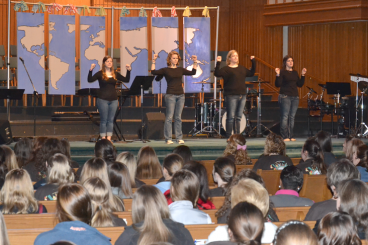
Teen girls learn about missions at Complete
The sent life is not the safe life. That was the message driven home to nearly 500 teen girls and
Share with others: