
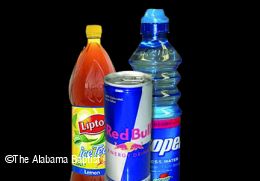
According to a New York Times article from May, roughly one-third of 12- to 24-year-olds now consume energy drinks like Red Bull, Rockstar and Full Throttle on a regular basis, creating a growing concern among nutritionists.
But what makes the drinks most harmful is the “hyperjolt and crash cycle,” said Donna Funderburke-McKinley, education and resource director for Safe Harbor, a Birmingham-based organization that helps inform and educate parents about issues facing teens.
“One drink is probably OK,” she said. “But the crash is the problem. When you crash after reaching the energy high, you are completely exhausted. So you end up drinking another one to get more energy again. It’s a cycle.”
Funderburke-McKinley said many parents, schoolteachers and youth ministers are either unaware of or simply choose to ignore the danger.
But news of problems associated with energy drink consumption has forced some parents and teachers to take a hard look at the issue. This past April, one student was hospitalized and several others became ill after consuming too many energy drinks during the high school prom for Tuscaloosa’s American Christian Academy (ACA).
In 2007, consuming a high-caffeine energy drink sent several high school students in Colorado to the hospital, and earlier this year, as many as six middle school students in Florida were hospitalized for the same reason. In the various cases, students cited light-headedness, sweating and rapid heart palpitations. As a result, several schools, including ACA, have considered banning the drinks from their campuses.
“I just don’t think parents want to be aware,” Funderburke-McKinley said. “We have become inundated with these types of things, and we think because we drink a cup of coffee each morning that these drinks are harmless to children. But their bodies can react so differently.”
Even college students and older adult groups can experience problems with energy drinks as they commonly mix them with alcohol, creating a potentially harmful combination for the body.
“It is scary to think that these energy drinks are being used as a mixer with vodka and whiskey,” David Pearson, director of the strength research laboratory at Ball State University in Muncie, Ind., told online magazine ScienceDaily. “You are just overloading the body with heavy stimulants and heavy depressants.”
People who mix alcohol with energy drinks do not feel the effects of the alcohol as readily because of the stimulant from the caffeine in the energy drink. According to research by Wake Forest University School of Medicine in Winston-Salem, N.C., this explains why college students who mix alcohol with energy drinks are at a higher risk of alcohol-related injuries than those who drink regular cocktails.
Despite the health warnings, the energy drink industry has continued to expand, with per capita consumption in the United States expected to grow from three to eight ounces by 2011, according to food and drink industries consultant Zenith International. And researchers have been left wondering why the drinks remain so appealing to young people, especially considering that the average energy drink costs between $2 and $4.
One theory from the Journal of American College Health posits that there is a relationship between energy drink consumption and “toxic jock identity.”
According to the research, “Sport-related identity, masculinity and risk taking are components of the emerging portrait of a toxic jock identity … . College undergraduates’ frequent consumption of Red Bull and comparable energy drinks should be recognized as a potential predictor of toxic jock identity.”
Because of their relationship with risk taking and hypermasculinity, many energy drinks have evolved into a type of “legal alternative” for drugs, said Funderburke-McKinley.
One energy drink holds little reservation about such a description. It’s called Cocaine Energy Drink. It contains 280 milligrams of caffeine in an 8.4-ounce serving, compared to a 12-ounce can of Coke, which contains only 34 milligrams of caffeine. On top of the caffeine, Cocaine Energy also boasts a special throat-numbing ingredient, designed to give a sensation similar to that of cocaine.
Strong said the bottom line is “parents just need to tell their kids to stay away from these drinks. Just stay away.”
Would you let your child drink four cans of Coke in one sitting? Not likely. But what many parents don’t realize is that energy drinks, which are quickly becoming a favorite beverage among teenagers, often have the same amount of caffeine and sugar in only one can.




Share with others: