
Many Americans know that the phrase “under God” was added to “The Pledge of Allegiance” in the 1950s. But do you know who wrote the Pledge, when and — perhaps more important — why?
Richard J. Ellis didn’t. So the politics professor at Willamette University in Salem, Ore., decided to research it, and the result is “To the Flag: The Unlikely History of the Pledge of Allegiance,” published in April 2005. Here are some of the surprising things he learned:
“The Pledge of Allegiance” is 113 years old. It was written in 1892, to celebrate Columbus’ discovery of America and the country’s public school system. It was written by Francis Bellamy. He and James B. Upham worked for Youth’s Companion, a Boston-based nationally circulated magazine. Their descendants have argued about who wrote the Pledge, but Ellis believes the evidence clearly shows it was Bellamy, a former Baptist minister with an interest in Christian socialism. Upham came up with the original Pledge salute.
The original salute began with a military gesture, the right hand, palm down, raised to the right eyebrow. Then, at the words, “to my flag,” the right hand was raised skyward, with the palm up. Over time, people didn’t turn their palms up and, by the 1940s, the gesture looked a lot like a Nazi salute. Congress changed it in 1942.
The Pledge was tied to a movement to fly the American flag over every public school. Before 1892, flags were scarce on school grounds. The Grand Army of the Republic, a group of Northern Civil War veterans, launched a public school flag drive.
Other motivations for the Pledge included anxiety about creeping materialism that critics saw threatening patriotic ideals, and a desire to stress the nation’s unity, promoted by Northern veterans of the Civil War, which had ended just 27 years before the Pledge was written.
Anxiety about immigration also prompted the Pledge. The United States had long been a melting pot, but the 1880s saw a surge in immigrants, especially from countries in southern and eastern Europe.
The Pledge has been edited several times. National Flag Conferences, attended by veterans and patriotic groups in the 1920s, changed the phrase “my flag” to “the flag of the United States” and, a year later, inserted the phrase “of America,” because they worried that immigrant children were pledging allegiance to the flags of their homelands, either “out of ignorance or deviously,” Ellis said. Bellamy didn’t like the changes, arguing that they destroyed the cadence of the original version.
Bellamy died in 1931 and didn’t live to see Congress add “under God” to the Pledge in 1954 as an antidote to godless communism. His son, Ellis said, argued against editing what had become an “American classic.” (RNS)
_____________________________________
House panel kills Pledge bill
A House panel has unexpectedly killed a bill designed to remove the jurisdiction of the federal courts over cases involving the Pledge of Allegiance.
The House Judiciary Committee deadlocked 15–15 on the so-called “Pledge Protection Act” June 28. A tie means the bill does not move forward.
A similar bill passed the House in 2004, and was expected to pass the body again in this election cycle. The Senate did not consider the 2004 bill and is not expected to consider the latest version.
The 9th U.S. Circuit Court of Appeals originally ordered the words removed from the pledge in 2002 and said their recitation in public schools violates the First Amendment’s guarantees for religious freedom. After a public backlash, the appeals later backtracked on the removal of the words, but maintained their ruling that public-school teachers should not lead students in reciting the oath.
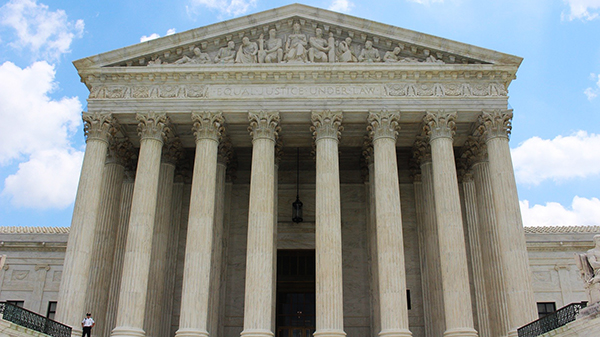
The Supreme Court overturned that decision.
But some have said the pledge is still at risk from lawsuits like the one that inspired the 9th Circuit decision. The bill relies on a hotly debated section of the Constitution that supporters say allows Congress to remove federal courts’ jurisdiction over any matter it chooses.
Many legal experts have debated that conclusion, saying removing the federal courts’ power to adjudicate civil-rights cases would violate the Constitution’s equal-protection and due-process provisions.
The bill is H.R. 2389. (ABP)

Share with others: