
Absurd.”
That one word is how Southern Baptist missionary Paul Biswas sums up Hinduism, the religion in which he was born and indoctrinated as a boy growing up in a conservative, higher-caste, ultrareligious family in his native Bangladesh. While still in elementary school, he learned the religion at his grandfather’s knee.
“It is only by the grace of God I was able to overcome all the hardships and persecutions of my life,” said Biswas, now 56, the oldest son in his family. Among Hindus, being the oldest son brings extra respect and responsibilities. Rejecting Hinduism as the oldest son brings absolute family rejection, legal disownment and persecution.
Biswas — 21 years old at the time — could no longer believe in a religion based on reincarnation, 300 million gods and goddesses, predestination and “karma.”
“From the Bible, I came to know that salvation is by grace through faith in Jesus Christ alone,” Biswas said. “It is by faith only. I don’t need to do karma. I don’t need to show my good works and prove them.”
Disowned by his father and kicked out of the house, Biswas would endure years of persecution, humiliation, hardship and even physical torture because of his Christian faith.
“Before I left my father’s home, I told my father he could disown me but that my Eternal Father would not disown me.” He and his father have since reconciled, but even today, his parents won’t hug him because he’s considered an outcast.
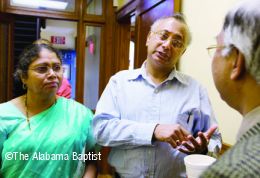
Today Biswas ministers to Hindus and Muslims as a church-planting missionary and founding pastor of Boston Bangla Church. Biswas is jointly supported by the North American Mission Board (NAMB), the New England Baptist Convention and the Greater Boston Baptist Association.
According to Biswas, about 1 million Bengalis live in the United States, but there are only four Southern Baptist Bengali churches nationwide to serve them. Some 20,000 Bengalis live in New England, where there’s only one Bengali Baptist church. About 7,000 Bengalis live in Greater Boston — 4,000 in the Cambridge area. He said 88 percent of Bengalis from Bangladesh are Muslim; the other 11 percent are Hindus and Buddhists. Christians are only 1 percent.
“The biggest challenge for my ministry here is to mobilize the local churches,” Biswas said. “We have more than 150 people groups here in the Boston area, and the American churches are getting a new experience. They don’t know how to reach out to the vast number of Muslims and Hindus.”
Language is not a problem for Biswas, who understands Hindi and Urdu and speaks Bengali and English fluently.
He prefers to preach Christ and not Christianity because the word “Christianity” is a politicized word with a strongly negative connotation for Muslims, who associate it with the Crusades and the Western world.
A key problem with witnessing to Bengalis in Boston is merely finding a time to coincide with their busy work schedules.
“It’s hard to reach the Bengali immigrants because they work so hard — seven days a week. We have one group that meets at midnight because that’s when the people come home from work. At midnight or 1 a.m. they have their Bible study meeting, eat together, go home by 3 a.m., sleep a few hours and then get up and go to work again,” he said.
Biswas’ two biggest partners in sharing the gospel are his wife, Elizabeth, and Abu Mansur, a converted Muslim he first knew back in Bangladesh. Biswas said he is partnering with three local churches but needs the prayer and financial support of four more churches in 2009.
For more information on this year’s Week of Prayer missionaries and the ministries of NAMB, visit www.
anniearmstrong.com. (NAMB)

Share with others: