
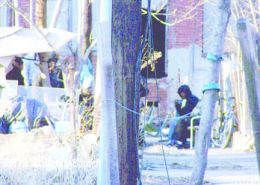
It’s an economic reality. The poor are becoming poorer. Amid the economic downturn, people with little education are losing entry-level service jobs to high school and college graduates. With dwindling opportunities to work, the poverty-stricken often wind up roaming the streets in a survival mode that often includes drugs, crime and despair.
Bill Simpson’s office, nestled in a row house in what he calls the “poorest neighborhood in Maryland” — Baltimore’s McElderry Park — is surrounded by distress.
Within one-third mile of Simpson’s office, 846 households scrape by on less than $15,000 a year — 30 percent below the U.S. poverty level for a family of four. Reach out to two-thirds of a mile and the number triples to 2,559 households.
“In any given month, about 60 percent are unemployed. Our high school dropout rate is over 65 percent, and our teen pregnancy rate exceeds 80 percent,” said Simpson, executive director of Open Door Community Development Corporation, a nonprofit organization dedicated to revitalizing families and neighborhoods on Baltimore’s lower east side. “Business as usual won’t get it done here.”
For Simpson, who moved his office into the neighborhood this past summer, it is worth the hourlong commute to simply “show up” and seek to make a difference in the hurting community. The Baptist Convention of Maryland/Delaware helped the ministry get started.
Simpson said he feels McElderry Park is “quarantined” from the rest of the city because of its overwhelming needs. But he also knows through Christ, much can be accomplished there.
“Emphasizing the redemptive principles of renewal, restoration and reconciliation, we believe it’s wrong for 140,000 Baltimoreans to live in poverty in the nation’s most affluent state,” Simpson said. “We are strong advocates for addressing the generational poverty that devalues life, immobilizes families and communities and feeds a cycle of failure and futility.”
Open Door’s mission, he explained, is threefold: “To be a source of hope and encouragement for people who need a new start; to be a community hub that links folks to positive and constructive activities; and to be a safe haven where God’s heart for hurting people and struggling families is made real every day.”
Open Door’s initiatives include adult learning, workforce development, life skills training, computer literacy and family services, information and referral.
“We also place a strong emphasis on emergency compassion outreach and strategic community organizing,” Simpson added.
“In the final analysis, we’re convinced that if you help parents and adults with their education, employment, housing and other ‘felt need’ issues, you really are helping the whole family and the larger community.”
Simpson saw that happen when Open Door helped a 45-year-old man find a full-time job for the first time in his life.
“We helped him develop a resumé, strengthened his soft skills (appearance habits, ability to fill out forms, communication and motivation skills) and practiced interviewing with him,” Simpson said. “It felt really good to know that we helped him get meaningful employment.”
In spite of the great challenges they face, the people Open Door serves are remarkably proud, resilient, determined and optimistic, Simpson said.
“Most believe life can be better for their families. Nearly all just need a helping hand from someone who cares,” he noted.
Because the need in the community is so great, Simpson describes Open Door’s ministry as a “long-term proposition.”
“Our goal is to not only provide short-term emergency relief but to also form relationships that can help lead to larger life solutions for those in need,” he said.
It is necessary to build trust in the community, and it takes time for Open Door to be a place people turn to if they need food for the day or simply somebody to talk with, Simpson said.
“We may not be fully resourced, but they can see us work to help them,” he said. (BP)


Share with others: