
Equal faithfulness and equal sacrifice are common themes for Baptists, especially when a church undertakes a building program or is encouraging financial stewardship. These are themes commonly heard in state and national conventions as well. Much Cooperative Program (CP) promotion is based on the idea of equal faithfulness and equal sacrifice by all partners. Now some are questioning whether those principles apply to the Southern Baptist Convention’s (SBC) Great Commission Resurgence (GCR) Task Force.
The CP giving percentages of the churches of task force members have been widely disseminated. It was surprising to learn that 14 of the 23 members come from churches that give less than the SBC average to missions through the CP — 6 percent. Only six members come from churches that equal or exceed the SBC CP average. Information from the churches of three members is not available.
As a point of clarification, the 14 members mentioned above come from 11 churches. Three churches have two members on the task force.
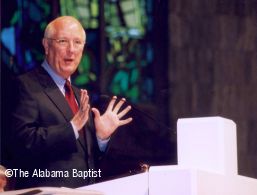
Johnny Hunt, SBC president and head of the GCR Task Force, has attempted to dismiss concern about the CP giving percentages. He said it is more important to examine the “heart” of the church.
Attempting to respond to Hunt’s concern, The Alabama Baptist compared the total missions expenditures of members’ churches to the total income of the churches. This allowed churches credit for their special offerings as well as funds spent on direct missions projects.
Interestingly the six churches at or above 6 percent CP gifts averaged using 17 percent of their total receipts in missions. This ranged from a high of 24 percent to a low of 11 percent. The 11 churches below 6 percent averaged 13 percent in total missions expenditures. The high was 24 percent and the low 4 percent.
Both groups seem to be about equally involved in missions causes with the difference in percentages largely reflecting the differences in CP giving.
Hunt also has been defensive of his church’s CP record. First he argued that those outside a local church have no right to criticize the giving decisions of that church. At the most recent GCR Task Force meeting, he said the direction of CP giving should be considered. On both points, he is correct.
A church is responsible only to God and its members for the decisions it makes. It is also true that those charged with determining “how Southern Baptists can work more faithfully and effectively together in serving Christ through the Great Commission” can be expected to demonstrate a thoroughgoing commitment to Southern Baptists. That is not a church issue. That is an SBC issue, and SBC participants can rightly be concerned about those recommending the convention’s future direction. It is a question of equal faithfulness.
It does take time to move from where one is to where one wants to be. The church Hunt serves as pastor has climbed from 2.2 percent in CP giving in 2007 to 2.5 percent in 2008, according to the Annual Church Profiles. We rejoice that he is leading his church upward as we are sure the 2009 figures will demonstrate.
Many task force members are great leaders as their churches demonstrate. Their annual undesignated receipts top CP funds channeled through many state conventions. One church reported $14 million in undesignated receipts in 2008, another $15 million, a third $17 million and still another $22 million. One topped out at almost $28 million in undesignated receipts.
By comparison, according to SBC figures, the Missouri Baptist Convention received $15.6 million in 2008. Arkansas’ convention received $20.7 million and Louisiana’s $22.1 million.
Some of the churches represented on the task force receive more funds and have more staff members than many state conventions, including Alabama’s. That is one reason people listen when they speak. After all, Baptists pay bills with dollars, not percentages, and 2 percent or 3 percent of $15 million to $20 million is a lot of money — more than the average Baptist church gives through the CP to be sure. Despite their low percentages, some of these churches are near the top of the list for total CP contributions in their respective states. It is no wonder Hunt said during the most recent task force meeting that churches should be judged on the dollars they give and not on percentages.
Still, if the 11 churches giving below the SBC CP average had given 6 percent in 2008, then it would have meant another $4.4 million for missions causes in addition to the $2.9 million that they did give.
It is especially disappointing that six of the seven task force members who are employed by the denomination in some way — associational, state convention or SBC level — are members of churches giving less to the CP than the SBC average. These are people whose ministries depend on missions giving through the CP. One would think they would be leaders instead of laggards where CP giving is concerned.
The task force will receive a lot of recommendations. Because the members are men and women of vision, they will initiate a lot of new ideas themselves. Judging from Hunt’s comments, one idea already seems to be jelled.
According to the Florida Baptist Witness, Hunt has issued a “warning” to state conventions to give a greater percentage of their receipts to national causes. He said, “If states are not willing to release greater percentages and greater dollars to the nations, they are going to find people like Johnny Hunt designating their dollars where they want it themselves instead of sending it to them when they’re not listening to us.”
Giving a greater percentage of CP missions funds to the SBC has been a part of the GCR from its birth. What is overlooked is that state conventions are already doing that. SBC statistics show that 27 of the cooperating state conventions gave a higher percentage of CP receipts to the SBC in 2007 than they did a decade ago. The average percentage for all state conventions also was higher.
It should be remembered that state convention employees do not determine percentage divisions between state and national missions causes. That is done first by state boards of missions that recommend percentage divisions. Final decisions are made by messengers attending annual meetings of their state convention. With such polity, it is hard to understand the charge that “they” are not listening.
Equal faithfulness in Baptist work is a worthy cause. It is hard to see how a threat about going a separate way unless one’s desires are met contributes to equal faithfulness. Pray for the GCR Task Force. Pray for each of its members. They are all good and godly people. Pray for Alabama Baptists, for Southern Baptists, for the lost of the world. And pray all of us will agree to join in equal faithfulness and equal sacrifice in carrying out the Great Commission at home and around the world.
Share with others: