
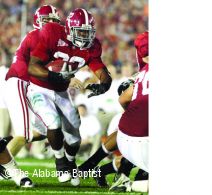
When Colt McCoy of the University of Texas expressed his faith in an interview following the Longhorns’ BCS championship game loss to the University of Alabama on Jan. 7, the quarterback placed himself in a growing cadre of Christian athletes becoming increasingly vocal about their commitment to Jesus Christ.
“I always give God the glory,” said McCoy, who was knocked out of the game — the last of his college career — by a shoulder injury. “I never question why things happen the way they do. God is in control of my life. And I know that if nothing else, I’m standing on the Rock.”
Like McCoy, sophomore Alabama running back Mark Ingram recently vocalized his faith in God. With tears running from his eyes, Ingram praised God for his achievements during his December 2009 acceptance speech for the Heisman Trophy.
“First and foremost I’d like to thank God,” Ingram said. “I am so blessed, and without Him I wouldn’t have been able to accomplish this.”
Highly publicized expressions of faith have become standard fare in college and professional sports at least since 1977, the year running back Herb Lusk dropped to one knee after scoring a touchdown for his Philadelphia Eagles. The end-zone prayer often is cited as the first to be televised across the nation.
Many Christians find those high-profile testimonies encouraging, prominently featuring evangelical sports figures in worship services and evangelistic conferences. The trend prompted writer Tom Krattenmaker to call big-time sports “one of the most outwardly religious sectors of American culture.”
In part, the prominence given Christian athletes can be attributed to American Christianity’s addiction to celebrity culture. But some observers believe sports figures offer a more distinctive appeal than mere fame.
Christian athletes appear more demonstrative and outspoken in testifying about their faith than celebrities in entertainment or business in large part because they understand what it means to be on a team and share credit, said Grant Teaff, executive director of the American Football Coaches Association.
“The simple answer is that as committed Christians, they know from where their strength comes and recognize the source of their talents and gifts,” he said. “As team players, they know they didn’t get this far alone, and they want to give credit.”
That same attitude extends to athletes who compete in individual events, he added.
“They understand they have been trained and developed, and they have been blessed with somebody who helped shape that raw talent,” Teaff said. “Unless the person is unusually self-centered, athletes know they don’t win alone. And Christians, especially, should have that tendency not to be self-centered but to want to share credit.”
That not only means thanking coaches, trainers and teammates, but also giving glory to God, he explained. But most Christian athletes understand the distinction between praising God for allowing them to perform to the best of their ability and believing God plays favorites in athletic competitions and determines their outcome, Teaff insisted. “God loves the players and coaches on the other side. God loves the officials. He loves — period,” he said.
Some sporting fans find such public expressions of faith discomforting. In his book, “Onward Christian Athletes,” published last year, Krattenmaker warned that vocal expressions of faith in stadiums risks alienating an increasingly pluralistic society.
“There are many secular fans who really feel annoyed by that kind of religious expression,” Krattenmaker, a Portland, Ore., specialist on religion in public life, told The Associated Press. “Even people who are religious themselves often resent this situation where athletes talk about God in this big moment of victory, sometimes seeming to imply God gave them the victory.”
But others, like University of Florida quarterback Tim Tebow, who famously puts Scripture references in his game-day eye black, say it’s simply a part of who they are. And focusing on one’s faith keeps athletes’ priorities in order, Tebow says.
Tebow, who grew up the son of missionaries in the Philippines and has seen desperate poverty at close quarters, told The Washington Post he couldn’t imagine getting stressed out over something as inconsequential as a BCS National Championship Game.
“Pressure is not having to win a football game; pressure is having to find your next meal,” he told the Post last year before the Gators’ win over the University of Oklahoma.
Nevertheless outspoken Christian athletes like Tebow — whom Sports Illustrated writer Austin Murphy called “the most effective ambassador-warrior for his faith I’ve come across in 25 years” at the magazine — continue to feature prominently in evangelistic outreach.
For more than a year, billboards across the Dallas-Fort Worth area and spots on local broadcast media have presented sports and other celebrities — and a few regular folks with a story to tell — proclaiming the message, “I am Second,” and directing people to the iamsecond.com Web site. Recently a commercial featuring Texas’ McCoy launched nationally prior to the BCS National Championship.
Athletic figures such as Jason Witten of the Dallas Cowboys and former NFL coaches Joe Gibbs and Tony Dungy figure prominently in the campaign, which also features Jason Castro of American Idol, Michelle Aguilar of TV’s “The Biggest Loser” and other celebrities.
A Texas-based church-planting ministry, e3 Partners, developed the media campaign, and Norm Miller, chief executive of Dallas-based Interstate Batteries, provided key support.
On its best day soon after the campaign was launched in December 2008, about 15,000 people visited the ministry’s Web site — many to view the testimony of Brian Welch, formerly of the heavy metal rock band Korn, said Nathan Sheets, vice president of e3 Partners and team leader for the “I am Second” campaign.
But when the campaign featured quarterbacks McCoy and Sam Bradford of the Oklahoma Sooners prior to the two teams’ big rivalry football game in Dallas, their videos attracted 33,000 visitors in one day to the Web site and prompted “a tremendous amount of forwarding,” said Sheets, a member of Prestonwood Baptist Church in suburban Dallas.
Athletes draw attention, and they often are more open about sharing their faith than some other public figures, he noted.
“Athletes in general are not reliant on continuing relational development for their success,” Sheets said. Actors or recording stars might put future contracts in jeopardy by being outspoken about their faith, but athletes tend to be judged almost exclusively by performance in competition, he explained.
Of course, any public figure invites scrutiny. And sometimes athletes who have cultivated a straight-and-narrow image may find themselves losing lucrative endorsements if personal frailties come to light, as golfer Tiger Woods discovered when his marital infidelity became known.
Athletes at every level — and to some degree, any celebrity who makes his or her faith public — find themselves subject to close scrutiny, Teaff observed. “There’s a segment of society that has negative feelings about people who achieve success. They love to see them tumble and to fall short of what they proclaim themselves to be,” he said.
Teaff, who coached football at Baylor University from 1972 to 1992 and led the Bears to a Southwest Conference championship, noted he always spent three days with freshmen athletes at the beginning of each year to provide them a solid foundation to help them deal with the temptations they would face. As the coach at a Christian university with a strong Baptist heritage, Teaff noted he required participation in team devotionals prior to each game.
“We talked about the importance of reading the Bible, about their prayer life and about attending church,” he recalled. (ABP, TAB)



Share with others: