
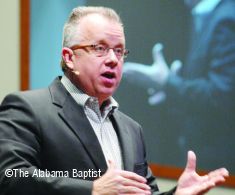
Alabama Baptist preachers dominated the main preaching portion of the State Evangelism Conference, held Feb. 22–23 at Vaughn Forest Baptist Church, Montgomery.
Monday afternoon and all day Tuesday, nine men from churches and ministries around the state brought messages of encouragement to burned-out pastors and challenges to share the gospel more passionately and frequently.
• Opening to the story of the prodigal son in Luke 15, Ed Litton, senior pastor of First Baptist Church, North Mobile, in Saraland, explained, “It’s a three-character play. … And you and I are in it.”
Litton called the first character introduced “the far son.”
“The far son wanted freedom, not just from the world he saw himself in but freedom from responsibility,” he said. “He’s the far son because his heart is at a distant place.”
The son moved away, participated in frivolous living and found himself “in need,” Scripture says. Desperate for food and help, he decided to return home and beg his father for forgiveness and to be hired as one of his servants.
But grace is something freely given by the prodigal father, the second character.
Pointing out that “prodigal” does not speak of reckless living or a sinful lifestyle but rather “freely spending resources recklessly,” Litton said, “The real prodigal is the father who pours out grace — grace upon grace. … When we have sinned and strayed from [God], He pours out His love. He beckons us to come home. He is the prodigal God.”
The third character is the near son, Litton said, referring to the son who was home tending to his father’s flock.
“He was in the right place — near the father — doing the right things. He was the near son, but he wasn’t even close to the father’s heart,” he said, adding that drawing near to the Father’s heart is pertinent to true revival.
But no matter whether preaching to the near son or the far son, “we preach the grace of God to both.”
• It’s that same grace that Christ gave to the woman at the well in John 4, preached Evangelist Mike Satterfield of Field of Grace Ministries in Alabaster.
Noting the well, the woman and the water, Satterfield said Christians must come as the thirsty woman to the well for refreshment. But God wants to give the water — “the God life,” Satterfield said.
“In the text, there is water that represents the purpose of His coming. He comes to bring us ‘God life,’” he said. “If it’s been awhile since you’ve experienced the doorpost shake, since you’ve seen God high and lifted up … you need to cry, ‘Give it to me,’” Satterfield preached, as respondents echoed his “give it to me” cry.
Satterfield said no matter what one may be going through, Christ is the one who rewards those who diligently seek His face. He offers the well and “you drink from it,” he said.
• Seeking after Him diligently requires endurance, said Jimmy Jackson, president of the Alabama Baptist State Convention and senior pastor of Whitesburg Baptist Church, Huntsville. And it requires surrounding oneself with the right kind of “helpers.”
Opening to the story of the paralyzed man in Mark 2, Jackson told listeners about the helpless man (whom he named John): those who do not know Christ, the helpers: those who carried the man to Jesus, the hinderers: those who stood in the way of the man being carried to Jesus and the great Healer.
Jackson challenged attendees to consider whether they are helpers or hinderers when it comes to carrying others to Jesus.
“Here’s the bottom line: Their job was to get John to Jesus. That’s it. They had to get John to Jesus. If they don’t get John to Jesus, nothing else makes any difference in John’s life. You can’t disciple the dead. … The job of the church is to constantly go back to its moorings and say our job is to find ‘John’ and bring him to Jesus, and ‘John’ is usually not in the church.”
• “Do we agonize over our friends? Do we weep over them? When we get broken before God, we will become bold before men. … But we can’t do it with burned-out pastors and worn-out staff,” said Mark McClelland, senior pastor of Willowbrook Baptist Church, Huntsville.
McClelland turned to Numbers 11, explaining that just as Moses was in a place of discouragement with lack of encouragement from his people, pastors, too, may be prone to discouragement.
But they can avoid burnout by getting alone with God and pouring out their heart — not to mention rest, he said. “Sometimes the most spiritual thing you can do is rest … because you’re not superpastor. Maybe some pastors are burned out because they’re worn out.”
• Doug Ripley, senior pastor of Decatur Baptist Church, said if you love ministry because you love the people you’re serving, then it’s just a matter of time before that burns out.
“It’s the wrong motivation,” Ripley said. “I’ve got to do what I do (for people) because I’m in love with the One who loves them. Sometimes I have to get a renewal of my love for God. Not my love for people — my love for God. And that’s the motivation.”
• That motivation should drive believers to share Christ with people who don’t have hope, said Wade Wallace, pastor of Calvary Baptist Church, Russellville.
“Do you have burnout? It’s time we as preachers of the gospel of Jesus realize that they don’t need to hear the newspaper; they need to hear Jesus,” he said. “We must realize that there are people who don’t have hope in our communities, and we must take Jesus to them.”
Our state is growing faster than we’re winning people to Jesus — that alone should be motivation to share, he said.“ Church, tonight hope is all people need. Hope is what we have. We must go where they are.”
• Bruce Word, senior pastor of CrossPoint Community Church, Gadsden, also called on Baptists to share and shine. “What are you going to do when you leave this Evangelism Conference, after you hear what you’ve heard today?” he asked. “If this doesn’t change us, then we have done nothing more than taken a break from our work or church. It hasn’t done anything for us or changed the world.”
• Keith Thomas, pastor of Cottage Hill Baptist Church, Mobile, wholeheartedly believes that exalting and trusting God when things are tough is a way to proclaim His glory. He found this out firsthand when he discovered he had pancreatic cancer in 2007.
Beginning with the theme of suffering in 1 Peter, Thomas landed in 2 Peter 2:4 with “the living hope.” His prayer became, “Help me suffer well for Your glory.”
“We live in a world with no hope, but we have the living hope and we must declare it. We must display it,” he said. “And the world around us will watch us sing and shine ‘on Christ the solid rock I stand, all other ground is sinking sand.’”
• Tim Anderson, pastor of Clements Baptist Church, Athens, focused on living by faith as he preached from Habakkuk 3.
Habakkuk didn’t understand what God was doing, but he resolved that God knew more than he did. Habakkuk determined that no matter what, he would exalt God and trust Him.
“We have to choose to believe God,” Anderson said. “It all comes down to the character of God and who we believe and what we believe God is. God is still sovereign, still in control. … God’s all we need.”


Share with others: