
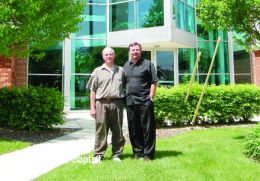
Everyone here is worried about the future of their ministries, their jobs, their living,” said Ted Stephens, cooperative missions ministries team leader for the Baptist State Convention of Michigan (BSCM). “It is a major concern, and there are so many unknowns.”
Stephens was referring to the potential impact of the report of the Great Commission Resurgence (GCR) Task Force of the Southern Baptist Convention (SBC), which recommended the North American Mission Board (NAMB) phase out its support of state conventions, including conventions in new work areas. For the full report from the GCR Task Force and related stories, visit www.thealabamabaptist.org/promo.php.
The task force report says nurturing state conventions in new work areas will become the responsibility of mature state conventions. Funds freed up by phasing out work with state conventions will be redirected to direct church-planting efforts in the nation’s major cities and underserved areas, the report says.
Since Alabama Baptists have a ministry partnership with Southern Baptists in Michigan, convention leaders in the Wolverine State were asked what kind of support would be needed if the task force report is adopted by messengers to the SBC annual meeting in June and the nature of ministry partnerships changes.
“First of all, it (the task force recommendation) would devastate our convention,” said Michael Collins, BSCM director. He explained the convention anticipates $1,534,223 coming from cooperating churches for the 2010 budget. NAMB anticipates investing $1,447,732 in Baptist work in Michigan. Additional funds come from LifeWay Christian Resources, GuideStone Financial Resources and other areas.
This amount does not include benefits for each appointed missionary, which are slightly more than $13,000 per couple annually, according to NAMB.
“Our cooperative agreement specifies we will put up 15 percent of each approved item and NAMB will put up 85 percent,” Collins continued. A cooperative agreement is the tool used by NAMB to determine ministries and missionaries state conventions and the national organization will jointly fund.
Collins said even though Michigan is a new work state, the convention forwards 30.5 percent of Cooperative Program (CP) funds to SBC missions causes. The remainder, together with funds from the state missions offering, is used to help meet the state’s 15 percent responsibilities as well as fund those things in which NAMB does not participate. The state convention would immediately lose its evangelism director and all four of its full-time missions staff, Collins said. That includes the leader of work with blacks, the leader of language ministries and the leader of missions ministries, which include church and community ministries, chaplaincy, student work and more.
Stephens, who oversees work with Anglos as well as the state’s 12 directors of missions (DOM) and whose position also would be eliminated, said an irony of the proposal is that his position as well as the three other missions staff positions to be eliminated are about church planting.
“If NAMB is going to redirect its money and do church planting directly, does that mean they are going to work outside of a state partnership or outside the local association?” he asked. “That would be a new kind of cooperation as I understand the term.”
Also impacted by the task force recommendation would be all the DOM positions, which receive 85 percent NAMB funding through the cooperative agreement.
“One or two of our associations might be able to pick up the support of the DOM,” Stephens observed. “But there is no way the others could do that. They are just too small.”
He added that even the one or two that might be able to support a DOM on their own would likely do so by redirecting funds away from CP missions giving.
NAMB also funds three part-time consultant positions in Michigan — one for senior adult evangelism, one for youth evangelism and a bivocational ministry.
Each of these would be eliminated, Collins said. Twenty-one current church starts now supported through the cooperative agreement at the 85–15 ratio would also be impacted.
“We have a five-year plan through which annual support is reduced until each church start is self-supporting,” Stephens explained. If NAMB money were withdrawn, then he said there would be “no way Michigan Baptists can pick up that much money.”
Stephens asked if the task force recommendation was going to result in state conventions, associations and individual ministries competing for support across the nation.
“How we do things as Southern Baptists has been a real part of who we are,” he said. “The GCR report seems to be changing that.
“I believe in autonomy but I believe Baptists should work together,” he added. Collins noted that in addition to eliminating personnel, the proposal would impact the state evangelism conference and all other evangelism and missions ministry activities that now receive financial support through NAMB.
“If we in Michigan were to ask Alabama as a mature Baptist convention to fund us to the tune of $1.5 million annually, that would really change the nature of partnership missions, and I am not sure it would change it for the better,” he said.
Adding to the concern about mature conventions nurturing new work areas is the number of areas needing help. While no clear definition of mature conventions has been set forth, a map used by the task force in making its presentation showed the area of traditional SBC presence stretching from Virginia across Kentucky to Oklahoma and south. This area includes 16 state conventions, including two each in Texas and Virginia.
There are 27 state or regional conventions (including the Canadian National Baptist Convention), all of which now work through NAMB with cooperative agreements.

Share with others: