
At the Alumot Dam on the edge of Kibbutz Deganya, a community located a couple of miles south of the Sea of Galilee, you can smell the Jordan River long before you see it.
Once there, two Jordan rivers come into view.
North of the dam, the water is calm and clean enough for swimming, and every year, tens of thousands of Christian pilgrims flock to Yardenit, the picturesque baptism site on the Israeli side of the Jordan, the river in which Jesus was baptized.
South of the dam, the river is tainted with untreated and partially treated sewage, saline water and fish pond effluents that tumble from large drainage pipes built into the riverbed. The stench is choking.
This pollution, coupled with the diversion of much of the river’s clean water by Israel, Syria and Jordan, is endangering the river — the backdrop of so many biblical narratives — to the point of extinction.
“In the summer, the Lower Jordan River (the river below the Galilee) is dry in certain places, and this is a totally man-made problem,” said Gidon Bromberg, an Israeli environmentalist, as he watched toxic water drain into the river, which meanders another 200 kilometers (124 miles) from this junction.
“The Lower River is an open sewage canal, and the sad irony is that the sewage water is keeping the river flowing. Being baptized in the water below the dam — something that takes place on the Jordanian side of the river — cannot be too spiritually uplifting,” said Bromberg, who heads the Israeli branch of Friends of the Earth Middle East.
The Old and New Testaments present the lush Jordan River Valley, which stood in stark contrast to the parched desert beyond, as the Gates to the Garden of Eden. The Book of Genesis says that Lot decided to settle in the valley because he found it “well watered everywhere like the garden of the Lord.”
Moses dreamed of crossing the river into the promised land but died in Jordan, atop Mount Nebo. The Bible says John the Baptist found refuge by the river, where he baptized countless followers, including Jesus. It’s the place where the Gospel writers say the Spirit of God “descended like a dove” on Christ.
The Jordan River’s main water source is precipitation from Mount Hermon, a snow-covered peak shared uneasily by Israel and Syria in the north. Three streams originating in Lebanon, Israel and the contested Golan Heights also feed the river. On its way to the Dead Sea, its final destination, the Jordan swells the Huleh Lake and the Sea of Galilee and waters the Jordan Valley.
The river’s decline began in the 1950s, when Israel started to divert the water for agriculture and other domestic use. Jordan and Syria built a series of dams and canals on the Yarmouk River, the Jordan’s main tributary, further cutting the flow to the river. Another large Jordanian-Syrian dam is slated to open by 2006, making the issue that much more urgent for environmentalists.
Prior to the diversions 50 years ago, the average amount of water that flowed down the Jordan to the Dead Sea each year was 1.3 billion cubic meters, according to environmentalists. Today it’s just 50 million to 100 million cubic meters annually. “In summertime up to half of that flow is untreated sewage from communities in Israel, Jordan and the Palestinian Authority,” Bromberg noted.
The diversions are also endangering the Dead Sea region, where the Bible says Lot’s wife was turned into a pillar of salt and the Dead Sea Scrolls were discovered. The salt-filled sea, its shores abounding with spas that offer medical treatments for skin ailments and other conditions, has lost a third of its surface area during the past half-century. As a result, sinkholes are swallowing up land adjacent to the sea.
Speaking by phone from the Jordanian capital of Amman, Khaled Nasser, director of the Jordan Society for Sustainable Development, said that “regional mismanagement” of the Jordan and its tributaries is exacerbating the Middle East’s chronic water shortage. The Jordan River, he stressed, “is holy to Muslims as well.”
Nasser said that “a lot of water is lost through leakage through the (pipe) networks, and not all parties are taking their share. Israel is taking much more water than international law allows.”
Uri Schor, spokesman for Israel’s Water Commission, said, “Israel is fulfilling its side of our agreements and in fact gives more water to our neighbors than the agreements require.” He called on the Palestinians to treat and recycle their sewage water for agricultural use.
Nasser was also critical of the region’s governments, including his own, for encouraging farmers to grow crops “without enforcing wise agricultural strategies.”
This, he said, “has led to the salination of land in some parts of the Jordan Valley.” Rather than growing fruits, which need a great deal of water, Nasser said, “the land should be used for vegetables suitable to the environment.”
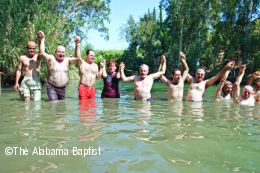
Friends of the Earth Middle East, one of the few successful partnerships between Israelis, Palestinians and Jordanians, has recently stepped up its efforts to bring the Jordan River’s sorry state to world attention. One July publicity stunt saw Jewish and Arab mayors from local municipalities jumping into the river’s clean part, hand in hand.
Religious leaders, who also have a stake in the Jordan, say more needs to be done to get the word out.
“The whole Sea of Galilee and Jordan River are in and of themselves a holy site,” said David Parsons, information officer for the International Christian Embassy, an evangelical ministry that brings thousands of Christians to the Holy Land every year. “If this news gets out, I think a lot of Christians will be very concerned.” (RNS)

Share with others: