
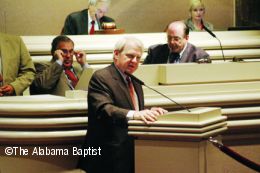
The earth did not stand still April 21 when Rep. Marcel Black, D-Tuscumbia, announced he did not have the 63 House votes needed to pass the latest electronic gambling bill, Senate Bill (SB) 380.
Alabamians did not march in protest as some predicted.
Statehouse phones did not ring off their hooks with calls from disgruntled citizens complaining of civil rights violations.
House Speaker Seth Hammett, D-Andalusia, simply commended Black for his hard work to pass the gambling bill and moved to the next order of business.
With that action, gambling opponents felt a David and Goliath-sized battle had been won in Montgomery. But instead of breathing easy, they are shifting their focus to upcoming elections and Alabama Supreme Court decisions, which they believe could drastically affect the war against slot machine-style “electronic bingo” gambling.
“This is an issue that is not going away,” Black warned his colleagues before pulling SB 380, which was originally sponsored by Sen. Roger Bedford, D-Russellville.
Black said he made the call to pull the bill because he did not want it to prohibit the passage of other good pieces of legislation. House Minority Leader Mike Hubbard, R-Auburn, said he believed Black lacked seven to eight votes, which may have been impacted by an FBI investigation of corruption surrounding the bill.
According to Hubbard, someone changing from a “no” vote to a “yes” vote would be in a very difficult position with the pending investigation.
Eric Johnston, a Birmingham attorney and president of Citizens for a Better Alabama (CBA), commended legislators for refusing to vote for the bill.
“It was a small group of people pitted against a wealthy and powerful group of people,” he said, adding, “They withstood the pressure.”
According to Gov. Bob Riley, the bill’s opposition was bipartisan.
“I believe enough Democrats and Republicans in the House became truly offended by the deceptive tactics of some on the pro-gambling side,” he noted in a press release. “The gambling lobby tried to deceive lawmakers, and that eventually caught up with them.”
Joe Godfrey, executive director of Alabama Citizens Action Program (ALCAP), called the lack of gambling votes a “great victory for the people of Alabama.”
“Gambling bosses wanted to take over the state, and they failed in their attempts to do so,” he said.
“I am also encouraged because churches and pastors and associational directors of missions all came together to take positive action to stop this bill by phone calls, writing letters and sending e-mails. It just shows you what can be accomplished when churches get engaged in the culture.”
Rep. Richard Laird, D-Roanoke, said the lobbying efforts of churches directly increased the number of representatives who would have voted against SB 380.
“There were some that were leaning toward voting for gambling, but over the weekend, they got so many calls and contacts that they came back and said they would vote against it,” Laird said.
With the legislative push for slot machine-style gambling resolved for this session, Johnston believes the gambling industry is in trouble.
“Once all the frivolous lawsuits have settled and all the rulings are final, they (so-called electronic bingo facilities) will be closed down,” he said. “They will only be able to have paper card bingo.”
But this process may take months, Johnston added.
“It is important to understand that the Supreme Court can only deal with cases as they are brought to them from the lower courts,” he said, adding, “This can be frustrating and seem to take a long time but it in the long run, it works best.”
Chief Justice Sue Bell Cobb sat in the gallery during Black’s announcement but would not comment on the “bingo” issue since several gambling cases are pending in the Supreme Court. At press time, she did not know if any oral arguments would be scheduled in the cases but said she thinks more cases should be argued orally.
“It’s a transparency issue,” she said. “I think it brings the people into the courtrooms and helps focus the courts on the most serious issues of the cases.”
Alabamians on both sides of the issue believe upcoming elections will play a large role in the gambling debate during next year’s session.
“I expect the money men of gambling to … come from another angle,” said Tom Anderson, chairman of Concerned Wiregrass Citizens. “They will seek to sponsor candidates of their own desire and makings.”
If voters get engaged in the election process, then ALCAP Director Emeritus Dan Ireland believes they will see a “new climate” in the Statehouse next year.
“The people are tired of do-nothing legislative sessions and letting pending gambling legislation decide the direction of the Legislature,” he said.
But this change requires believers to change their approach, according to Catherine Snow of CBA.
“Instead of trying to play defense, we need to go on the offense and elect candidates who support our convictions,” she said.
Godfrey agreed and said Christians need to look beyond the surface and do a little research.
Pro-gambling forces are “putting up candidates in both party’s primaries,” he noted. “People need to attend public forums or even sponsor public forums. Invite candidates and ask them where they stand on the gambling issue. If they are incumbents, you can research their voting records over the last four years. The church has got to be involved in this representative republic on a national level as well as the state and local levels.”



Share with others: