
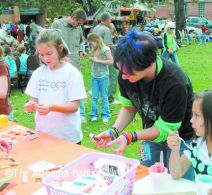
It’s the easiest evangelism in the world,” said Sammy Gilbreath, director of the office of evangelism for the Alabama Baptist State Board of Missions. “It’s not every day that we get folks standing in lines to get into our buildings.”
“It” is a fall festival, and if your church is not among the hundreds of Alabama Baptist churches that already host one each fall to reach their communities with the gospel, then maybe it should be.
According to a North American Mission Board (NAMB) fall festival resource, the attraction of this type of event is that “many families are looking for safe alternatives to Halloween. … Experience shows that at least 50 percent will not be from your church.”
So how does a church do a fall festival?
- Secure the date and location.
In “High Impact Events: People Reaching People,” a NAMB resource book, it is suggested that the pastor secure a date for the festival on the church calendar six to 12 months prior to the event.
Chip Warren, minister of education of First Baptist Church, Albertville, advises planning a year in advance, especially if the church wants to secure inflatables for the event.
Most churches have found success in hosting a festival Oct. 31 since people will already be dressed in costumes and looking for something to do for Halloween. NAMB suggests picking a day that will be most effective in reaching one’s community and eliciting the best response.
As far as location, some churches find it most effective to hold the festival outside so it will be more visible to people passing by and to hold it on the church’s property so people will learn where it is located. But be sure to have a back-up plan in case of bad weather.
But “High Impact Events” suggests holding the event at a “neutral site.” It contends that moving an event away from the church building can sometimes draw a larger unchurched crowd.
- Enlist volunteers.
“It takes hundreds of volunteers to make [a festival] work,” Warren said.
“You need a big church participation. The earlier you start signing up volunteers the better.”
First the ministerial staffer in charge of the event should enlist lay leadership. If there is already a children’s committee or council, then ask someone from that group to help plan the festival.
Second make a list of all the jobs that will require volunteers before (such as advertising, setting up and praying), during (working the registration table, supervising games and distributing food) and after the event (tearing down and following up).
“I find that the adults really want to be involved but they don’t know how to be. … If you give them a job description and tell them this is what it means, then you get great results,” said Tracy Womack, volunteer children’s director of East Pointe Baptist Church, Spanish Fort.
But other age groups can get involved as well. Consider recruiting the help of the youth, college students and senior adults.
Third stay in communication with volunteers so that nothing is overlooked the day of the festival.
“Follow-up with your volunteers is probably the most important thing,” Womack said. “Stay in contact with them, and remind them (of what needs to be done) because people have everyday lives and they’re not getting paid for it. Ask, ‘How can I help you?’”
- Determine the purpose.
The staff person and lay leadership in charge of the festival should determine the purpose of the event. For most churches, the purpose is to share Christ so volunteers need to be ready to share the gospel in a nonthreatening way. A NAMB resource called Using Halloween to Share Jesus suggests that leaders train volunteers to use tracts or share personal testimonies prior to the festival.
Once the purpose is decided, then the leadership can determine how to best accomplish that purpose.
- Set a budget.
“You could do it with almost no budget or with a big budget,” Gilbreath said.
Estimate how many people will attend, and make a list of projected costs. It is best to budget for more people rather than less.
For churches that want to limit their budget, Womack recommended enlisting the help of Sunday School classes. Class members could provide items like candy, cupcakes or drinks.
- Follow up after the event.
“I have a strong belief that we never have an evangelistic event without follow-up,” Gilbreath said. “We build into every event, like a fall festival, a follow-up.”
“High Impact Events” suggests that follow-up visits take place within a week after the event to explain what the church offers.
First Baptist Church, Athens, follows up with attendees two weeks after its annual fall festival. Pictures of the children are taken at a photo booth at the festival, and two weeks after later, someone from the church delivers the pictures to homes and invites the families back to the church.
“It’s great to give out candy that day but even better to go back in two weeks to visit the families,” said David Carter, children’s minister of First, Athens.
Like the festival, follow-up can involve the entire church. Sunday School classes could be assigned certain homes to visit, or a child could accompany an adult team on a visit.
_______________
Resources
- “High Impact Events: People Reaching People”: www.nambstore.com or www.gps2020.net
- “Using Halloween to Share Jesus” and “Evangelistic Halloween Ideas You Can Use”: www.gps2020.net
- “Introduce Jesus at Your Fall Festival” by Keith Manuel: www.lifeway.com
- “Fall Family Fun” by Vicki Hulsey: www.lifeway.com
Other outreach events to host as alternatives to Halloween:
- Trunk or treat — an outreach event that can be held in conjunction with a fall festival or by itself. Have different children’s ministries decorate the trunk of a car of the back of a truck with creative scenes to share the gospel. Give out gospel tracts with the candy.
- Hallow-teen party — an activity for teenagers who feel too old for typical Halloween activities but too young to give up the fun. Skip the booths and cakewalk; go light on the candy. Find what is fun to the teens, and have several youth from the church dress up as Jesus or other biblical characters as a way to share the gospel.
- Scary stuff — a walk-through presentation based on the Halloween “haunted house” idea. Depict life, sin, death and eternity. Usually judgment before Christ or heaven and hell is presented in the last room with a gospel presentation.
- Costume party for grown-ups — an outreach event church members host in their homes for their neighbors. Dress up as Jesus or other biblical characters as a way to share the gospel.
- Reverse trick-or-treating — Go door to door in neighborhoods on Halloween to give candy or a small gift and the gospel message.
(Source: North American Mission Board’s “High Impact Events: People Reaching People”)
Advertising tips:
- Television stations/Christian radio stations (Most will do a free public announcement.)
- Newspapers (Most have a community events section where you can advertise an event for free.)
- Fliers/posters (Some schools will let you put a flier or poster in their building.)
- Community board
- Chamber of commerce
- T-shirts (If your church plans to do a fall festival every Oct. 31, then make shirts with the name of the event and date. By not including the year, you can reuse them each year.)
- Church website
- Church newsletter/bulletin
- Postcard/letter to send to homes in the community
- Phone calls
- Word-of-mouth
To-do checklist:
- Be organized.
- Come up with a theme such as “Harvest Day,” “Harvest Hoedown,” “Holyween” or “Halloween Hallelujah Party.” Then plan decorations, music and games around that theme.
- Keep things fresh and appealing. Add a new element each year or change things up so that the community will keep coming back.
- Ask local businesses to participate, especially Christian-affiliated businesses. At First Baptist Church, Albertville’s fall festival last year, Chick-fil-A had a booth.
- Have some sort of registration. Registration is necessary to make follow-up visits. Some churches place the names of those who register in a drawing for giveaways as an incentive to register. Other churches use registration cards as people’s “ticket” or “pass” to come into the festival. Consider having several registration tables so that the lines do not get too long.
- Have a team praying during the event. The prayer team is especially good for senior adults or the disabled who cannot be as active but want to participate.
- The week after the festival, evaluate what worked well and what didn’t work well.
What not to do:
- Don’t get too uptight. Elbert Charpie, pastor of First Baptist Church, Citronelle, said, “If you’re inviting the community, you have to realize that if lost people come, they will act like lost people. If you’re not careful, you might offend people and do the opposite (of what) you are trying to do.”
- Don’t do anything that might be interpreted as a game of chance. If you have a cakewalk, then make it where people do not have to purchase a stub or pay to play. Chip Warren, minister of education of First Baptist Church, Albertville, suggested giving candy or a “prize” to everyone who plays a game, not just the winner.
- Don’t try to do too much. There are a lot of things a church can do at a fall festival. It is better to keep it simple, making sure you have enough volunteers rather than doing too much and not having enough supervision. “The simpler it is and the less complicated it is, the better and smoother it runs,” said Tracy Womack, volunteer children’s director of East Pointe Baptist Church, Spanish Fort.


Share with others: