
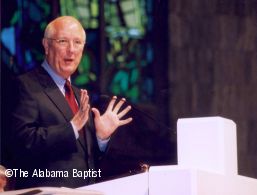
Alabama Baptists are certainly glad the new president of the North American Mission Board (NAMB) has a history of church planting since that is supposed to be NAMB’s major focus in the years ahead.
As senior pastor of Highview Baptist Church, Louisville, Ky., for the past 14 years, Kevin Ezell led his church to help sponsor seven new church plants. That is a good record. Some of the church plants were done in cooperation with Southern Baptists. Riverside Community Church near Philadelphia, for example, was a partnership effort involving NAMB, the state convention, the local association and Southern Baptist Theological Seminary.
Other church plants were done independently. For example, Highview Baptist supported a church planter through a network called Acts 29 while the church planter started Trademark Church in Boise, Idaho. Ezell also led Highview to plant churches in New York, Cleveland, Indianapolis and Atlanta. Many readers will be glad the new NAMB president recognizes the Deep South needs new churches just like other parts of the nation. Let us hope he will not forget our region as he leads NAMB to address North America’s growing lostness.
Alabama Baptists also can rejoice that the new president is a compassionate person. Ezell and his wife, Lynette, have adopted three children from three different countries — Ethiopia, China and the Philippines — to go along with their three biological children. Historically Southern Baptist home missions efforts have been marked by compassion through helping hands extended to hurting people. More recently, that part of our corporate witness has diminished except for disaster relief efforts.
Perhaps Ezell’s compassion can help restore the biblical relationship between ministry and evangelism for NAMB.
In 1996, when Ezell assumed the pastorate of Highview, the church was in chaos. The previous pastor had been forced out and the congregation was divided. Now Ezell assumes the leadership of a Southern Baptist Convention (SBC) entity that saw its last two presidents resign under pressure. During the Great Commission Resurgence (GCR) discussion of the past year, some said NAMB was “broken” and recommended combining it with the International Mission Board.
In truth, NAMB has never achieved the vision of its founding in 1997, when the Home Mission Board, the Radio and Television Commission and the Brotherhood Commission were folded into one new organization. Instead of enhancing SBC outreach through radio and TV, that ministry was lost. To say that missions education for men and boys has floundered in the current organization is a kind description.
Ezell not only helped rebuild the fellowship of his church but he also led in establishing six satellite campuses in the Louisville metropolitan area. He earned a reputation as a visionary leader and capable administrator. In his new post, all his leadership, vision and administrative skills will be necessary if NAMB is to be refocused on a viable future.
What is giving some people pause about the new president is his lack of support for the traditional ways Southern Baptists do missions — the Cooperative Program (CP) and special missions offerings. Said another way, Ezell led Highview to focus the majority of its missions money on church missions efforts rather than cooperative efforts with other Southern Baptists. That is why about 25 percent of NAMB trustees voted against his election (37–12). (See story, page 11.)
Out of $6.27 million in undesignated receipts for 2009, Highview gave $140,100 to missions through the CP. That is 2.23 percent. Based on worship attendance, the per capita giving through the CP was $42.98 compared to an SBC average of $84.71.
The church’s giving to the Annie Armstrong Easter Offering for North American Missions was $10,000. On a per capita basis, that is one-third the SBC average ($3.07 for Highview; $9.12 for the SBC).
In 2009, the church gave $50,000 to the Lottie Moon Christmas Offering for International Missions. That put the per capita giving at slightly less than two-thirds the SBC average ($15.34 to $24).
Nearly half the church’s Million to Missions campaign goes to local missions, including $145,000 to an intern program with Southern Seminary (its president and dean of the school of theology are both leaders in the church). Another $340,000 is used for campus ministry in the area.
The church also sets aside $124,000 to supplement international and national missions trips for church members and $25,000 for a student missions trip. The church-planting efforts receive $150,000 total.
Southern Baptists have been clear that missions support through the CP remains primary. The GCR Task Force report was amended during the June annual meeting of the SBC to say, “We affirm that designated giving to special causes is to be given as a supplement to the Cooperative Program and not as a substitute for Cooperative Program giving.”
Some, including two state convention executive directors, argued that Ezell lacks “moral authority” to lead an SBC entity because of his model of missions support. Ezell dismissed his critics in a sermon the Sunday prior to his election, saying, “Typically those are bloggers who live with their mother and wear a housecoat during the day.” He told his congregation to “just ignore them.”
Interestingly, a few days before Ezell was elected, a story was released about the Kansas-Nebraska Convention of Southern Baptists (KNCSB) reducing the percentage of receipts it will forward to SBC causes. One of the two reasons cited was “diversion of cooperative missions funds into direct missions causes.”
Ron Pracht, president of the convention, wrote, “Because some churches in KNCSB have chosen to redirect some of their mission dollars in light of the adoption of the Great Commission Resurgence Task Force report, we need to consider a redirection of funds received through KNCSB.”
Obviously models of missions support have consequences. The more one does separately, the less one can do cooperatively.
Ezell’s model, a model used by a growing number of larger membership churches, is different from that used by Southern Baptists for the past 85 years. To those of us who believe in working cooperatively through a coordinated strategy involving local, state and national partners, it is a troubling model. Whether it will work remains to be seen.
It seems clear, however, that the way Southern Baptists have done missions in the past will not be the way they do missions in the future. The GCR Task Force report was a step in a new direction. Ezell’s election is another step. The model he uses for missions support is still another.
Alabama Baptists need to unite in praying for the new NAMB president, the mission board he now leads and God’s help as we seek to impact the lostness of North America with the saving knowledge of Jesus Christ.

Share with others: