
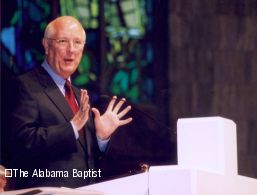
Is social justice an essential part of the mission of the church?” That was the topic of a debate sponsored by Trinity Evangelical Divinity School in Deerfield, Ill., on Oct. 27, 2011. The two participants were billed as “evangelical heavyweights.” Jim Wallis, president of Sojourners, argued the affirmative position. Al Mohler, president of Southern Baptist Theological Seminary in Louisville, Ky., took the negative side.
In introducing the topic, Trinity officials observed that a renewed interest in social justice issues is “transforming the blueprint and vision of ecclesial ministry.” They also said the re-emergence of these issues is causing some evangelicals to conjure up “concerns about 20th century liberal Protestantism and a watering down of the gospel’s message of salvation” by grace.
The debate was another chapter in the conflict between two poles in evangelical life. One side, called indirect influence by one scholar, argues that the gospel only incidentally implies social justice concerns. This is the position espoused by Mohler. For him, the gospel is “an atonement only gospel.” Christians should act justly because it is part of the whole council of God, he declared, but social justice is an “implication” of the church’s mission, not an essential part.
Wallis represented what has been termed the direct influence understanding of the gospel. He argued that as a consequence of having a right relationship with God, individual Christians and the church as a whole are to bring other relationships and dimensions of life into alignment with God’s righteousness and care for humanity.
Both positions start with the confession that the gospel is designed to bring one by faith in Jesus Christ into a right relationship with God. Both Mohler and Wallis affirmed this in their statements.
A key moment in the debate was Mohler’s contention that the New Testament does not provide support for the church being programmatically involved in social justice issues. Because Baptists believe the Bible is the sole authority for faith and practice, what it teaches about this question is the determining factor on how we approach social justice issues.
Of course, Baptists believe the whole Bible, both the Old Testament and the New Testament. That is why it is important to consider a conclusion offered by the late Vernon C. Grounds in his essay Evangelicalism and Social Responsibility. Grounds wrote, “There we have the Old Testament stance from Genesis through Malachi. Religion divorced from social justice is a blasphemous mockery: true spirituality manifests itself in a concern for the needs and rights of people.”
He added, “Unquestionably, therefore, the Old Testament insists on social justice. Passionately it affirms that the evidence of a right relationship with God is a right relationship with one’s neighbor — and this implies a willingness to struggle for his (the neighbor’s) rights.”
Grounds, who served for more than 20 years as president of Denver Conservative Baptist Theological Seminary and was a renowned writer and lecturer, observed that the New Testament does not negate the Old Testament demands for social justice. Rather it fulfills and intensifies the demands of the Hebrew revelation.
This is seen most clearly in the nature of Jesus Christ, whom Grounds described as “God become Man, God who accordingly is for Man, the Man who accordingly is for God, the God-man who is entirely the Man-for-others.”
In Luke 4:18–19, Jesus described His ministry being “to preach good news to the poor, to proclaim freedom to the captives and recovery of sight to the blind, to set free the oppressed, to proclaim the year of the Lord’s favor.”
Of the good Samaritan story recorded in Luke 10, Grounds wrote, “The Man-for-others teaches that the next- and nearest-person-in-need whom a disciple meets is his neighbor and has a claim upon loving ministry, even if that ministry must overleap the barrier of racial prejudice and be carried on at the cost of danger and delay, to say nothing of money that will never be repaid.”
In Matthew 5:44–48, Jesus urged believers to “love your enemies and pray for those who persecute you so that you may be sons of your Father in heaven.” Here, again, love for God results and is expressed in love for others.
In Matthew 22:37–39, Jesus tied Christian ethics to Christian belief when He said, “Love the Lord your God with all your heart, with all your soul and with all your mind. This is the greatest and most important commandment. The second is like it: Love your neighbor as yourself.”
In Matthew 25:35–36, Jesus linked judgment to ethics when He insisted that believers are to minister to the widow, the poor, the hungry, the sick, the imprisoned and the naked. This is putting love of God in action. When Christians care for “the least of these,” it is as if they are caring for Christ Himself.
The fullest expression of God’s love was the cross on which Jesus died. There God’s holy love satisfied His own demands with a self-giving that knew no limits. Romans 5:6 declares, “Christ died for the ungodly.” The apostle Paul then adds in verse 8, “But God demonstrates His own love for us in this. While we were yet sinners, Christ died for us.”
From all of this and more, Grounds concluded, “In Jesus Christ, therefore, the New Testament discloses God’s character as well as man’s obligation and possibility. Hence the New Testament ethic is an imitation of Jesus Christ, an ethic of gratitude and faith and obedience, all grounded in love and issuing in love.” He added, “The imitation of Jesus Christ, Calvary-inspired and Spirit-enabled, means a life of service and sacrifice, a life of sensitive caring, a life of identification with the oppressed and disinherited and needy, a life of constructive” engagement against any political and religious forces that are frustrating to God’s will.
Grounds essay can be found in the book “Tough-Minded Christianity,” published by Broadman & Holman in 2008. There the author expands the New Testament case for direct involvement in issues commonly referred to as social justice far beyond what is reflected here.
Yet, from looking only at Jesus’ life, it seems to this writer that the New Testament does, in fact, continue and intensify the Old Testament teaching that genuine religion expresses itself in concern for social justice.
That alone should make it an essential part of the church’s mission.


Share with others: