
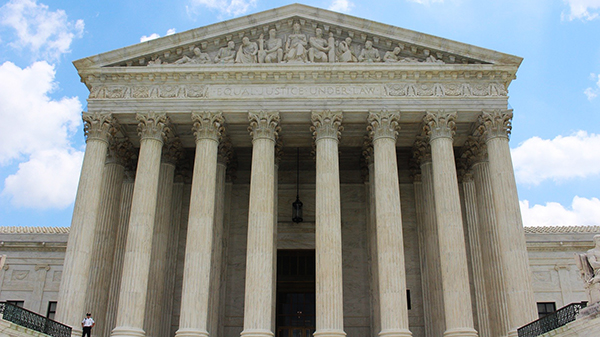
To protect traditional values from what they consider crushing blows from the gavels of activist federal judges, many members of Congress are attempting to prevent the federal courts from hearing specific cases.
The U.S. House of Representatives approved the Pledge Protection Act (PPA) Sept. 23 by a vote of 247–173. If the PPA becomes law, it would prevent the federal courts from hearing any case related to the Pledge of Allegiance.
Spencer Bachus, R–Ala., and a member of Hunter Street Baptist Church in Hoover, said, “the Pledge Protection Act defends the constitutionality of reciting the Pledge of Allegiance (including the phrase “under God”) by simply restricting the jurisdictions of all federal courts, including the Supreme Court.”
Alabama voices
Bachus, one of five Alabama Congressmen to vote for the bill, added, “This body (the U.S. Congress) is more than within its bounds to limit the role of federal court jurisdiction.”
He pointed to Article III of the Constitution of the United States, which reads, “The judicial power of the United States shall be vested in one Supreme Court and in such inferior courts as the Congress may from time to time ordain and establish.”
“The Constitution provides that the lower [federal courts] are entirely creatures of Congress, as is the jurisdiction of the Supreme Court,” Bachus said.
The PPA is the second attempt by the House of Representatives to limit the jurisdiction of the federal courts. In July, the House passed the Marriage Protection Act (MPA), which sought to prevent federal courts from hearing challenges to the definition of marriage as being between one woman and one man.
A third attempt to limit the jurisdiction of federal courts is currently in committee in both the House and Senate. Called the Constitutional Restoration Act of 2004, this bill seeks to remove an array of cases involving questions of government and religion from federal court jurisdiction.
Although the Supreme Court could rule the laws unconstitutional if any of them pass both houses, history reveals the constitutionality of Congress’ power over the courts has rarely been challenged in the highest court.
“The constitutionally of congressional removal of jurisdiction over specific issues has been considered only once by the U.S. Supreme Court — in 1868 — and the decision was inconclusive,” said William G. Ross, professor of law at Cumberland School of Law, Samford University.
History records congressional curbing of courts as an uphill battle, he noted. “This is the first time since Reconstruction (1865–1877) that bills designed to curb the power of the federal courts over decisions have passed either house of Congress,” Ross said.
He said legal scholars disagree sharply about the practice of stripping the federal courts of jurisdiction over certain issues. “It’s one of the most controversial issues of constitutional law,” he said.
Senate passage of the bills is unlikely, many legal scholars believe.
“I don’t think it [PPA] has any chance of passing the Senate.” said John Carroll, dean of Samford’s Cumberland School of Law.
Should the bill become law it would open the door for an unprecedented specificity in case-barring by Congress, he said. “Congress has the power to decide what the federal courts can hear, but it has never gotten this specific. I’m afraid it would open the door to Congress micromanaging the federal courts, which I think would be a disaster.”
Carroll said groups espousing diverse values and morals would also push for their interests to be protected by court-barring legislation.
Carroll said a hallmark of America’s system of three branches of government — legislative, judicial and executive — is the independence of the federal judiciary.
Congress’ potentially frequent muscle over the courts could dilute this independence, he noted.
Some members of the House Judiciary Committee said the onslaught of court-stripping proposals, including the PPA, was vindicating their earlier warnings when the committee considered the MPA. U.S. Rep. Jerrold Nadler, D-N.Y., warned the committee that passing the PPA would “set a dangerous precedent for future Congresses” in which majorities might want to prevent unpopular judicial decisions on constitutional issues regarding minority rights.
Supporters say the PPA is necessary to protect the traditional moral and religious beliefs that run deep into the fabric of Alabama and across America.
PPA sponsors said it was a preemptive measure to prevent future challenges to the constitutionality of the pledge under the First Amendment. In 2002 the California-based U.S. Court of Appeals, 9th Circuit, ruled that the teacher-led recitation of the pledge — including the words “under God” — in public schools violated the Constitution’s ban on government establishment of religion.
Bachus said although atheists do not have to recite the pledge they do not have the right to “impose their atheism on the vast majority of Americans whose beliefs now and historically have defined America as a religious nation. Indeed, the concept of the separation of church and state was not born to establish freedom from religion, but to establish freedom for religion,” he said.
If federal courts do not hear cases involving government and religion, court rulings on such cases would come from state courts, noted U.S. Rep. James Sensenbrenner, R-Wis.
“Far from violating the separation of powers, legislation that leaves state courts with jurisdiction to decide certain classes of cases would be the exercise of one of the very ‘checks and balances’ provided for in the Constitution,” he said. “State courts are not second class courts, and they are perfectly competent to decide federal … cases.”
(Wire services contributed)

Share with others: