
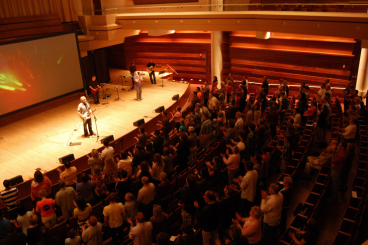
Six churches in Alabama are part of more than 5,000 congregations that host worship services at more than one physical location.
According to a new report researchers say these “multisite” churches, which may share worshippers across town or many miles apart, are growing at a much larger pace than traditional megachurches.
Without the burden of additional expensive buildings congregations find they grow faster in new places, said Warren Bird, research director of Leadership Network who announced his conclusions Aug. 21.
“It’s a combination of both evangelism and saying, ‘People may not come to this particular building. How can we take where we are to where they are?’” he told Religion News Service.
Bird, the author of books on the multisite trend, has tracked the number of churches meeting in more than one place for his Dallas-based church think tank; he combined his findings with Faith Communities Today surveys to produce the report.
Multisite churches have grown from fewer than 200 in 2001 to 1,500 in 2006 to an estimated 3,000 in 2009 to more than 5,000 today. In comparison, U.S. megachurches have grown from about 50 in 1970 to about 1,650 in 2012 in North America.
Multisite comes in all kinds of models: Some congregations speak different languages at different locations; some hear from different “campus pastors” onsite and others are preached to by a senior pastor who speaks live or via video.
“The more campuses you have, the more likely you are to use video teaching,” Bird said.
Sergio De La Mora, senior pastor of Cornerstone Church of San Diego, preaches five times every Sunday on its main campus in National City, Calif. — with one service in Spanish and another translated into Japanese. After morning services, he hops in his car and drives to the La Jolla campus for a 5 p.m. service before returning to National City for its last service at 6:30 p.m.
Meanwhile, videos of his 8:30 a.m. sermon are played in satellite campuses in Escondido, Calif., and across the board in Tijuana and Mexico City. A campus pastor runs the service at a location in Tucson, Ariz.
Disadvantages?
Is one of the disadvantages of multiple sites an exhausted pastor?
“You got to remember we’re born to do this,” said De La Mora. “This is the new generation of preachers. People are in transit so they want options when they come to church.”
At Community Christian Church in the Chicago area, Pastor Dave Ferguson has taken a different approach with its dozen sites. “I can only be at one location at a time,” he said.
Each week he gathers in a room with a team of campus pastors to develop a “big idea” into a sermon. A video featuring one of them is created, but the pastors can choose whether to speak from the original manuscript, a version of it they edited or show the video.
The general message reaches about 10,000 people worshipping at sites that include a community center, a college theater, reopened churches and office parks.
The Bridge Community Church, a congregation based in rural Indiana, has campuses in Anderson, Decatur and Muncie but also has one in Bihar, India.
Bird said churches that total at least 500 people tend to be the ones that start a second campus, but smaller churches have also created additional sites.
“It was the megachurches that pioneered it and because megachurches tend to be ones people glean ideas from, pretty soon churches said, ‘Why couldn’t we do that? You don’t have to be really big to do that,’” Bird said.
Multisite churches in Alabama include Cornerstone Church, Auburn (two campuses); South Roebuck Baptist Church, Birmingham (four campuses — two in Birmingham, two in Odenville); New Hope Baptist Church, Birmingham (two campuses); Westwood Baptist Church, Alabaster (three campuses — Alabaster, Calera and Montevallo), Church of the Highlands, Birmingham (seven campuses across the state); and The Rock Family Worship Center, Huntsville (four campuses; three in northern Alabama, one in Tennessee).
South Roebuck Baptist Pastor Christopher Crain said, “[Leadership] decided to become a multicampus church in October 2005. The key leaders of the church had been praying for a way to continue reaching people with the gospel. We had a small cluster of church members living in a growing area in St. Clair County. We knew that if there was a way to break out of [the plateauing/declining] cycle, it was our responsibility to do it.”
Although South Roebuck now meets in different places, it does not want to move to a video-pastor model. “I was taught that preaching is about a human connection to an audience … where the pastor … may adjust his sermon as the Holy Spirit guides,” Crain said.
(RNS, TAB)

Share with others: