
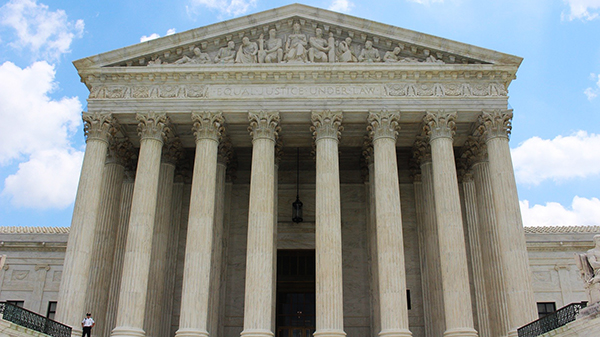
Uncertainty remains as to how the United States Supreme Court will rule on the constitutionality of “one nation under God” being a part of the Pledge of Allegiance. But Alabama Baptists know how they believe in this case, which is scheduled to be heard by the High Court March 24.
“I do believe it’s important because it’s one of several cases that can lead to an erosion of our basic freedom of religious expression,” said Joe Godfrey, president of the Alabama Baptist State Convention. “While we certainly do not want a state-run religion, if we keep removing any mention of God from our culture and society, then we are establishing the religion of secular humanism, and that’s just as wrong as establishing any other religion. The first amendment does not promise the freedom from religious expression,” he said.
Case in question
The “one nation under God” case, Elk Grove Unified School District and David W. Gordon, Superintendent vs. Michael A. Newdow, originated in the trial courts of California in 2002 when Newdow, an atheist, filed suit. He claimed a public school required his daughter to say the pledge. Brought into question by Newdow and not by his daughter, the district court ruled in favor of the school district, allowing the pledge. But later the U.S. Ninth Circuit Court of Appeals ruled in Newdow’s favor on appeal.
Newdow’s daughter, a Christian, never complained about the pledge and continues to say, ‘under God’ in her classroom. Her mother, Sandra Banning, has custody of her, according to a Christian Examiner story. Banning and her daughter, whose name she withholds, are active members of an evangelical church — Calvary Chapel of Laguna Creek in Elk Grove, Calif. The upcoming decision could settle the question, while either opening or closing doors for more attempts to remove references to God, according to Chriss Doss, director of Samford University Center for the Study of Law and the Church.
“It’s hard to tell at this point just what the Supreme Court will do. I do expect it to be a close vote — maybe 5–4, however it goes.”
Baptist Press reports that associate justice Antonin Scalia has recused himself from the case without explanation. He had spoken critically of the Ninth Circuit’s ruling. His absence could mean a 4–4 deadlock among the justices.
“It’s unthinkable that the Supreme Court would not reverse the Ninth Circuit,” said Richard Land, president of the Ethics & Religious Liberty Commission of the Southern Baptist Convention. “If the Supreme Court were to uphold the Ninth Circuit’s ruling that the pledge is unconstitutional, it will have a full-scale revolt on its hands, which will in short order result in either a constitutional amendment or a removing of this area from the court’s jurisdiction by Congress,” he said.
Preserving religious liberty through references to God in public life is important to Alabama Baptists, said Joe Bob Mizzell, director of the office of Christian ethics with the Alabama Baptist State Board of Missions.
“I would say that 98–99 percent of Alabama Baptists favor the phrase ‘one nation under God’ being in the pledge,” Mizzell said.
“If they (Supreme Court) were to rule it be taken out it would be a tremendous attack on the religious freedom in our country and to our founding fathers,” he said.
Obvious religious foundation
Reading historical documents of the nation’s founding and of its founders makes it “obvious that our forefathers were very religious and expected faith to be a part of this country and its heritage,” Mizzell said.
Still, the words “under God” have only been in the pledge for about half a century, Doss said. And some say including the words “under God” violates the wall of separation of church and state, “which many in this country feel is very crucial and undergirding to religious liberty,” he said. The Center for Individual Freedom, a nonpartisan group, says the origin of the phrase ‘wall of separation’ is not in the constitution but came many years later from a brief letter written by Thomas Jefferson in 1802 to Danbury Baptist Association, Danbury, Conn. The purpose was to reassure them that government had no intention of establishing an official religion, and that they as Baptists, outside of the mainstream of religion at that time, would not be discriminated against.

Share with others: