
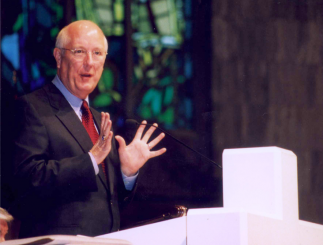
Southern Baptist Convention (SBC) leaders deserve kudos for their efforts to put a good face on a bad situation. At the end of the last budget year, SBC Executive Committee President Frank Page said Southern Baptists were in “hallelujah territory” because Cooperative Program (CP) receipts for the year had topped the budget goal.
Little attention was called to the fact that CP receipts were actually $200,000 below the previous year’s receipts. In fact, the 2011–2012 receipts also were below CP totals for each of the past two years. Giving is near the 2003–2004 level.
Through the first six months of the SBC fiscal year (Oct. 1–Sept. 30), there is little reason for optimism. CP giving is down 2.47 percent, or $2,412,536, according to SBC statistics.
In Alabama things are no better. CP receipts have declined annually since 2007 sliding from $44,958,759 to $39,853,810 in 2012. That is a total decline of more than 11 percent in five years. In that same time period undesignated receipts of churches have grown by 2.3 percent, from $566,581,204 in 2007 to $579,499,154 in 2012. The percentage of undesignated receipts given to missions causes through the CP by Alabama Baptists has declined from 7.94 percent in 2007 to 6.88 percent in 2012.
For the first quarter of 2013, CP giving is short of its goal by $169,091 and that is based on an annual goal reduced by $1 million from last year. In addition, the Alabama Baptist State Board of Missions has already adopted a proposed 2014 goal that is $1 million less than the current goal.
Even though Alabama continues to lead all SBC states in CP giving through the first half of the SBC budget year, there is no escaping the conclusion that the CP is taking it on the chin here and across the nation.
The question observers are asking is why? Most troublesome is the fact that in 2012 churches in Alabama and elsewhere, as a whole, experienced a rise in income. Yet the decline in CP giving accelerated.
Some say not to worry. Giving to churches normally lags about 18 months behind economic trends. Although the economy collapsed in the fall of 2008, it was not until the 2009–2010 year that CP receipts suffered their biggest drop. Recovery, these observers say, will come the same way. If true, church finances and CP giving should both improve this calendar year.
Others believe the SBC has made a fundamental change in the way ministries and missions are supported and contend that CP giving will never be as prominent in SBC life as it was in the past. These observers point to the 2011 SBC decision calling all missions giving by a church Great Commission Giving (GCG). As a result, they say, a growing number of churches are redirecting missions giving away from CP and using it in direct missions efforts.
Other churches are giving directly to their favorite ministry or missions effort and dropping support for the state and national “program” part of the CP and still calling it Great Commission Giving.
Hard evidence for this position is difficult to find since only one full SBC budget cycle has passed since that decision. That means most of the concern is based on anecdotes such as one megachurch reporting more than $3 million in GCG but only 27 percent of that was CP giving. A number of churches have adopted special missions projects — local and international. To finance them, many of these churches reduced CP giving.
There are some snapshots of church giving that lend credence to this view. For example, according to information from the SBC Executive Committee at the halfway point of this SBC budget year, four of the five largest CP giving states from last year (including Alabama) show a decrease in CP giving but an increase in designated giving. The fifth state has a decline in both but its CP decline is nearly three times larger than its designated giving decline.
Again, these are only snapshots of giving. Not enough time has elapsed to demonstrate trends and reliable conclusions.
Doubtless some will ask why the concern about the channel of giving rather than celebrating the total giving. The answer goes back to the reason the GCG decision was careful to emphasize that CP giving was the preferred method of supporting ministries and missions among Southern Baptists.
CP giving is important because of concern for efficiency and effectiveness.
Southern Baptists should never forget that hard experience taught us that working together is better than working alone. A single church can do a missions project in a foreign land. A few churches can establish a missions program in that place. Still fewer churches can manage multiple on-going programs but none can take the gospel into the whole world alone. Baptists need each other and we need other evangelical Christians, too.
Hard experience also taught us that direct service needs a network of infrastructure to be effective over time. Volunteers for ministries and missions have to be called out. They have to be trained. They have to be equipped and supported. Reports of their work have to be shared so others can support them in prayer.
Those hard lessons are why Southern Baptists have an infrastructure that includes helping churches do the work of the church; training facilities for church vocational volunteers and Christian laypersons so they will be able to see and serve a needy world; a communications network through which information is shared to keep Baptists informed about what God is doing around the world; and so much more.
All of this is part of the “Program” in the Cooperative Program. It is the infrastructure that makes ministry and missions possible decade to decade.
When CP takes it on the chin then all the infrastructure that helps churches do direct missions take it on the chin as well.
Yes, a favorite cause may prosper for a season, but over time all that Baptists do together will suffer. If Southern Baptists are to do our part in reaching North America and the world for Christ, we need more than direct service. We need more than designated giving. We need the Cooperative Program.


Share with others: