
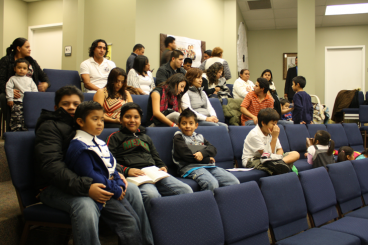
Hispanics currently make up 17 percent of the population of the United States and are the largest ethnic minority in the country, according to the U.S. Census Bureau. And because the Hispanic birth rate in the U.S. has now overtaken the immigration rate the population by 2060 is expected to be 31 percent.
Cary Hanks Jr., a catalytic missionary for the Central Alabama Baptist Hispanic Ministry Coalition, believes the growing Hispanic population affords Southern Baptists a unique evangelism opportunity.
“We Baptists have always believed we can do more together, so we should partner with other churches and associations and share Christ with our Hispanic friends,” he said.
“Networking is a key word for us,” Hanks said of the coalition. “We bring Anglo and Hispanic Christians together in order to train leaders, evangelize and to plant churches.”
The coalition is a partnership between the Alabama Baptist State Board of Missions and nine local associations — Bibb, Birmingham, Bessemer, Mud Creek, Pleasant Grove, Shelby, Sulphur Springs, Tuscaloosa and North Jefferson. The North American Mission Board also helped in the ministry’s founding in 2005.
Hanks, who spoke in the mid-week service Aug. 27 at Siluria Baptist Church, Alabaster, explained that the coalition’s mission is to strengthen existing Hispanic work and to start new work.
A native of Atmore, Hanks grew up in Killeen, Texas, where his father was stationed at Fort Hood. He earned an undergraduate degree at Samford University in Birmingham and two degrees from New Orleans Baptist Theological Seminary. He and his wife, Anne, spent 15 years in Ecuador with the Foreign Mission Board (now International Mission Board) before moving to Indiana to work in church planting. The Hankses moved to Alabama in January 2009.
A member of First Baptist Church, Pelham, Hanks serves in what he calls a “co-interim” pastorate for the congregation’s Hispanic church currently seeking a pastor.
“I’ve found that our Bible studies and worship groups do better when they have Hispanic leadership,” he said. “Alabama Baptist churches can offer facilities and should have a simple document of cooperation and procedure, such as who’s responsible for keys to the building and the like.
“But indigenous leadership is the best way to reach the Hispanic population.”
Hanks also helps with the Hispanic Baptist Bible Institute currently meeting on Saturdays at First Baptist Church, Indian Springs. He’s one of several teachers offering classes in church leadership and biblical studies. The institute offers a three-year program to train leaders and grants a ministry diploma upon completion.
Hanks said there are a number of ministries that have proven effective beyond the traditional Bible study and worship groups.
“Churches can offer English classes, GED preparation and health clinics,” he said. “And after-school tutoring has been well-received. Hispanic children and youth are in our schools and speak English, but often the parents aren’t as fluent which means they can’t help with school work as they’d like.”
Hanks said churches offering Spanish-language Bible studies for adults find that Hispanic children blend well in the traditional English Sunday School.
Medical assistance
He also noted the effective work of Community of Hope Health Clinic, a faith organization that meets at the Shelby County Health Department in Pelham. The clinic offers medical assistance for adults without health insurance and has served large numbers of Hispanics.
“Churches should be sensitive to the needs of people around them and consider ministry to Hispanics,” Hanks said. “Don’t ignore them because you don’t speak their language.”
To contact Hanks, call 205-669-7858.
For more information on church planting efforts related to Hispanics, contact Lamar Duke at the SBOM at lduke@alsbom.org or 1-800-264-1225, ext. 332.
Share with others: