
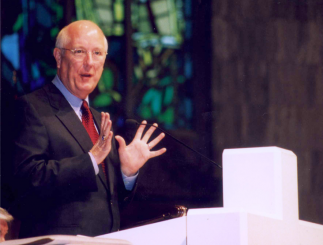
When people reflect on the 2014 annual meeting of the Alabama Baptist State Convention (ABSC) they will likely remember the many good things that happened. They also may remember some lingering questions raised by a few developments during the 192nd annual meeting.
Perhaps the most memorable single moment was Samford University President Andrew Westmoreland’s announcement that Samford was voluntarily requesting its portion of the state Cooperative Program (CP) budget be reduced by 50 percent — about $2 million (see story here).
Much of the reduction — which will be phased in — will go to help Alabama Baptists reach the goal of dividing CP funds equally between state and national causes. The 2015 budget of $40.5 million is only $601,280 (1.5 percent) short of that goal. Part of the reduction may also go to other state convention work already strained by the downturn in financial support from cooperating churches.
Alabama Baptist CP giving has dropped from a high of nearly $45 million in 2007 to an expected $39 million this year. That is a drop of almost 14 percent. Together with a shrinking percentage of the CP budget for state work, many entities have been left struggling.
That Westmoreland led Samford’s trustee executive committee to endorse this self-sacrificing act in order to strengthen other Southern Baptist and Alabama Baptist ministries was an act of statesmanship for Westmoreland and for the trustees.
Another positive memory may be the doctrinal debate around the 2000 Baptist Faith and Message (BF&M). The motion adopted did not attempt to make all Alabama Baptists theological clones of one another. Instead the statement of faith was adopted as “an expression of our unity in doctrine and practice.” The motion did not seek to force agreement by employees or trustees. Rather the BF&M was “recommended … to all trustees elected by the Alabama Baptist State Convention.”
While not referenced on the convention floor, the motion had the feel of action recommended by the SBC Executive Committee and approved by the 2014 Southern Baptist Convention which urged churches to have a statement of faith “which closely identifies with the convention’s adopted statement of faith.”
The action provides guidelines affirming major characteristics of Baptist understandings of the Christian faith. The adopted motion also provides opportunity for individual understandings and differences within the broad guidelines. That position seems in the best tradition of Alabama Baptists who have always been clear about commitment to God through faith in Jesus Christ and on the primacy of God’s Word as our only source for faith and practice. At the same time, we have worked together in missions and ministries despite different understandings about how the details of some of those faith commitments work out.
Concern about doctrinal guidelines in Alabama Baptist life is not a new issue. More than a year ago several entity leaders, this writer included, joined together to ask the state convention’s Committee on Boards and Commissions to amend their guidelines for nomination to include the statement “Does the person (nominated) affirm support of the doctrines and practices generally accepted by Alabama Baptists as founded on the authority of Scripture.”
Even though entity leaders only recommended such persons, we wanted a way to assure Alabama Baptists that those chosen to oversee various ministries share the faith to which Baptists are committed.
That wording was later approved and added to the statement affirming the CP as the preferred means of financial support for sharing the gospel throughout the world. The motion adopted at the recent convention seems consistent with actions already initiated by leaders of Alabama Baptist-related ministries.
Great preaching will be another fond memory. The Tuesday evening service was all inspiration — first through music then through the magnificent preaching of Robert Smith of Samford’s Beeson Divinity School.
The preaching of Robert Smith defies description. It has to be experienced to grasp the breadth of his knowledge, the depth of his understandings and the heights to which he transports one’s spirit. It is no wonder he is not only one of the nation’s best teachers of preaching but one of its best practitioners.
Alabama Baptist pastors were not far behind him. Different styles of preaching were demonstrated in the convention sermon and the theme interpretations but each left messengers inspired and challenged.
If there is a lingering question it will be about the election of officers. There is nothing wrong with having contested elections even though this was the first time in 16 years all three offices have been contested in the same convention.
What raises a question is the impression of a drive-in campaign for voting. Attendance this year was 941, only two fewer than the last time the convention met in Birmingham in 2010. What is different is that Wednesday morning 147 messengers registered. In 2010 there were 40. Last year in Huntsville 18 people registered during the final Wednesday morning session.
Alabama Baptists are encouraged to attend whatever portion of the convention they can, even if only the final session. Still it is odd when nearly 15 percent of the total registration turns out for the one session where all of the convention officers are elected.
Every Alabama Baptist elected a messenger by a church has a right to vote but driving in for the final session just to vote is unhealthy. Hopefully every messenger will be concerned enough about Alabama Baptist life to learn about it by attending its sessions, not just showing up to cast a ballot.
The future role of the convention president in officer elections will also be watched going forward. For the first time in this writer’s memory, the president was involved in overt electioneering by posting on Facebook who he was voting for, sending emails urging people to vote for that candidate and even in the hallways telling people to be sure to be in place to vote for a particular person.
Those who know John Killian attribute the actions to an overflow of his normal activity. He is a Republican leader in western Jefferson County and it is hard to talk to John without some election coming up. Still previous convention presidents have focused on staying out of elections during their time in office rather than using the influence of their office to help a particular candidate achieve election.
Whether this year was an anomaly or a new normal will be interesting to watch.
But Killian’s concern about elections did not interfere with his presiding. He led the meeting with skill and knowledge. He was supportive of every aspect of Baptist work as he has been during his two years in office. His humor kept people relaxed and the program moving forward. He demonstrated he is both affable and astute.
When the final gavel sounded Alabama Baptists still faced budget problems to solve, ministries to accomplish and a God to serve. And they left better equipped to do them all because of what transpired during the 2014 annual meeting.
Share with others: