
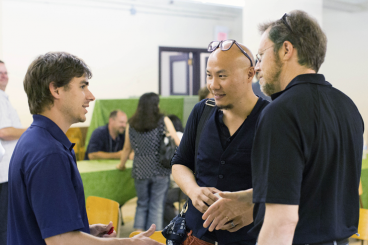
Clint Eastwood directed, produced and starred in a film called “Gran Torino” in 2008. The film was about Walt, a retired Detroit autoworker and widower whose neighborhood was no longer homogenous. Gangs were wreaking havoc in the area. When an Asian teen refused to steal Walt’s treasured Gran Torino automobile under gang initiation pressure, Walt befriended the boy, who was Hmong.
Eastwood filmed the movie in Daniel Yang’s childhood neighborhood.
“‘Gran Torino’ was glamorized compared to how I grew up,” said Yang, who is a second-generation American Hmong. “Jesus, rock ’n’ roll and the girls in my youth group saved me [from the gang experience].”
Minority group
The Hmong are a minority people group from Southeast Asia, and they have no homeland. They reside in Vietnam, Thailand, China and Laos. Following the Vietnam War and the Laotian Civil War many sought refuge in Thailand. By the late 1970s, many of those refugees resettled in Western countries. Detroit was just one landing spot.
The immigrant experience defined Yang both then and now. As he struggled to define God’s call upon his life after college and while starting his career, one thing became clear from God, “I made you for the Word,” Yang felt Him saying. “I’m going to use your story of being a second-generation immigrant.”
Immigration is a jolting experience as families face lingual, cultural and economic barriers. His parents made a profession of faith through a Lutheran church then started attending a Southern Baptist church. By age 7, Yang also had professed faith in Christ.
“It set the trajectory of my life and prevented me from joining gangs,” Yang said.
By age 21, Yang sensed a calling to “some kind of missional ministry.” But first there was the American dream.
Yang attended the University of Michigan in Ann Arbor on a full scholarship majoring in computer science, then spent more than eight years as a software developer. But deep inside he wanted to study the Bible and answer the question, “Do I believe this stuff?”
He enrolled in extension courses through Southern Baptist Theological Seminary in Louisville, Ky., and realized God was redirecting him to vocational ministry.
“I didn’t want to be a pastor,” Yang said. “I thought I would be a missionary.”
He learned about church planting and saw it as a great merger of being a missionary and staying in North America where he felt led to help churches navigate cultural issues. Detroit seemed the natural place to do that. But even with a team and meeting place secured, Yang and his wife, Linda, realized Detroit was not their destiny.
So he detoured to Texas.
After participating in an assessment process and deciding not to plant in Detroit, Yang received an invitation to Texas where he joined the staff of NorthWood Church for the Communities in Keller, a predominantly Anglo congregation where he developed a college and young adult ministry while also serving as an associate worship pastor.
“God was orchestrating something completely different from what I would have ever planned for myself.”
He finished his seminary degree at Southwestern Baptist Theological Seminary in Fort Worth, Texas, while receiving mentoring at NorthWood Church. Pastor Bob Roberts introduced Yang to the North American Mission Board’s (NAMB) then Farm System, aimed at assisting churches in discovering, developing and deploying the next generation of missionaries.
Yang began looking for a city to plant a church. That’s when Toronto, Canada, came into view. After their second vision trip there Yang recalled, “My wife looked at me and asked, ‘Why aren’t we doing this already?’”
Though just four hours from Detroit, the cities are vastly different. Detroit is 87 percent black. Toronto is vastly intercultural and rapidly on the rise as the financial capital of Canada, while Detroit has been in steady decline. Still he found one similarity.
“I grew up in one of the worst neighborhoods in Detroit and Regent Park historically was the worst in Toronto,” Yang said.
Regent Park is a revitalizing area near downtown Toronto. Today Regent Park is fast changing as young adults, many of whom are college educated, are choosing to live there.
“It’s a thinking city. You engage people’s hearts through their minds,” Yang said.
Fellow church planter Mike Seaman and his wife, Missy, joined the Yangs in planting Trinity Church. The families started a home Bible study as they began building relationships in the city.
Influencing the city
“It’s always tempting to do what is manageable and predictable,” Yang said. “We could have stayed a house church for a long time.”
Through a relationship with the Toronto Kiwanis Boys and Girls Club, a meeting space opened up. In September 2013, Trinity Life Church launched with the motto, “Discovering identity and destiny in Christ, influencing the city and the world.”
As one of North America’s most culturally diverse cities, Toronto is a natural platform for influence. This is one of many reasons it is 1 of 32 Send North America cities. But first there’s the matter of planting more churches there.
“We’d like to see multiple churches planted in different neighborhoods,” Yang said. Soon a church planting intern will join them from NAMB’s Farm System.
Yang has come to appreciate how Canadian and Southern Baptists do missions through the Cooperative Program and Annie Armstrong Easter Offering.
Yang recognizes the advantage that support from NAMB and Canadian Baptists affords him.
“We are part of something bigger.”
(NAMB)
Share with others: