
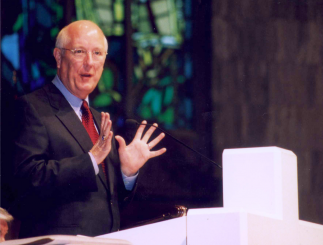
When former Auburn University football coach Pat Dye and former Alabama Power Company president Charles McCrary announced the formation of a new organization to promote gambling in Alabama, hope faded that the upcoming special session of the state Legislature would concentrate on adopting a state budget to take effect this October.
Instead the legislators will be sidetracked by another round in the ongoing fight over gambling in Alabama.
A spokesman for state Sen. Del Marsh said as much when he announced, “Sen. Marsh believes that giving the people the ability to vote on gaming should be an option in the special session.” Marsh, who is president pro tempore of the Alabama Senate, became the primary sponsor of gambling legislation earlier this year.
Gambling will not be included in Gov. Robert Bentley’s call for a special session but Marsh will likely introduce a constitutional amendment to establish a state-sponsored lottery and authorize casino gambling at the state’s four dog tracks. It will take the same three-fifths majority to pass his proposed constitutional amendment whether it is done in regular legislative session or a special session.
Different reality
Dye said he believes a lottery and casino gambling would solve the state’s financial problems. That is always the promise of the gamblers. But reality is far different. This year 20 states in addition to Alabama have a budget shortfall, according to the Alabama Policy Institute. All but one of those 20 states have a state-run lottery. Fourteen of the states have casino gambling as well.
Obviously gambling does not solve a state’s financial problems. At best it is a Band-Aid to protect legislators from having to make difficult decisions about responsible government spending and just tax policies. At worst state-sponsored gambling is a manipulative tool of the powerful to protect themselves at the expense of society’s most vulnerable.
The evidence is conclusive. As the Federal Reserve Bank of St. Louis reported, “A large portion of lottery profits come from people … with the least disposable income.” In other words, lottery is a sucker’s bet for those who have no hope but to grasp at straws.
It is surprising and disappointing that noted business leaders such as McCrary and Raymond Harbert, CEO of Harbert Management Corporation, have lent support to the effort to expand gambling in Alabama. Neither man would lead his company into a saturated market with a declining future. Yet that is the status of casino gambling.
In nearby Mississippi two casinos went broke and closed last year. In Atlantic City, the poster child of the gambling crowd, four casinos have closed or announced closing including the city’s newest one, the $2.4 billion Revel.
Atlantic City’s gambling revenue is down more than 47 percent since 2006. In Maryland, Delaware, Pennsylvania, Connecticut, Indiana, Ohio, Wisconsin, Louisiana and other places the reports are the same — gambling revenue is declining with no stop in sight.
It is a pipe dream to think people will travel from out of state to gamble at Alabama casinos. The market for such behavior is too saturated for that. Alabamians will be the ones victimized by casino gambling. Is that what business leaders are encouraging rather than the proven disciplines of work, thrift and responsibility?
Burdening those least able to pay
Gambling places the financial burden of the state on the backs of those least able to pay rather than on a fair and just tax system focused on capital and corporations.
Pulitzer Prize-winning tax reporter David Cay Johnston found that 11 states already raise more money per person through lotteries than they raise through corporate income taxes. That is not the direction Alabama should go.
Through the years gambling has tried to wrap itself in various social causes — education, care for the aged, medical care and now jobs. Don’t be fooled. Alabama Jobs Foundation is only the latest front designed to hide the selfish nature of gambling that results in losses for many in order for one to profit — either directly or indirectly.
The new gambling organization promises a slick media campaign complete with TV and radio ads. That is nothing new. Gamblers always have been able to outspend citizens’ groups. This means elected officials will be placed under enormous pressures.
It is up to Baptists and other concerned citizens to counter those pressures — not with money but with contacts. Alabama Baptists make up more than one-fifth of the residents of this state. Baptists are the largest affinity group in Alabama and are located in every state house and senate district.
Contact elected officials
If those concerned about expanding gambling in our state — concerned about a state-sponsored lottery and casinos in every part of the state — personally contact their elected officials and ask them to oppose expanding gambling in Alabama it will make a difference.
During the recent regular session of the Legislature the state’s mental health program was threatened with draconian cuts. But after an extensive effort to inform legislators about the importance of mental health programs, mental health was made a budget priority along with Medicaid and corrections. Contacting legislators really works.
Baptists and other concerned Christians don’t have the dollars for a media campaign and we cannot fill someone’s campaign war chest with donations. But Baptists do have the votes. Baptists can make a difference if they want to. The time to make that difference is now.
This week Alabama Citizens Action Program mailed information to every Baptist pastor in the state and other religious leaders urging immediate contact with elected officials. A letter would be helpful. A visit or a phone call would be better.
Alabama has many problems that need attention from the state’s Christian communities. Hunger and poverty are high in our state. Physical and mental health are below national norms. Education lags in places. Income is low.
Alabama does not need to complicate its problems by expanding legalized gambling. By acting now we can keep that problem at bay so we can work on the many pressing issues we already face.
Share with others: