
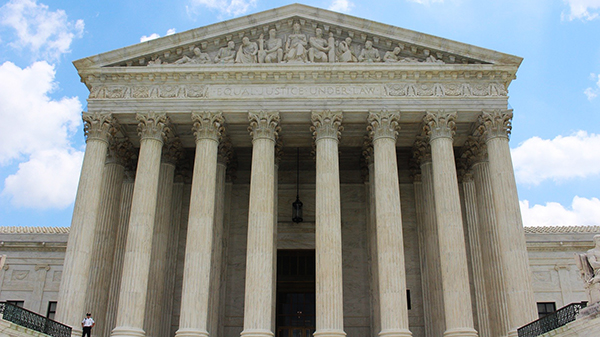
For pastor Clyde Reed, a win at the highest court of the land was a significant victory not only for his small church but also for many Americans.
“I thank God that the Supreme Court affirmed our First Amendment freedoms and sent the message that the church’s speech can’t be targeted for restriction,” Reed said after the U.S. Supreme Court’s opinion was issued June 18. “More importantly, I am blessed to have been a part of a victory for free speech that will certainly outlast us and that I pray will benefit others for many years.”
The justices unanimously ruled a Gilbert, Arizona, sign code violated the free-speech rights of Good News Community Church. The decision not only will free Good News Church to set up its signs without harassment from the local government, but it could provide aid to the church planting efforts of the Southern Baptist Convention and other organizations that often use such signs to inform communities of their presence.
In its opinion, the Supreme Court overruled a federal appeals court decision, finding the sign ordinance adopted by Gilbert — a Phoenix-area city of about 200,000 — “imposes content-based restrictions on speech” and fails to pass the government test for such a law. That code limited the size of directional signs — like those for church meetings — to six square feet and 12 hours for display while permitting far greater sizes and durations for the exhibition of political, ideological and homeowners’ association signs.
The Southern Baptist Ethics & Religious Liberty Commission had signed a friend-of-the-court brief by the Christian Legal Society that contended the sign ordinance violated the church’s freedom to speak and assemble.
The Missouri Baptist Convention and its Christian Life Commission also filed a brief in the case in support of the church. The brief — authored by the Southern Baptist, father-son lawyer team of Michael and Jonathan Whitehead — argued the sign code infringed the First Amendment protection of religious freedom, as well as free speech and assembly rights.
(BP)

Share with others: