
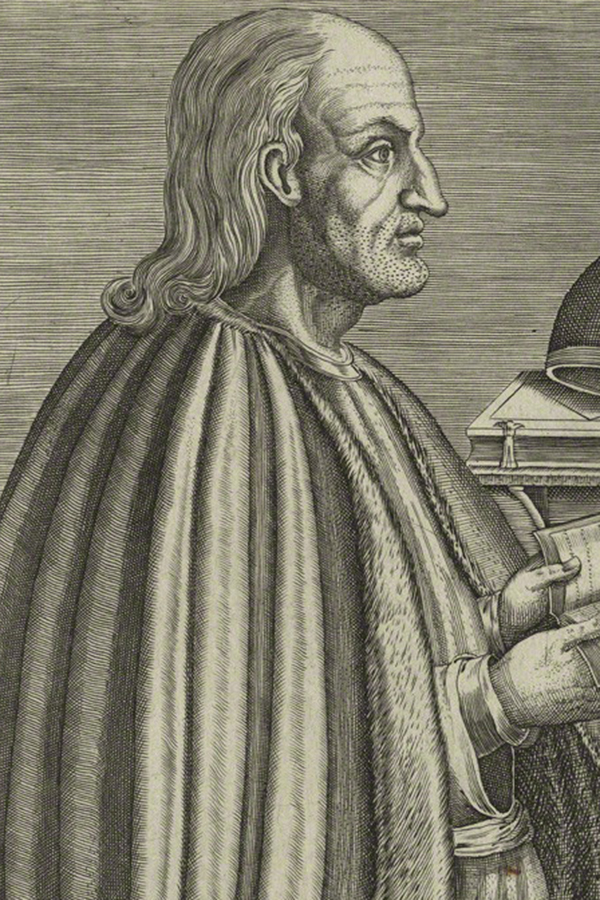
Archbishop of Canterbury considered ‘one of the greatest thinkers of the Middle Ages’
By Joanne Sloan
Anselm (1033–1109) was a Benedictine monk, abbot, philosopher, theologian and prolific author. He served as Archbishop of Canterbury from 1093 to 1109.
Today he is remembered as one of the greatest thinkers of the Middle Ages. This year marks the 925th anniversary of his becoming Archbishop of Canterbury in 1093.
Anselm was born in 1033 to Gundulf and Ermenberga in Aosta in the Italian Alps. His father was harsh but his mother was virtuous. She gave Anselm a thorough religious education.
Devout, young Anselm desired to become a monk at age 15, but his father would not give his consent. In 1056, after his mother’s death, he left home with an attendant, crossed the Alps and traveled in Burgundy and France. He visited his mother’s relatives in Burgundy and studied there and in northern France for some time.
In 1060 he entered the Benedictine Abbey of Bec in Normandy to study under its prior, Lanfranc, a distinguished instructor in northern Europe. Three years later he was elected prior to the Abbey. In 1078 he succeeded Lanfranc as Abbot when Lanfranc became Archbishop of Canterbury.
In 1087, while still at Bec, he wrote one of the 50 books he would write in his lifetime. “Proslogium,” his “ontological argument” for the existence of God, defined God as “that which nothing greater can be thought.” He argued that this being must exist in the mind and in reality, since a being that exists in reality is greater than one that exists only in the imagination.
Under Anselm’s leadership, the Abbey of Bec grew in reputation and became one of the most important places of learning in Europe.
After the death of Lanfranc, King William II of England made Anselm archbishop of Canterbury in 1093.
As archbishop he maintained his monastic ideals, which included stewardship, prudence, prayer and contemplation. He continued, though, to push for reform. The king and Anselm continually disputed the king’s right to intervene in church matters such as trying to appropriate church lands, offices and revenues.
Anselm was exiled in 1097 and remained in Italy until William died in 1100.
Anselm returned to England at the invitation of the new king, Henry I. The two disagreed about the lawful extent of Henry’s control over the selection of bishops and abbots. Again, Anselm went into exile for three years until he and Henry reached a compromise.
Anselm returned to Canterbury in 1107. For two years he continued to study, write and live in peace.
He died on Holy Wednesday, April 21, 1109, and was buried in Canterbury Cathedral, near Lanfranc.
Canonized as a saint
He was canonized as a saint after his death. Pope Clement XI proclaimed him a Doctor of the Church in 1720.
Anselm’s motto was “Faith seeking understanding.” He said, “I do not seek to understand in order that I may believe, but I believe in order to understand.
His legacy continues today. In 2015, Christian History magazine chose Anselm’s book, “Why God Became Man,” one of the 25 most influential Christian books in history.
EDITOR’S NOTE — Joanne Sloan, a member of First Baptist Church, Tuscaloosa, has been a published writer of articles and books for 30 years. She has a bachelor’s degree double majoring in history and English from East Texas State University (now Texas A&M–Commerce) and a master’s degree specializing in English from the University of Arkansas (1978).
Share with others: