
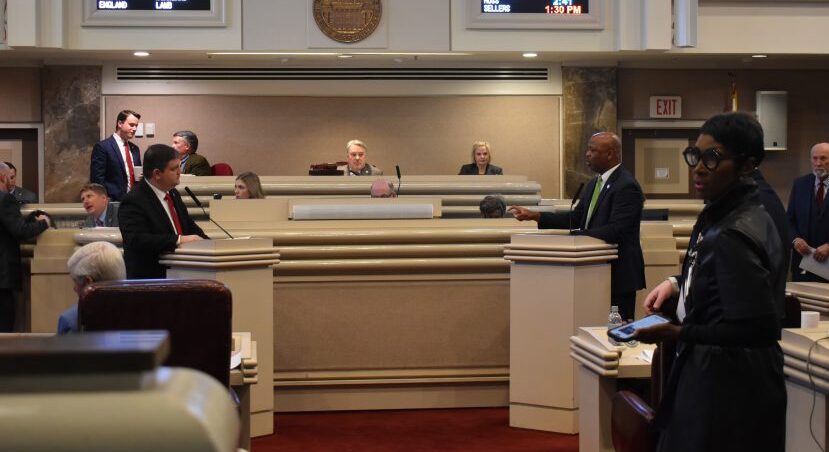
The House passed a bill Tuesday (Jan. 27) to make the rape, sodomy or sexual torture of children younger than 12 a capital crime punishable by death.
House Bill 41 — called the Child Predator Death Penalty Act — passed the House last year, but it never made it out of the Senate. The bill has moved with urgency this session after law enforcement discovered a child sex trafficking ring involving multiple victims and adult predators in Bibb County last year.
Subscribe to The Alabama Baptist today!
SIGN UP for our weekly Highlights emails.
“This crime is the worst-of-the-worst offenses,” sponsor Rep. Matt Simpson, R-Daphne, said. “When you take the innocence of the children, I believe in my heart that that is the worst-of-the-worst offensive and as it being one of the worst-of-the-worst offenses, it deserves the worst-of-the-worst punishments.”
Likely legal challenges?
Sen. April Weaver, R-Brierfield, whose district includes Bibb County, is sponsoring the companion bill, Senate Bill 17.
During debate on the floor, Democrats questioned Simpson about the constitutionality of the bill and objected to the state passing a bill that will likely face legal challenges.
House Minority Leader Anthony Daniels, R-Huntsville, said he thinks this bill wouldn’t change anything because it would be thrown out for legal reasons.
“I want to do something that’s constitutional but also has the stiffest punishment possible,” Daniels said. “I think what’s going to happen is we’re passing a piece of legislation to keep it like it is. That’s what we’re doing because it’s going to be marked unconstitutional.”
In 2008, the U.S. Supreme Court ruled in the case of Kennedy v. Louisiana that the death penalty for crimes involving the rape of a child where the victim did not die constituted cruel and unusual punishment, given that at the time, only five states had such laws on their books. Since then, five more states — Florida, Tennessee, Arkansas, Idaho and Oklahoma — have adopted similar laws.
Simpson repeatedly said in debate on the floor that he believed that the additional states passing similar laws could lead to the Supreme Court overturning its decision in the Kennedy case. He said the Supreme Court has been wrong before, citing the reversal of cases like Dred Scott v. Sandford and Plessy v. Ferguson.
Daniels objected to this comparison and said Simpson “wasn’t comparing apples to apples.”
Weighing the cost
Democrats further objected because of the potential cost of a lawsuit to defend the bill in court.
“It takes taxpayers’ money to defend those (unconstitutional bills),” Rep. Patrice McClammy, D-Montgomery, said. “We have laws that have cost over from 40 million to 50 million plus to defend laws that we passed here that are unconstitutional already, and so my concern is the fiscal responsibility to the taxpayers of the state.”
When asked what a potential lawsuit could cost, Simpson said there was no cost too high to protect the children of Alabama.
Rep. Ontario Tillman, D-Bessemer, proposed an amendment that would change the punishment from the death penalty to a life sentence without the possibility of parole. It failed by a vote of 75-26.
The bill passed by a vote of 73-6, with 17 abstentions. It now heads to the Senate.
EDITOR’S NOTE — This story was written by Claire Harrison and originally published by Alabama Daily News.


Share with others: