
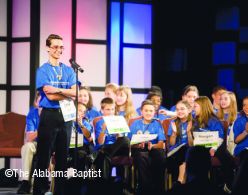
Competitions for spelling and math have long brought young people to national stages to test their vocabulary and prodigious memories. But now the “bee” concept has gone biblical.
Culled from more than 17,000 students ages 7–18, the National Bible Bee finals grilled 21 children on their knowledge of Scripture, including home-schooler Ellen Lawrence, a member of Whitesburg Baptist Church, Huntsville, who took third place in the senior division, winning $15,000.
Lawrence made studying her part-time job after finishing her high school work last spring. The former Bible Drill state champion prepared to answer questions from six books of the Bible and practiced reciting huge chunks of Scripture, including some passages as long as 25 verses.
“Studying pretty much consumed all my time,” she said.
But each person has his or her own way of memorizing Bible verses and information.
Under the bright stage lights Daniel Staddon, an 18-year-old home-schooler from Salem, W.Va., squeezed his eyes shut as he methodically recited verse after verse from the Bible at the inaugural National Bible Bee.
The concentration technique came in handy as he recited the first 20 verses of the fifth chapter of Ephesians and the 21 verses of Psalm 145 in the tie-breaker round on the stage of the JW Marriott Hotel ballroom in Washington.
His skills paid off big-time, earning Staddon first place and a $100,000 prize.
“Dad suggested closing my eyes,” said Staddon, adding that his seven siblings helped him study for months for the contest that ended Nov. 6.
The five-hour finals were preceded by regional competitions in 49 of the 50 states in September, oral contests and SAT-like tests for 300 contestants.
The Bible bee was created after the death of Shelby Kennedy, a 23-year-old Texas woman who died of a rare form of cancer in 2005. An anonymous benefactor was inspired when he learned of her commitment to Scripture memorization at her memorial service and donated money for the Shelby Kennedy Foundation to launch the bee.
“Kids are learning to spell words,” Mark Rasche, executive director of the foundation, recalled the benefactor saying. “That’s great, but there’s no eternal value.”
Students and parents alike, chatting between breaks in the competition, seemed to agree.
“I have to try and take it and really apply it to my life to make sure it’s heart knowledge, not just head knowledge,” said Lawrence, whose father, Tim, still coaches the Bible Drill team at Whitesburg Baptist. “Kids memorize all kinds of things all the time [such as] movie lines and songs. But as Christians, there is nothing more important than studying God’s Word and memorizing it.”
The bee, attended predominantly by home-schoolers and members of a range of evangelical churches, marks a new juncture in Bible memorization. The tradition that remains active in some circles — such as Southern Baptist children’s Bible drills and Scripture memory activities in weekly Awana clubs in evangelical churches across the country — has faded elsewhere.
Pamela Braithwaite, office manager of Scripture Memory Fellowship in St. Louis, recalled winning a trophy in a church Bible bee as a teen in 1971 but said such activities have dwindled over the years. David Bunker, spokesman for Chicago-based Awana, said his organization supports the bee and hopes it will help reinvigorate Bible memorization.
“We are probably one of the holdouts and now it’s kind of like … what was considered antiquated is now becoming chic,” he said.
Despite the biblical emphasis — contestants’ T-shirts read “Building character … one Bible verse at a time” — some participants did admit that, at least at first, the thousands of dollars in prize money was a draw.
Staddon said he expects he’ll use the money for housing and schooling but he will have to “ask the Lord” for advice. (RNS)

Share with others: