
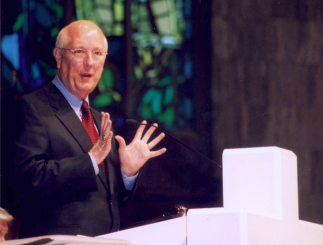
A Rotary club meeting may seem like an unlikely place for a worship experience, especially this Rotary club meeting. On Feb. 6, the Rotary Club of Birmingham celebrated its 100th anniversary. Rotary International President Sakuji Tanaka, of Japan, was on hand to offer congratulations on this milestone achievement, in part, because the Birmingham club is the world’s largest Rotary club.
Incidentally, when Rotary International celebrated its 100th anniversary in 2005, an Alabama Baptist, the late Glenn E. Estess Sr., a member of Brookwood Baptist Church, Mountain Brook, was the Rotary International president.
Planners for the Birmingham club’s centennial event wanted to make the Rotary meeting memorable so before the Japanese dignitary stood to speak, the award-winning University of Alabama at Birmingham classic gospel choir was introduced to entertain club members and guests.
The college students plunged into a lively rendition of “How Great is our God.” You would have thought it was a Sunday morning church service as they called on members to lift their hands in praise to God and some did.
Perhaps it was the setting that caused me to listen to the words of the song more carefully than ever before. At the table where I sat were members of Episcopal, Methodist, Presbyterian and Roman Catholic churches. All seemed to know the song and some hummed along.
Also in the room were Hindus, Buddhists, Shintos and Jews. There may have been other religions represented. The words of the song praised God’s greatness but they said nothing about why. The song contained no unique reference to the Christian God though it is commonly sung in Christian churches.
It was rather shocking to realize that all in the room could affirm the greatness of God because of the generic references about the Deity. I even wondered if that was the reason the song had been chosen for the occasion. It would offend no one.
Before singing a second song, the choir’s leader referenced Rotary’s motto of “Service above Self.” He explained the next song was about Jesus who put “service above self” when He died on a cross to pay the price for our sin and to give eternal life to all who believe on His name.
Immediately the choir began a gospel song I did not know and for about the next five minutes repeated the message over and over again that Jesus died for our sins and that life eternal was possible through Him.
As the choir sang, God’s Holy Spirit moved, at least in my heart. All I could do was bow my head and offer prayers of praise for the truth of the song and petition God that the repetition of the message might drive that truth deep into the hearts of all in the room.
Later a Presbyterian pastor asked me what I thought of our club meeting. “It was a worship service,” I replied and the pastor agreed. For both of us it was an unexpected worship event. It was a reminder that worship does not depend on outward circumstances. Nor is worship confined to particular places or predetermined times.
Worship is spontaneous. It is an act of the heart. Worship is offered to God because He is worthy of worship. The two Old English words which make up the word worship mean “worth-ship.” It is a quality of being worthy. Because God is God, He deserves our praise and thanksgiving.
Worship also is an individual act. Whether one is surrounded by fellow church members on Sunday morning or sitting around a table on a weekday afternoon, worship is still done on an individual basis. That is why some Rotarians squirmed uncomfortably in their chairs as the choir sang of Jesus’ “service above self” while others worshipped the Risen Lord.
One can see the same dynamic on Sunday morning when some church members leave a service having encountered God while others have just attended a religious function.
God’s Holy Spirit is always the energizer of worship. That implies a relationship with God who promised His Spirit as a guaranty to the believer of greater things to come (2 Cor. 1:22). Relationships are always changing, even one’s relationship with God. That is one reason something that prompts one believer to worship may not prompt another.
Worship is not only done “in spirit,” it is done in truth (John 4:23–24). Those moments of worship at Rotary were in response to the truth of the song that Jesus died for our sins. Worship is always in response to the truth of God’s redeeming love.
Oftentimes Christians act as if worship can only take place in certain places or done in certain ways. We forget that Abraham, Isaac and Jacob were not limited in their worship of God by holy places, holy rituals or holy times. And neither are we.
The Pharisees of Jesus’ day kept all of Moses’ laws concerning worship. Yet Jesus said their actions were in vain because “their hearts are far from Me” (Matt. 15:8). True worship is about what happens in the inner person, not about outward circumstances. It is about adoration and reverence. It is about praise and thanksgiving. It is about obedience and sacrifice.
The Bible is clear. Christians can worship anywhere and anytime the truth of God is proclaimed and the Spirit of God is at work. That may be in a worship service. It may be in a Rotary club meeting. It may be in the midst of nature. There is no telling when or how we will hear the truth of God and be prompted by God’s Spirit to worship Him.
Share with others: