
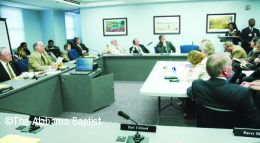
A passerby might have thought the Alabama House Tourism and Travel Committee public hearing March 11 was an electronic bingo gambling rally for Alabama’s soon-to-be mega-entertainment complex, Country Crossing.
A standing-room-only crowd rubbed shoulders with several country music stars including George Jones, Darryl Worley and Randy Owen. Tracy Lawrence even serenaded the bunch with his song, “Paint Me a Birmingham.”
But the true rising star of the show, House Bill (HB) 676 — which seeks to redefine and legalize bingo gambling in the state — endured criticism from opponents and supporters before passing from the committee and later being placed on the House calendar.
After holding a similar hearing, the Senate Tourism and Marketing Committee is expected to pass the bill’s twin, Senate Bill (SB) 471, soon.
Although sponsors — Rep. Marcel Black, D-Tuscumbia, and Sen. Quinton T. Ross Jr., D-Montgomery — say the bills will eliminate illegal gambling, regulate electronic bingo, generate revenue for the state and give the people “a voice,” opponents say the bills are nothing more than a concerted attempt by “gambling bosses” to set up monopolies and throw the state a few crumbs.
Originally both bills sought to change bingo to a for-profit industry and set up nine “points of destination” across the state with large “self-regulated” electronic bingo gambling facilities valued from $25 to $100 million. But after several speedy amendments at the tail end of the House public hearing, Calhoun and Lowndes County were removed from Black’s bill leaving seven areas initially offering electronic games.
According to the bill, other counties will be limited to traditional paper bingo games unless a local constitutional amendment is passed and significant investment requirements set by the amendment are met. Still, “only one point of destination may be authorized by the local governing body of any jurisdiction authorizing bingo,” the bill continues.
Eric Johnston, president of and general counsel for the Southeast Law Institute in Birmingham, which deals with moral issues affecting public policy in the state, believes this sets up monopolies for electronic bingo establishments already existing in the state.
“The ‘point of destination’… requires significant investment (minimum of 1,000 bingo machines, with a facility cost over $50 million, but for … Greene County, $25 million, and in Birmingham and Mobile, $100 million),” Johnson said. “Practically, this prohibits competition.”
Since the bills state “the definition of bingo equipment shall not be limited by any condition applicable to traditional bingo equipment and shall be liberally construed,” many believe the amendment opens the door to “virtually unlimited electronic bingo gambling” in the state.
Bingo operations will be “exempt from every constitutional, state and federal law there is,” Johnston said. “No court opinion can control it. They [can] do what they want to do … (There will be a) monopoly of illegal bingo gambling with no oversight.”
In an interview with The Alabama Baptist after the hearing, Black said the state gaming commission created by the bill would keep the spread of gambling “in check.”
Johnston disagreed and said the commission would not have that authority “because there is nothing for them to enforce.”
“This amendment would set up the points of destination — which are the casinos — as self-regulatory (and) laws unto themselves,” Johnston said. “That means they can develop any and all kinds of electronic equipment and call it bingo equipment and put it in their casinos … and not be subject to any law. I think what they tried to do is try to write a definition that is worded so broadly, generically and scientifically, to cover any future evolution of electronic gambling equipment.
“If they are not regulated by law — as long as it’s electronic and it doesn’t have a human dealer — they are going to call it bingo and it’s going to be very hard for anyone to say it’s not bingo. And the courts are almost required to uphold the casino operators’ definition of bingo equipment because it’s to be ‘liberally construed.’”
Since gambling expansion efforts at the legislative level have failed over the past few years, gambling opponents say the state tax included in the bill is just a way to draw more support for the bills.
According to a fiscal note for HB 676 dated March 11, the proposed amendment authorizes “bingo for profit” and could raise more than $2.25 million daily (or more than $821 million annually) for electronic bingo gambling operators. Yet the bill calls for a 20 percent state tax — 10 percent for facilities in Macon, Greene and Houston counties — to benefit the Department of Revenue, Education Trust Fund and State General Fund for Medicaid.
“People have said this imposes a significant tax, but what’s significant about this tax?” Bryan Taylor, policy director for Gov. Bob Riley, asked both committees. “Twenty percent is not a significant tax. The annual report from the American Gaming Association [reveals] states with tax rates from 35 to 60 percent of gambling.”
Instead of genuinely seeking to help the state, Taylor believes “the people who wrote this bill wrote it the way they wanted to write it. They get to keep 80 percent of the profits and the local fire department and charities get table scraps,” he said.
____________________________
‘Sweet Home Alabama’ plan not what you think
A commercial sponsored by the Enterprise-based Sweet Home Alabama Coalition calls for legalizing and taxing electronic bingo gambling in the state. Ronnie Gilley of Country Crossing confirmed he is part of the coalition, which encourages passage of HB 676 and SB 471.
____________________________
Another take on gambling…
Sen. Hank Erwin, R-Montevallo, pleaded with the Senate Tourism and Marketing Committee on March 11 to allow the Senate to discuss his legislation — Senate Bill 470.
This bill would “establish a firewall to prevent the further expansion of gambling in Alabama” and prevent the Legislature from “making laws for the people without their approval.”
After a short discussion, the bill was sent to a subcommittee for further review.


Share with others: