
Is the Bible allowed in public schools? According to the Alabama Education Association (AEA), the answer is a resounding yes.
At the beginning of the school year, AEA distributed some 50,000 copies of two booklets — “The Bible and Public Schools” and “A Teacher’s Guide to Religion in the Public Schools” — to its member teachers and staff, as well as churches and others who have requested copies.
The booklets — designed to help teachers know how to handle religion in the public school setting — are aimed at dispelling the widespread idea that faith isn’t allowed to permeate that environment, said AEA spokesman David Stout.
“Prayer and religious expression are in schools; the difference is that they are just not taught,” Stout said. “There are more people of faith in Alabama than probably any state in the union. We can’t avoid it; we must recognize it.”
The response AEA has gotten shows the booklet has touched a nerve, he said. “We haven’t had one negative comment about them. The response has been phenomenally positive, and we get constant requests from teachers, churches and people who are active in church wanting copies of the booklets.”
The First Amendment Center at Vanderbilt University in Nashville first published the books in 1999.
AEA decided to reprint and distribute them this school year so that teachers would have something to instruct them on how to better handle religion in the classroom setting, Stout said. “We want to help teachers know how to handle the importance of religion in everyone’s life.”
Joe Morton, Alabama superintendent of education, said knowing more about how to properly discuss faith in school is a “positive step.”
“It helps people understand there are more opportunities to discuss faith issues than they maybe even realized existed,” Morton said.
The booklets help teachers understand how to provide awareness of religion without promoting certain viewpoints. In other words, according to the guides, find a happy middle ground that isn’t pushy but doesn’t skip completely over exposing students to the topic either. Courses are scattered in public schools across the state that deal with biblical writing. In some schools, whole classes are offered on the Bible as a work.
In others, it is studied in English classes as a literary work or in history classes as a document that has played a major part in history and culture. The guide itself said it is intended to help Alabamians “move beyond the confusion and conflict that has surrounded religion in public schools …. For most of our history, extremes have shaped much of the debate.”
Christian teachers have a responsibility to be informed about what is and is not acceptable so they can walk to the edge without going over, said Martine Bates, principal of Priceville Elementary School in Morgan County.
“A public school employee is working for the government and is subject, while on the job, to the constraints set up by the law and the courts,” Bates said. “I believe, however, that a person’s worldview is going to come through … and it will impact the students. Show, don’t tell; they are listening more closely with their hearts than their ears.”
For more information call AEA at 1-800-392-5839.

Bible Studies for Life Sunday School Lesson for April 12

Here’s the Bible Studies for Life Sunday School Lesson for April 12, written by Rony Kozman, Ph.D., Assistant professor of Biblical Studies, Samford University.
Explore the Bible Sunday School Lesson for April 12
Here’s the Explore the Bible Sunday School lesson commentary for April 12, written by Douglas K. Wilson, Ph.D., professor of Biblical Studies, University of Mobile.
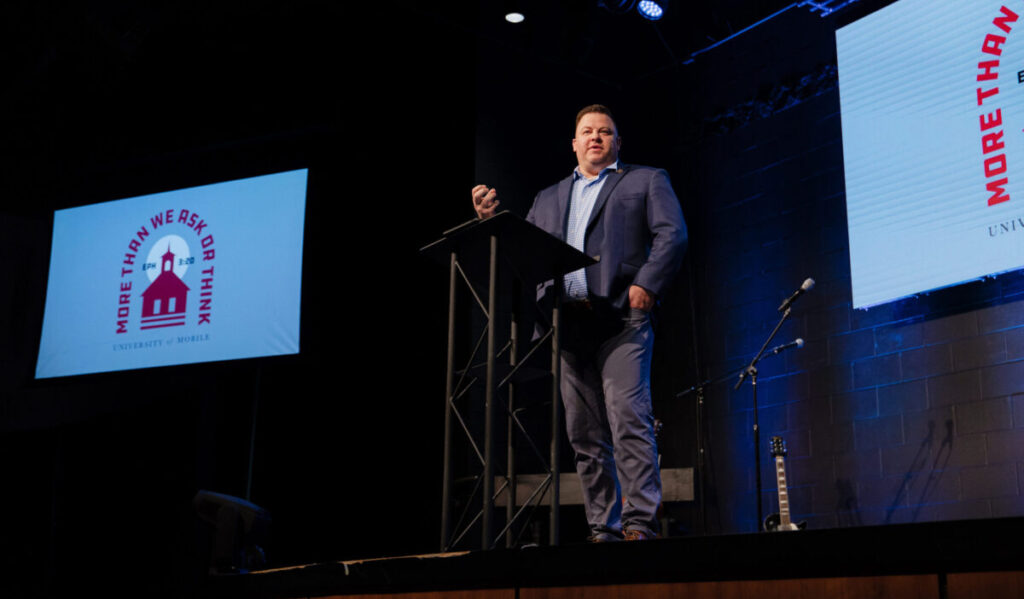
Tim Adams to UM students: Excessive devotion to anything other than God ‘wreaks havoc’
During the last chapel service for the spring semester at the University of Mobile on April 1, students heard from one of their own — Tim Adams, who serves as the vice president of student development and collegiate athletics.

‘Gulf of America’ bill passed by Alabama lawmakers
After delaying a vote before spring break, the Alabama Senate has awarded final passage to a bill renaming, for state purposes, the Gulf of Mexico the Gulf of America.
Share with others: