
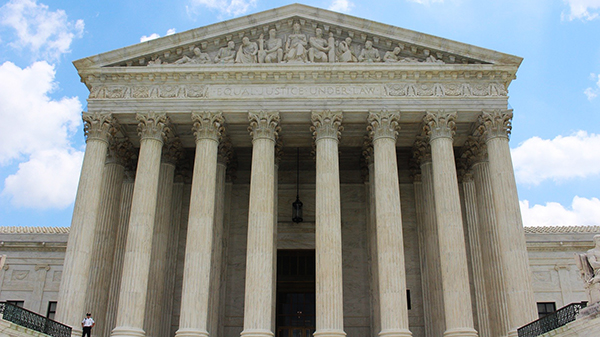
It has been one year since the U.S. Supreme Court issued an opinion that shocked the country and attacked the fundamental American doctrine, “A man’s home is his castle.”
Now the president is taking steps to preserve that principle.
President George W. Bush marked the anniversary of the Kelo v. New London (Conn.) decision by issuing an executive order barring the federal government from taking private land for someone else’s private use.
Specifically Bush’s order said, “It is the policy of the United States to protect the rights of Americans to their private property” by “limiting the taking of private property by the Federal Government to situations in which the taking is for public use, with just compensation, and for the purpose of benefiting the general public.”
Christian groups were concerned about the decision because churches are often located in commercial areas but typically pay smaller taxes than commercial businesses that might occupy a similar real estate “footprint.” Therefore churches and benevolence ministries could potentially be at risk by the Kelo decision.
The ruling sprung from a late-1990s conflict in which the city of New London, Conn., allowed the New London Development Corp. to seize Susette Kelo’s entire neighborhood for a shopping mall. Kelo and some of her neighbors sued — and lost.
The Kelo decision has brought both good news and bad news, according to Steve Anderson, a senior staff attorney for the Institute for Justice.
The bad news is that Kelo opened up a floodgate of government property seizures.
“We did a study from 1998 to 2002, which showed more than 10,000 instances of eminent domain abuse around the country,” Anderson said. “But in the last year, since Kelo, over 5,700 properties are being threatened or condemned for private development — that’s nearly triple the yearly average.”
The good news, he said, is that the ruling has unleashed a response from state legislatures and grass-roots activists.
“The one thing the court got right is that states are free to pass laws that are more restrictive and pass laws that are more protective of their residents,” he said. “We’ve seen that occur in about half the states. About 25 states (including Alabama) have passed some kind of reform.” (EP)

Share with others: