
If your radio is playing Christian band MercyMe’s “I Can Only Imagine,” then guessing whether the station is a Christian or secular one is something only you will know.
Although many listeners in the United States tune in to radio stations spinning exclusively Christian music, many others now hear gospel artists or songs with spiritual lyrics on mainstream stations.
“I like seeing this happen when it does so naturally,” said Derek Jones, director of radio promotions with Rocketown Records, a Christian record label in Nashville.
“When a contemporary Christian music (CCM) song maintains its lyrical and musical integrity and crosses over into the mainstream world, it really encourages me,” he said.
The crossover to a secular market can be a powerful ministry tool to millions of additional listeners as Christian artists find their homes on secular radio stations of like genre, he noted.
“Most of the time this ‘natural crossover’ happens in the R&B and urban mainstream formats,” Jones continued. “It was so exciting to see songs such as ‘Open My Heart’ by Yolanda Adams and ‘Shackles (Praise You)’ by Mary, Mary on the R&B/urban chart alongside artists such as Jay-Z and Nelly.”
Crossover of Christian into secular markets was historic during the second half of 2003, according to John W. Styll, president of the Nashville-based Gospel Music Association (GMA).
“In the past, gospel music has gained general market prominence in one-shot situations, such as God’s Property’s ‘Stomp’ and Bob Carlisle’s ‘Butterfly Kisses.’ This year, we’ve had several artists, each with unique music styles, penetrate the mainstream in a significant way.”
Christian CD and tape sales reflect the growth of this more widespread popularity in mainstream radio markets.
Gospel music commands a category all its own with nearly $1 billion in annual sales, according to the Recording Industry Association of America. And more than 60 percent of gospel music sales occurred in the general market, according to Styll.
Sales of gospel grew at mainstream retail outlets, where gospel music sales increased 6.7 percent in 2003 over the previous year.
Nielsen SoundScan noted that amid a slight slump in album sales in the last five years, gospel sales have ultimately increased. Records show that gospel album sales have grown 10 percent from 42 million units in 1998 to more than 47 million units in 2003, compared to a 10 percent decline in overall music sales for the same five-year period.
The music industry organizes numerous musical styles under the genre of “gospel,” including rock, pop/adult contemporary, country, black gospel, southern gospel, inspirational, praise and worship, R&B/hip-hop, Latin, instrumental and children’s, according to GMA.
But what constitutes “Christian” music can vary widely, according to the late Jerry Solomon, former director of field ministries and mind games coordinator for Probe Ministries.
“Music cannot be declared Christian because of particular ingredients,” he wrote in an article published on Probe Ministries Web site.
“There is no special Christian musical vocabulary. There is no distinctive sound that makes a piece of music Christian. The only part of a composition that can make it Christian are the lyrics,” he said.
Russ Breimeier, an associate editor for Christianity Today and director of the publication’s online music section, noted there are “Christian artists” and then there are “artists who are Christian.” The latter may or may not write religious songs while the former write worship or praise music for the contemporary Christian audience.
Breimeier lists Switchfoot with Amy Grant and Stacie Orrico as some of the artists who have crossed over from Christian music to the mainstream with faith intact.
“They’ve been very cerebral with their lyrics,” he said. “Now they’ve found a way to do it that’s meant for a broader audience, to make people think.”
This intertwining of worlds fits into American society at large, said Philip Goff, director of the Center for the Study of Religion and American Culture at Indiana University.
“Religion and American culture almost dance with each other,” he said. “Culturally, Americans are very comfortable having their pop culture served with a side of religion.”
He noted that blues songs often contained prayers and that Elvis Presley’s first Grammy was for gospel. After Elvis, the country saw a string of its rock icons wax spiritual from time to time.
Bob Dylan released a Christian album in the late 1970s, and Bruce Springsteen, of the Dylan tradition, has consistently heeded a higher call, he said.
Bono, both in the group U2 and Bono and the Edge, has also developed a reputation for musical spirituality, Goff said.
And he noted that although the Beatles sometimes had wanton tastes, George Harrison in the late 1980s covered an old Rudy Clark gospel number called “Got My Mind Set on You.”
More recently “I Can Only Imagine” with its straightforward lyrics about how a Christian might react when one day seeing Christ, crossed into several genres after its success in all-Christian radio markets.
“‘I Can Only Imagine’ sold more than 750,000 units and topped the Billboard singles sales chart for 11 weeks,” said Jeff Moseley, president of INO Records, the album’s label.
“For a record that was two years old, this shows the impact of a song, but also the tremendous impact Christian music can have once it is afforded increased exposure.” (Wire services contributed)
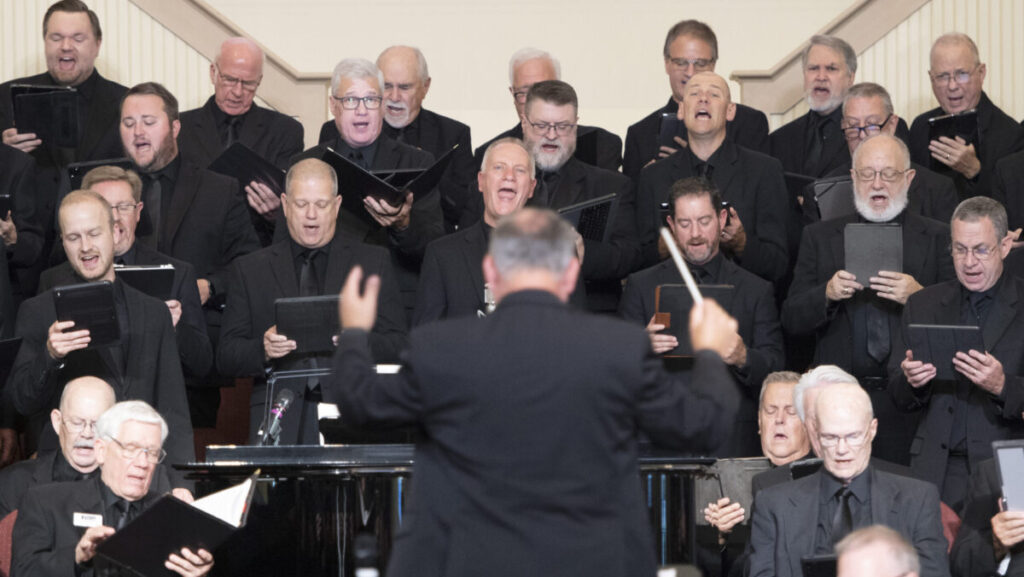
FBC Opelika hosting combined concert of Alabama Singing Men, Sons of Jubal on Aug. 8
For the first time ever, Alabama Singing Men will join Georgia’s Sons of Jubal for a concert at First Baptist Church Opelika on Aug. 8.

Crowder tops Billboard Hot Christian Songs Chart for the first time with ‘Good God Almighty’
“Good God Almighty,” the toe-tapping, can’t-help-but-sing-along song by Crowder, hit No. 1 on the Billboard Hot Christian Songs Chart April

Pat Barrett uses songwriting as a journal, a way of processing emotions
“Act Justly, Love Mercy, Walk Humbly” is not just a paraphrase of Micah 6:8b, in which the question, “What does
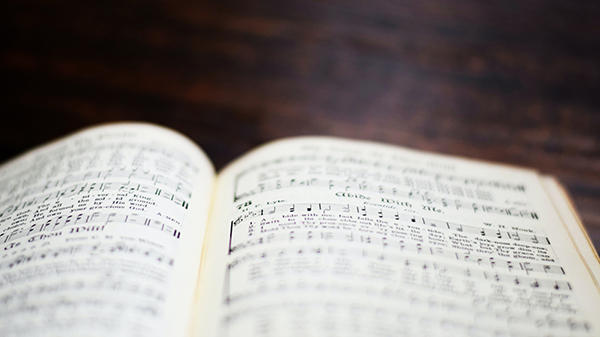
Christians worshipping at home during pandemic spikes hymn database
In 2020, we celebrated holidays at home amid the COVID-19 pandemic. We worked at home, attended school at home, even
Share with others: